



In the world of industrial instrumentation and process control, precision is not just a goal-it's a requirement. When a manual or system specifies a pressure of 250 kilopascals, you need more than just a quick guess at its equivalent in pounds per square inch. An incorrect conversion can risk equipment integrity and operational safety. That's why having a fast, reliable method to convert 250 kPa to PSI is the essential first step for any technician or engineer.
This expert guide delivers the immediate answer you're looking for and provides the critical context that a simple calculator can't. We will not only give you the exact conversion but also explain the straightforward formula so you can perform it yourself with confidence. Furthermore, we'll explore the real-world applications where this pressure reading is common and provide professional advice on selecting the correct instrumentation for measuring it accurately. Consider this your total solution for understanding and managing pressure with complete assurance.
In the world of pressure instrumentation and calibration, precision begins with a clear understanding of the units involved. Two of the most common measurements you will encounter in New Zealand are the kilopascal (kPa) and pounds per square inch (PSI). While New Zealand officially uses the International System of Units (SI), our industries operate in a global market. This means technicians often work with both modern, metric-rated equipment and legacy or US-made machinery that uses imperial units. Knowing how to accurately interpret and convert these values, such as calculating 250 kPa to PSI, is not just a matter of convenience-it's a critical requirement for safety, compatibility, and operational integrity.
The kilopascal (kPa) is the standard unit of pressure in the SI system, used globally for technical and scientific applications. It is a multiple of the base unit, the Pascal (unit), where one kilopascal equals 1,000 Pascals. As the globally accepted standard, you will find kPa specified on most modern instrumentation, particularly equipment sourced from Europe and Asia. Common applications in New Zealand include:
Pounds per square inch (PSI) is an imperial unit of pressure derived from the force of one pound-force applied to an area of one square inch. Despite the global shift to SI units, PSI remains deeply embedded in certain sectors, largely due to the influence of equipment and standards from North America. It is frequently encountered on older machinery still in service across New Zealand or on specific tools where it has become a legacy standard. Familiar examples include setting tyre pressure on older vehicles, operating compressed air tools, and specifications for some plumbing and hydraulic systems.
Misinterpreting pressure units can lead to significant consequences, ranging from equipment damage to complete system failure. An incorrect pressure input-for instance, mistaking a PSI value for kPa-can over-pressurise a system, compromising seals, damaging sensitive components, and creating serious safety hazards. For professionals in calibration and process control, precision is paramount. A correct conversion from 250 kPa to PSI ensures that instrumentation is calibrated correctly, processes run within specified tolerances, and the entire operation complies with both international and local safety standards. It is a foundational skill for any technician dedicated to quality and reliability.
In instrumentation and engineering, precision is paramount. Whether you're calibrating a pressure transmitter, setting tyre pressure, or working with pneumatic systems, converting between metric (kPa) and imperial (PSI) units is a fundamental requirement. This section provides the direct formula, a step-by-step guide, and a handy reference chart to ensure you can perform the 250 kPa to psi conversion accurately and confidently.
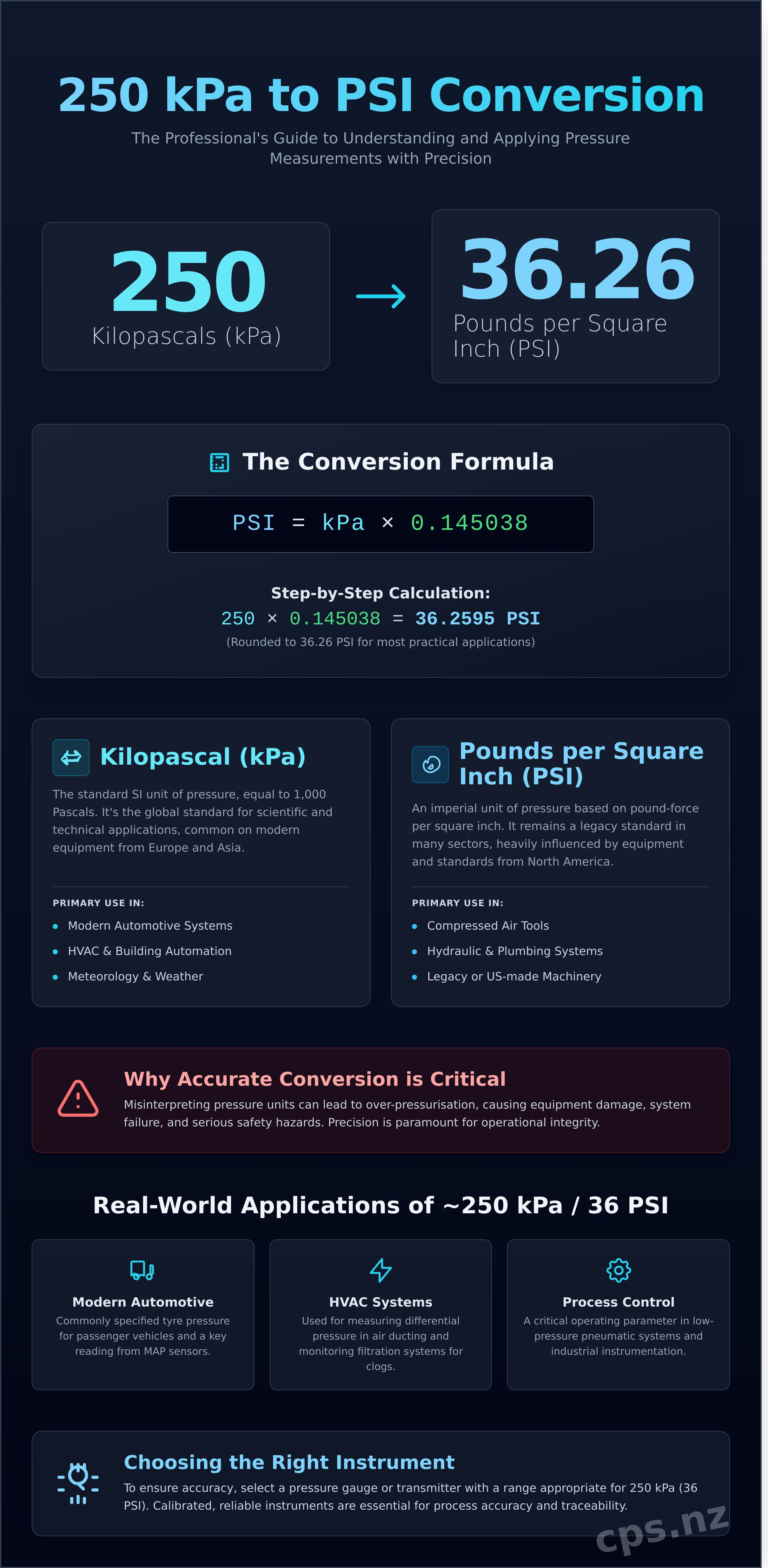
For those needing a quick, reliable answer, here it is: 250 kPa is approximately equal to 36.26 PSI.
This conversion is based on a precise mathematical relationship between the two units. The key to converting any kPa value to PSI is the conversion factor. The standard kPa to PSI conversion formula relies on this precise numerical relationship, which is derived from the definitions of a pascal and a pound-force per square inch. To perform the calculation yourself, use the following formula:
Manually calculating the conversion is straightforward when you follow a clear process. Using the formula above, we can break down the conversion of 250 kPa to PSI into three simple steps. This ensures accuracy and traceability in your work.
For most practical applications in the field, rounding to two decimal places is sufficient. Therefore, 36.2595 PSI is typically rounded to 36.26 PSI.
For your convenience, here is a simple conversion chart for common pressure values around 250 kPa. This table serves as a quick reference for technicians and engineers who frequently work with these pressure ranges.
| Kilopascals (kPa) | Pounds per Square Inch (PSI) |
|---|---|
| 200 kPa | 29.01 PSI |
| 225 kPa | 32.63 PSI |
| 250 kPa | 36.26 PSI |
| 275 kPa | 39.89 PSI |
| 300 kPa | 43.51 PSI |
While understanding the conversion formula is essential, the real value for New Zealand technicians lies in recognising where this specific pressure reading appears in day-to-day work. A pressure of 250 kPa is not extreme; in fact, it sits in a common low-to-medium range that is critical for the correct function of countless systems. Being able to quickly translate 250 kPa to PSI (approximately 36 PSI) is a practical skill that ensures accuracy in diagnostics, maintenance, and safety compliance across multiple industries.
For automotive technicians, 250 kPa is an everyday figure. It is a standard recommended tyre inflation pressure for a vast range of passenger cars, SUVs, and light commercial vehicles found on New Zealand roads. Maintaining this pressure is vital for vehicle safety, optimal fuel efficiency, and even tyre wear. Beyond tyres, you may also encounter similar low-pressure readings when diagnosing engine vacuum systems or testing low-pressure fuel lines, where precise instrumentation is non-negotiable.
In the world of heating, ventilation, and air conditioning (HVAC), 250 kPa is a key operational pressure. Technicians frequently measure pressures in this range for several critical applications:
Across industrial and manufacturing environments, 250 kPa is a common setpoint in low-pressure pneumatic control systems. These systems are not designed for heavy lifting but for precise control, actuation, and testing. Examples include vacuum lifting equipment for delicate materials, pneumatic clamps requiring controlled force, or leak-down testing for components. It's also a relevant pressure in process industries for moving certain fluids where high pressure is unnecessary or detrimental. Ensuring your pressure transmitters and gauges are accurately calibrated for this range is vital for quality control and operational reliability. Need expert advice on your application? Contact our specialists.
Understanding the conversion from 250 kPa to PSI is the first step, but ensuring accurate and repeatable measurements requires the right equipment. Selecting a pressure gauge or transmitter is a critical decision that impacts safety, product quality, and operational efficiency. As New Zealand's leading experts in instrumentation, we can guide you to the total solution for your application.
For optimal accuracy and longevity, your target pressure should fall within the middle third of your gauge's range. This is a fundamental rule in instrumentation. For a working pressure of 250 kPa (36 PSI), an ideal gauge would have a range of 0-400 kPa or 0-60 PSI. Using a gauge with a much higher range, like 0-1000 PSI, will result in poor resolution, making it impossible to read small but critical pressure changes. Conversely, using a gauge with too low a range risks over-pressurisation, leading to permanent damage and potential safety hazards.
The choice between digital and analogue instrumentation depends entirely on your application's requirements.
Our team at CPS can advise on the most suitable instrument for your specific operational environment.
An instrument is only as reliable as its last calibration. For professional applications, ensuring your gauge is accurate is not optional-it's essential for compliance, safety, and quality assurance. IANZ (International Accreditation New Zealand) accreditation provides formal, independent verification that a calibration laboratory meets international standards. This guarantees that your measurements are traceable and legally defensible. Without regular, accredited calibration, even the highest quality gauge can provide false readings, leading to costly errors.
Ensure your measurements are accurate and trustworthy. Explore our IANZ accredited calibration services and let our experts provide the confidence you need in your equipment.
Mastering the conversion from 250 kpa to psi is a fundamental skill for any technician or engineer. As we've explored, this common pressure value-approximately 36.26 PSI-appears everywhere from vehicle tyre pressure to industrial fluid systems. However, the true value of this knowledge lies not just in the formula, but in its practical application with reliable, accurate tools. An incorrect reading can compromise safety, efficiency, and product quality.
This is where precision instrumentation becomes non-negotiable. As New Zealand's leading calibration experts with over 35 years of industry expertise, CPS provides more than just equipment; we deliver a total solution. Our commitment to quality is backed by our IANZ Accredited Calibration Laboratory, ensuring every pressure gauge we supply meets the most stringent standards for accuracy and traceability.
When you need instrumentation that delivers unwavering performance, we invite you to Browse Our Full Range of Professional Pressure Gauges.
Equip your team with the tools and the confidence needed to get the job done right, every time.
Whether 250 kPa (approximately 36.26 PSI) is high pressure is entirely dependent on the application. For a standard car tyre, it's a typical inflation pressure. However, in high-pressure hydraulic systems that can operate at thousands of kPa, it would be considered very low. For meteorological measurements, it is significantly higher than standard atmospheric pressure. Context is critical when evaluating if a pressure reading is high or low for your specific process.
Both kilopascals (kPa) and bar are metric units used to measure pressure, but they differ in magnitude. The relationship is straightforward: 1 bar is equal to exactly 100 kPa. Bar is often used for higher-pressure applications like hydraulics or diving equipment due to the simpler numbers, while kPa is frequently used in lower-pressure systems such as HVAC, automotive, and scientific instrumentation where greater precision is required.
The required accuracy of your pressure gauge depends on the tolerance of your application. For non-critical monitoring, a gauge with an accuracy of ±1.5% of its full scale may be sufficient. For critical processes, quality control, or calibration work, a much higher accuracy of ±0.25% or better is often necessary to ensure safety and product quality. Our experts at CPS can help you select instrumentation with the correct accuracy for your specific requirements.
No, we strongly advise against this. Standard tyre gauges are designed only for intermittent use with clean air and a Schrader valve. They lack the durability, chemical compatibility, and appropriate process fittings for industrial systems. More importantly, they do not offer the traceable accuracy required for process control and safety. Using the wrong instrument poses a significant risk to both your equipment and personnel. Always use a properly specified industrial pressure gauge.
While New Zealand officially uses the metric system (including kPa), the use of PSI (Pounds per Square Inch) persists due to historical influence. Much of the industrial equipment, technical documentation, and engineering standards used in NZ originated from the United States or older British systems where PSI is the standard. This legacy means technicians often need to perform conversions like 250 kPa to PSI to work with both new and old specifications seamlessly.
As a best practice, annual calibration is recommended for most gauges. However, the ideal frequency depends on the instrument's usage and the criticality of the measurement. For gauges in harsh environments, subject to vibration, or used in critical safety systems, a more frequent 6-month calibration interval may be necessary. CPS provides IANZ accredited calibration services and can help you establish a calibration schedule that ensures ongoing accuracy and compliance.