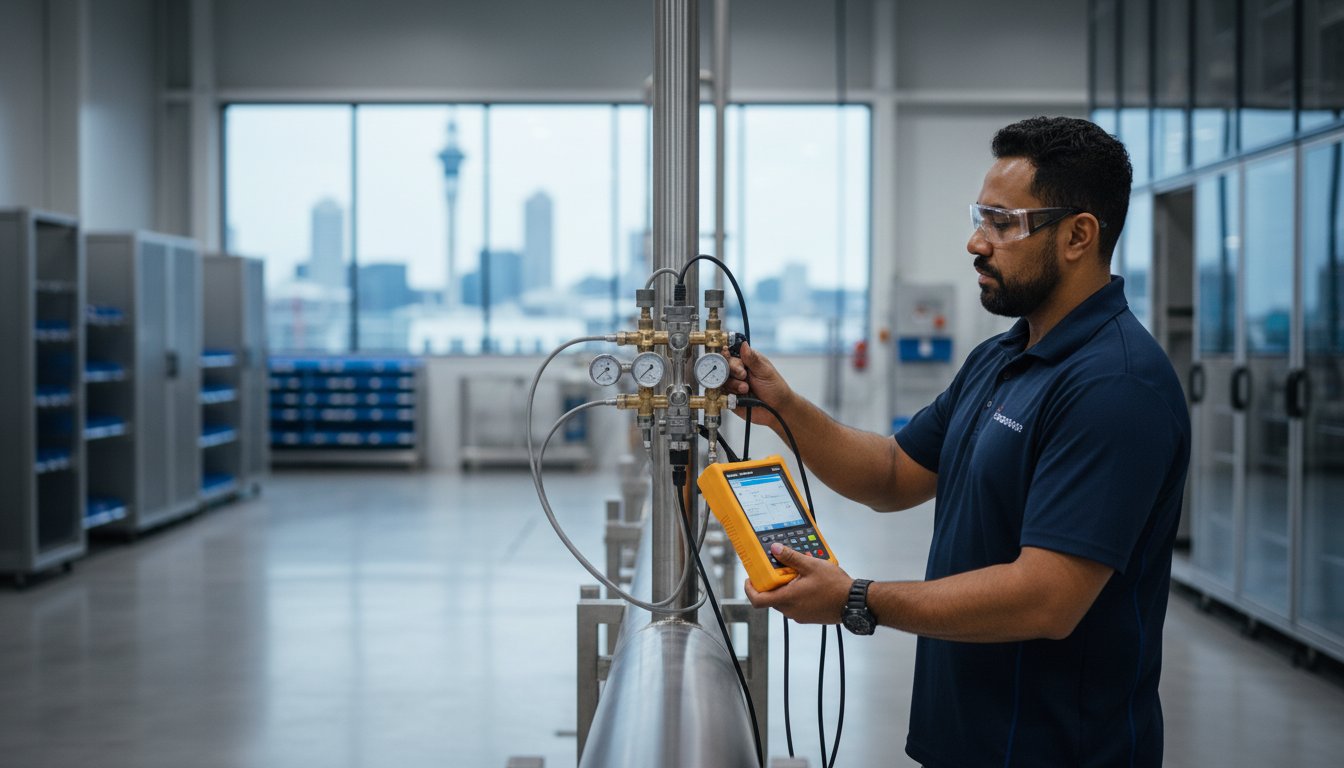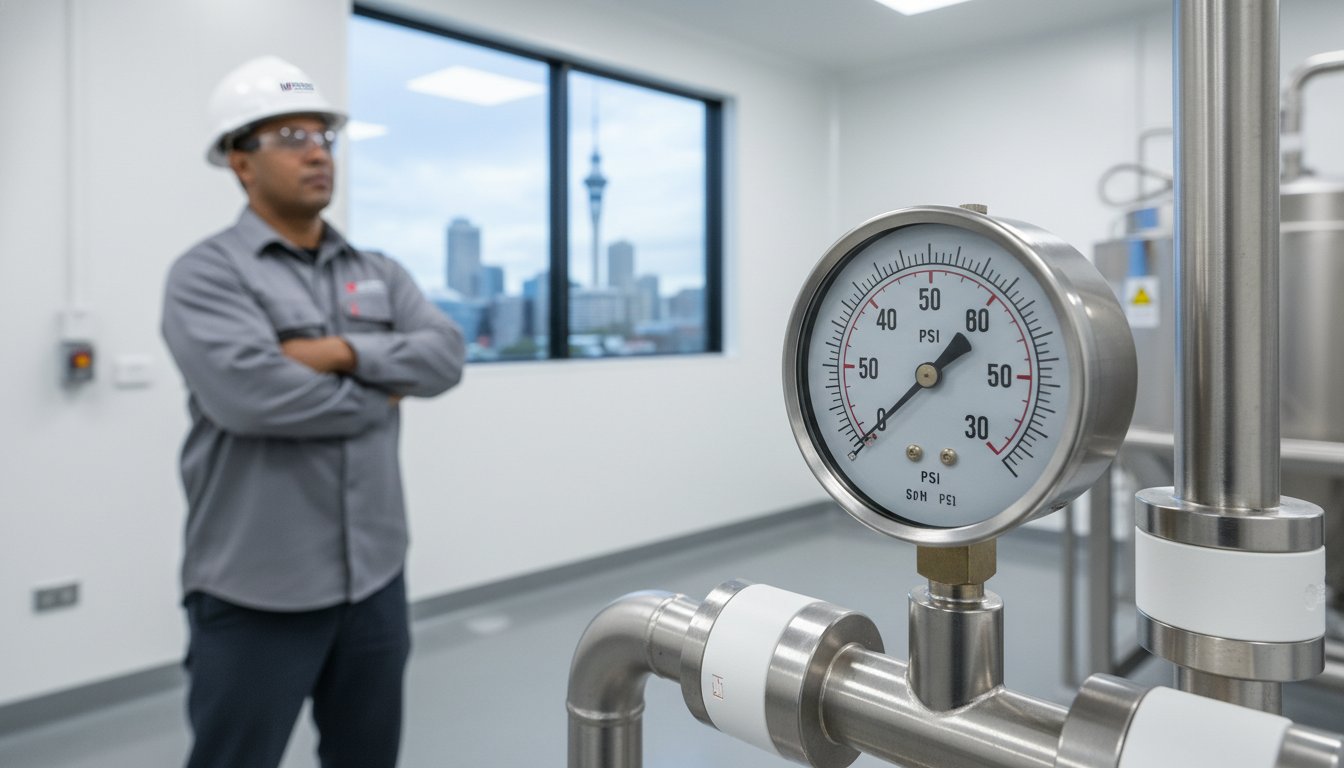



A $60 water pressure gauge is often the only component standing between a stable operation and a $45,000 pump failure, yet data from NZ service labs suggests that 35% of industrial gauges are currently providing inaccurate readings. You understand that a flickering needle or a leaked casing isn't just a minor maintenance task; it's a critical risk to your entire system's integrity. At CPS, we've seen how improper selection leads to rapid fatigue, especially when vibration and pressure spikes aren't accounted for during the initial specification.
This 2026 professional guide ensures you master the technical essentials of pressure monitoring to achieve long-lasting reliability and reduced downtime. You'll learn how to distinguish between glycerine and dry gauges for specific NZ environments, follow professional installation steps, and maintain IANZ-accredited calibration standards. We're covering everything from the initial fitting to the total solution for ongoing compliance, so your instrumentation remains an asset rather than a liability.
• Learn how to apply the "25% to 75%" rule to select a water pressure gauge with the ideal range and dial size for your specific application.
• Master professional installation steps, from system isolation to correct thread sealant application, ensuring a leak-free and secure setup.
• Understand the necessity of IANZ-accredited calibration to combat instrument drift and maintain the technical traceability required for NZ infrastructure.
• Identify how to prevent catastrophic pipe bursts and pump failures by using gauges as vital diagnostic tools for long-term system health.
• Discover the "total solution" advantage of using custom-engineered kits that provide the fittings, hoses, and carry cases needed for professional field work.
A water pressure gauge acts as the primary diagnostic window into the health of any fluid system. Operating a municipal or industrial network without precise instrumentation is essentially "blind" management. This practice frequently leads to catastrophic pipe bursts or premature pump failure. Since 2024, data from NZ infrastructure projects shows that a 5% error in pressure reading can lead to a 15% increase in operational costs. We don't just sell hardware; we provide a total solution for those who value system longevity over cheap, disposable imports.
High-quality instrumentation is the only way to safeguard expensive assets like multi-stage centrifugal pumps. If a gauge fails to report a drop in suction pressure, the resulting cavitation can destroy an impeller in less than 48 hours. Professional-grade gauges differ significantly from consumer-level products that companies "import and sell" without technical support. We focus on IANZ accredited standards to ensure every reading is traceable and reliable for New Zealand's industrial and municipal water sectors.
The reliability of a gauge depends on the quality of its Bourdon tube. This internal component must be engineered with precision to ensure linear movement and repeatable results. Professional-grade units use 304 or 316 stainless steel casings to survive the salt-laden air of NZ coastal facilities. Understanding the Principles of pressure measurement is essential for selecting the correct accuracy class. A Class 1.0 gauge provides a 1% full-scale accuracy, which is the benchmark for critical process control, while Class 1.6 is suitable for general monitoring.
Accuracy in Auckland's commercial pumping systems directly impacts the bottom line. When a water pressure gauge drifts, pumps often over-compensate, leading to a 12% spike in energy consumption. In remote facilities across Fiji, precise monitoring prevents the $45,000 expense of emergency site visits by identifying minor leaks before they become system-wide failures. Rapid pressure spikes exceeding 150% of the gauge's maximum scale range cause immediate fatigue and permanent internal damage. Our team provides the total package, including accredited calibration and custom fittings, to ensure your equipment survives these conditions.
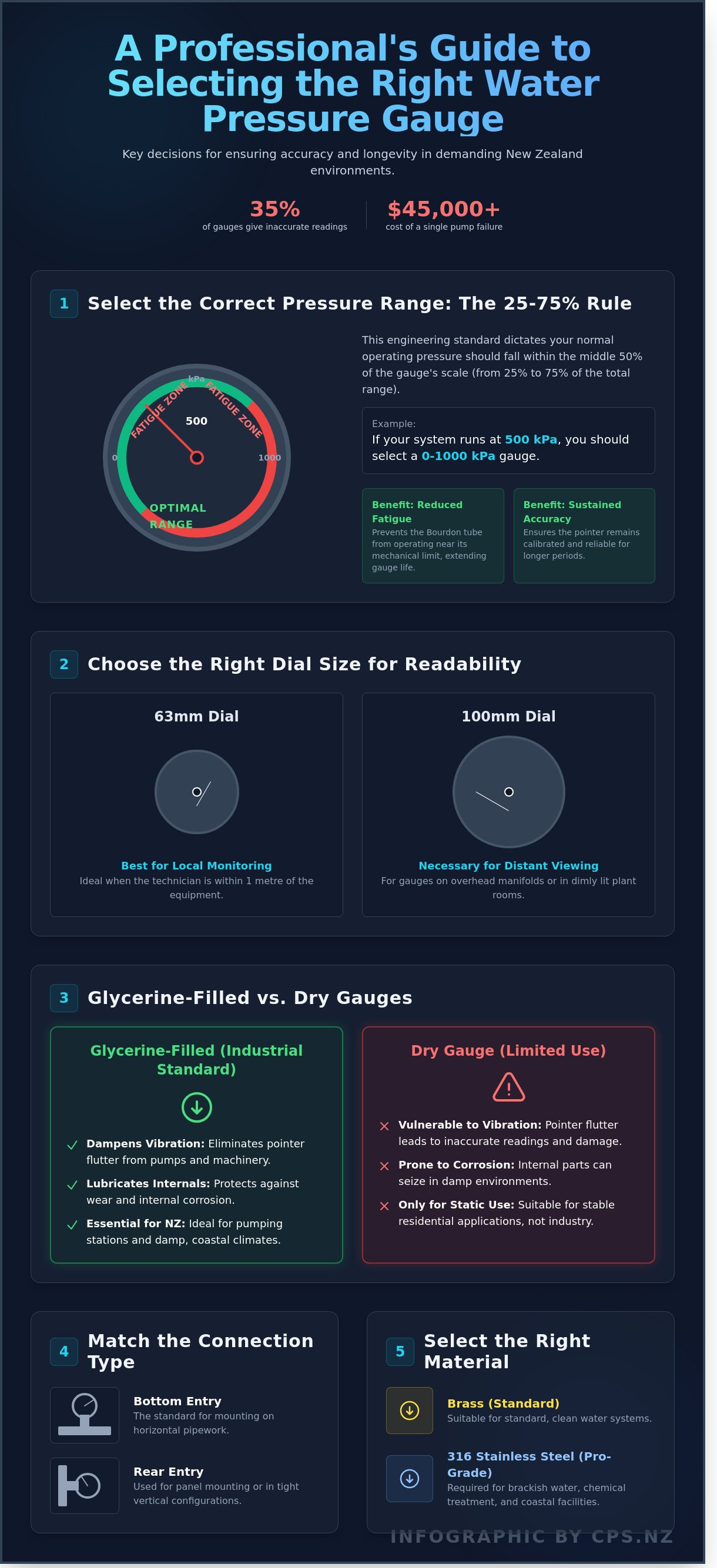
Selecting the correct water pressure gauge requires more than just picking a dial off a shelf. Accuracy and longevity depend on the 25% to 75% rule. This engineering standard dictates that your normal operating pressure should fall within the middle third of the gauge's scale. If your system typically runs at 500 kPa, you should install a gauge with a 0 to 1,000 kPa range. This prevents the bourdon tube from operating near its mechanical limit, which reduces the risk of fatigue and ensures the pointer remains calibrated for longer periods.
Physical constraints also dictate your choice. Dial sizes in New Zealand typically standardise at 63mm or 100mm. A 63mm dial is sufficient for local pump monitoring where the technician stands within one metre of the equipment. For gauges mounted on overhead manifolds or in dimly lit plant rooms, a 100mm dial is necessary for clear readability from a distance. You must also match the connection type to your existing pipework. Bottom entry gauges are the standard for horizontal pipes, while rear entry models are designed for panel mounting or tight vertical configurations.
Vibration is the primary cause of gauge failure in NZ pumping stations. Glycerine-filled gauges use a viscous liquid to dampen internal movement, effectively eliminating pointer flutter caused by high-frequency mechanical pulses. This filling also provides constant lubrication to the internal gears, which is vital in our damp, coastal climates where internal corrosion can seize dry movements. Dry gauges are only appropriate for static residential applications where the needle remains stationary for 99% of its service life.
Material integrity is where professional-grade instrumentation separates itself from budget imports. Standard water systems use brass internals, but 316 stainless steel is required for any environment involving brackish water or chemical treatment. Safety is another factor; polycarbonate windows are the preferred choice in high-traffic zones because they resist impact better than traditional glass. CPS (NZ) Ltd sources all components from world-leading partners to ensure 100% material traceability. If your site requires specific certifications, our experts can provide a total solution recommendation that meets your exact technical specifications.
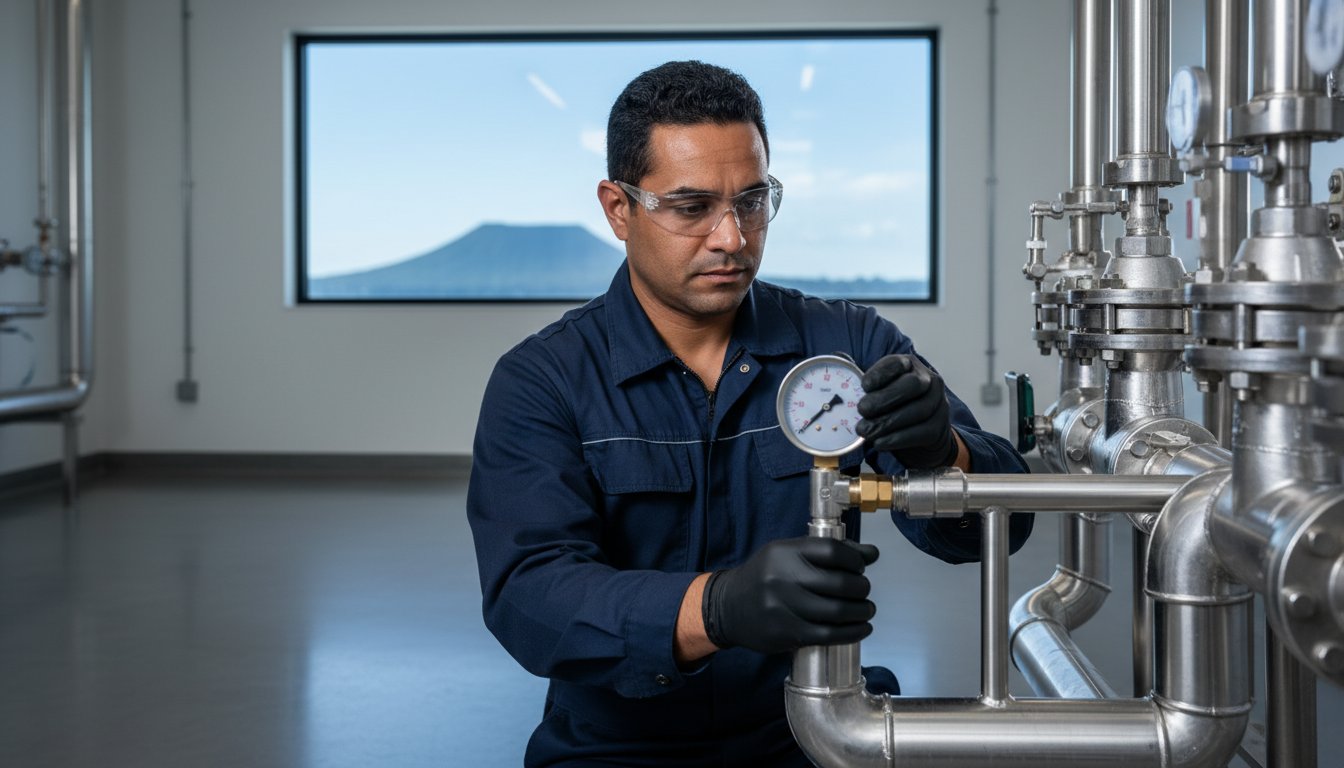
Installation requires more than just a wrench and a roll of tape. You must first isolate the system and ensure all pressure is bled completely. Working on a live line is a significant safety risk and causes 15% of avoidable onsite injuries in the New Zealand instrumentation sector. Once the line is depressurised, apply a high-quality PTFE tape or liquid sealant to the male thread. Ensure you wind the tape in the direction of the thread to prevent bunching during insertion.
Hand-tighten the water pressure gauge into the socket until it's snug. Use a wrench on the square flats located at the base of the gauge only. You should never turn the gauge by gripping the circular case; this practice often ruins the internal calibration and voids your warranty. Slowly re-pressurise the system while monitoring the connection point for leaks. Watch the needle for a smooth, consistent ascent. Finally, verify the gauge returns to zero when the system is depressurised to confirm the internal bourdon tube hasn't been over-stressed.
Using mismatched threads or low-grade adaptors leads to "creeping" leaks that can waste over 500 litres of water per month in high-pressure commercial systems. We don't just supply a gauge and leave you to figure out the connections. Our CPS "plug and play" kits provide the total solution, arriving with all necessary fittings and hoses pre-assembled for your 2026 onsite requirements. We also recommend installing snubber valves. These small components protect your water pressure gauge from the destructive "water hammer" effects common in NZ dairy and industrial wash-down systems.
Mounting a gauge directly onto a pump discharge is a common error that leads to premature failure. High-frequency vibration reduces the lifespan of a standard gauge by 40% within the first 12 months of operation. It's better to mount the unit on a stable bracket away from the vibration source. If your water temperature exceeds 60°C, use a syphon tube to create a cooling buffer that protects the internal sensing element from thermal shock. Always orient the dial face so maintenance staff can read it clearly from a standing position. Proper visibility ensures that pressure spikes are identified before they cause a system-wide failure.
Calibration is the formal process of comparing your instrument against a traceable reference standard. It's the only way to ensure your water pressure gauge provides data you can actually trust. Over time, every mechanical gauge experiences drift. This happens as the internal Bourdon tube or diaphragm loses its original elasticity through repeated pressure cycles. Even a high-quality instrument can drift by 3% to 5% within a single year of heavy operation, leading to skewed data and potential system failures.
In New Zealand, the stakes are high. Using uncalibrated instruments can lead to non-compliance with the Health and Safety at Work Act 2015. If a gauge fails to report an over-pressure event, the resulting pipe burst or equipment damage becomes a legal liability. We recommend a calibration frequency of 12 months for most industrial applications. If your site operates 24/7 or involves high-pulsation pumps, move that cycle to every 6 months to maintain system integrity. We don't just sell equipment; we provide the total solution to keep your plant running safely.
International Accreditation New Zealand (IANZ) represents the peak of technical competence in the country. Many companies claim to check gauges against a master, but without IANZ accreditation, those checks lack formal traceability. Our IANZ-accredited laboratory ensures your results are recognized globally through the ILAC Mutual Recognition Arrangement. This is vital for NZ exporters who must prove their quality standards to international buyers. Choosing an accredited lab means your certificates are legally robust and technically sound.
Visible damage is the first red flag. Look for leaked glycerine in the dial, which indicates a seal failure that will lead to internal corrosion. If the pointer is bent or fails to return to zero when pressure is removed, the internal movement is likely compromised. Perform a zero-point check as a daily maintenance task. If the pointer doesn't rest exactly on the zero mark at atmospheric pressure, your water pressure gauge requires immediate professional attention to avoid costly downtime.
These principles of monitoring and maintenance are just as critical in residential settings as they are in industrial ones. When homeowners spot issues like fluctuating water pressure or strange noises from their pipes, it's often a sign of a problem that requires professional diagnosis. For those in Canada, services like High Pressure Mechanical offer the kind of expert plumbing and HVAC support needed to address such issues before they lead to major damage.
CPS (NZ) Ltd operates on a clear principle: we provide a total solution, not just a piece of hardware. When you source a water pressure gauge from us, you aren't just buying an instrument. You're securing 35 years of technical expertise that spans the New Zealand and Fiji markets. We don't just ship a box and leave you to source your own connectors. Our team supplies the specific fittings, high-pressure hoses, and adapters needed to make your equipment functional the moment it arrives.
Field technicians face enough challenges without worrying about missing parts. We solve this by offering custom carry cases and plug-and-play kits. These kits keep every adapter and lead organized and protected, reducing the risk of lost components or damage during transport. It's a professional approach that eliminates guesswork. We encourage you to consult with our engineers rather than guessing your requirements. We've spent decades refining these systems so you don't have to.
Our Auckland-based laboratory is the core of our service promise. Having a local facility means we deliver fast turnaround times for calibration and repairs, which is vital for maintaining project timelines. We don't just serve NZ; we provide tailored solutions for clients in Fiji and the wider Pacific. This includes onsite installation and specialized training services. Whether you're in a remote pump station or a metropolitan treatment plant, our support ensures your water pressure gauge performs to IANZ accredited standards.
Selecting a low-cost instrument is often a false economy. High-quality gauges pay for themselves through significantly lower failure rates and long-term accuracy. In our experience, sub-standard imports often fail within the first 12 months, leading to expensive downtime or safety incidents. We provide the after-sales support and technical traceability that ensures you're never left stranded. We aren't a company that just imports and sells stuff to make a buck. We invest in world-class reference equipment because we're committed to your long-term success.
This principle of investing in quality and ensuring component purity is universal, applying far beyond industrial settings. It extends to natural products sourced from extreme environments, where purity and origin are just as critical. For example, the premium supplements from Gold Rock Shilajit are valued for their Himalayan origins and quality, demonstrating this commitment in the wellness space.
Ready to upgrade your instrumentation?
Contact the experts at CPS (NZ) Ltd for your total pressure solution
Maintaining precise pressure control through 2026 requires more than just buying a device off the shelf. You need a system that ensures long term reliability and meets strict NZ compliance standards. Selecting the correct water pressure gauge is only your first step. Professional installation and regular IANZ accredited calibration are what keep your infrastructure safe and efficient. We've spent over 35 years refining our expertise to ensure you don't just get a product; you get a partner who understands the technical demands of New Zealand's industry.
At CPS (NZ) Ltd, we provide a total solution from our IANZ Accredited Laboratory in Auckland. We don't just sell hardware. We deliver custom kits complete with the exact fittings and hoses you need for your specific application. Our team ensures every instrument provides the traceability your operations demand. You won't be left stranded with a gauge that doesn't fit or a reading you can't trust. It's about having confidence in your data every single day.
Explore our range of professional Pressure Gauges and Calibration Services to secure your system today. We're ready to help you achieve absolute accuracy.
You can determine accuracy by comparing your reading against a calibrated master gauge or by submitting it to an IANZ-accredited laboratory for a 5-point calibration check. If the needle doesn't return to zero when the system is depressurised, it's likely out of calibration by more than 2%. Most industrial water pressure gauge units are designed for ±1.6% or ±1.0% full-scale accuracy. We recommend testing against a reference gauge with 0.05% accuracy to ensure your system operates within its 500 kPa design limit.
You shouldn't use a standard air gauge for water because the internal Bourdon tube is often made of materials that corrode when exposed to moisture. Water gauges typically use 316 stainless steel or specially treated brass to prevent internal rust. Using an air-only gauge on a 700 kPa water line often leads to internal failure within 90 days of installation. Always select a dedicated water pressure gauge to ensure the internal components withstand constant hydraulic contact and prevent premature leaks.
Excessive vibration is usually caused by rapid pressure fluctuations from a nearby pump or high-velocity water flow. This constant movement can wear out the internal brass gears in under 500 hours of operation. You can solve this by installing a glycerine-filled gauge or using a snubber to dampen the pulses. These solutions reduce needle flutter by up to 90%, protecting the delicate internal mechanism from fatigue and ensuring you get a steady, readable measurement.
The difference lies entirely in the location of the connection thread relative to the gauge face. A bottom entry gauge has the thread at the 6 o'clock position for upright mounting on horizontal pipes. Rear entry gauges feature the connection on the back, which is essential for flush-mounting into control panels or 2mm thick steel enclosures. Choosing the correct 1/4 inch BSP entry point ensures your display remains visible and accessible for your specific plumbing configuration.
We recommend calibrating your water pressure gauge every 12 months to maintain IANZ traceability and system safety. In high-stakes environments like NZ dairy sheds or municipal plants, 6-month intervals are often required to meet strict compliance standards. Since we established our lab 35 years ago, we've found that gauges left uncalibrated for over 2 years deviate by an average of 15%. Regular servicing ensures your total solution remains accurate and reliable for long-term use.
Glycerine filling is safe for drinking water systems provided you use a food-grade solution with 99.7% purity. If a leak occurs, the small volume of vegetable-based glycerine is non-toxic and biodegradable. Many NZ food processors specify 316 stainless steel gauges filled with this clear liquid to prevent condensation in 4-degree Celsius environments. It's a standard industry practice that meets health and safety regulations for potable water while providing the total package of durability and clarity.
Installing a gauge with a range that's too low will likely rupture the Bourdon tube, while a range that's too high results in poor readability. For a 600 kPa system, you should select a gauge with a 0 to 1,000 kPa range. Operating a gauge at over 75% of its maximum scale for extended periods reduces its functional lifespan by 40%. Correct sizing ensures the needle stays in the middle third of the dial for maximum precision and safety.
You read a dual-scale gauge by identifying which unit of measurement is assigned to the inner and outer rings of the dial. Typically, the outer scale shows PSI in black ink while the inner scale displays Bar or kPa in red or blue. Since 1 Bar equals approximately 14.5 PSI, the markings will align accordingly across the face. Most NZ professionals focus on the metric Bar scale to stay consistent with local engineering standards and 100 kPa increments during site inspections.