


Could a single certificate of calibration be the difference between a successful audit and a costly operational shutdown? You've likely felt the pressure of choosing the right service level, often fearing you'll overpay for accreditation you don't need or, worse, fail a compliance check because you chose the wrong one. When comparing accredited vs traceable calibration NZ, the distinction isn't just technical jargon; it's about the verified competence of the laboratory performing the work. As of April 2026, there are only 55 IANZ-accredited metrology and calibration laboratories in New Zealand, reflecting the rigorous standards required for ISO/IEC 17025:2017 compliance.
We understand that deciphering the gap between ISO 9001 and ISO 17025 is frustrating when your primary goal is keeping your equipment accurate and your business compliant. This guide clarifies the IANZ requirements you must meet and helps you decide which service level fits your specific risk profile. You'll discover the critical differences between a simple paper trail and a formal guarantee of competence, ensuring you invest in the right protection for your temperature and pressure devices.
• Learn why a traceable calibration provides a documented chain of evidence but lacks the independent competency audit required for high-stakes industries.
• Understand the critical differences in accredited vs traceable calibration NZ to determine if your specific industry requires IANZ-verified technical competence to pass an audit.
• Identify whether your business operates in a high-risk sector where ISO 17025 accreditation is a mandatory regulatory requirement rather than an optional upgrade.
• Discover how an all-in-one service model simplifies compliance by combining the supply of high-end calibration equipment with accredited laboratory certification.
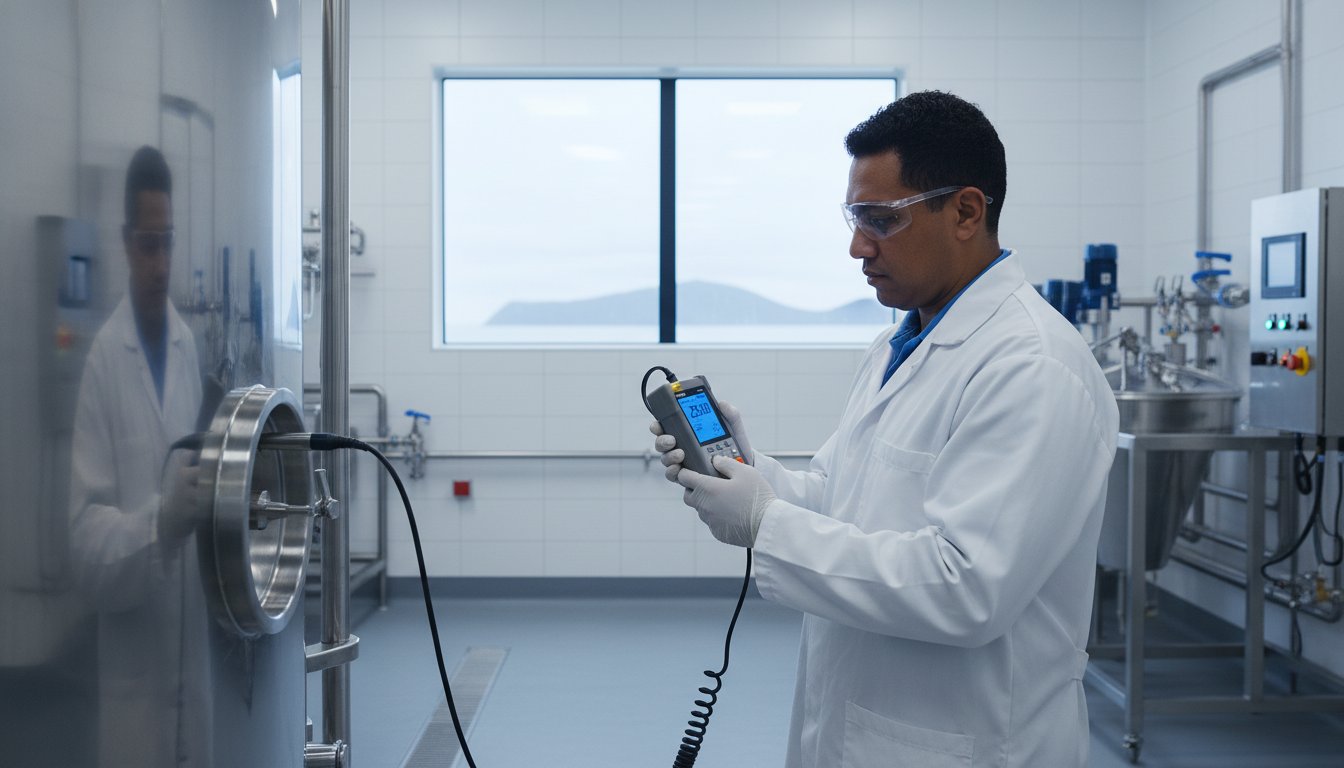
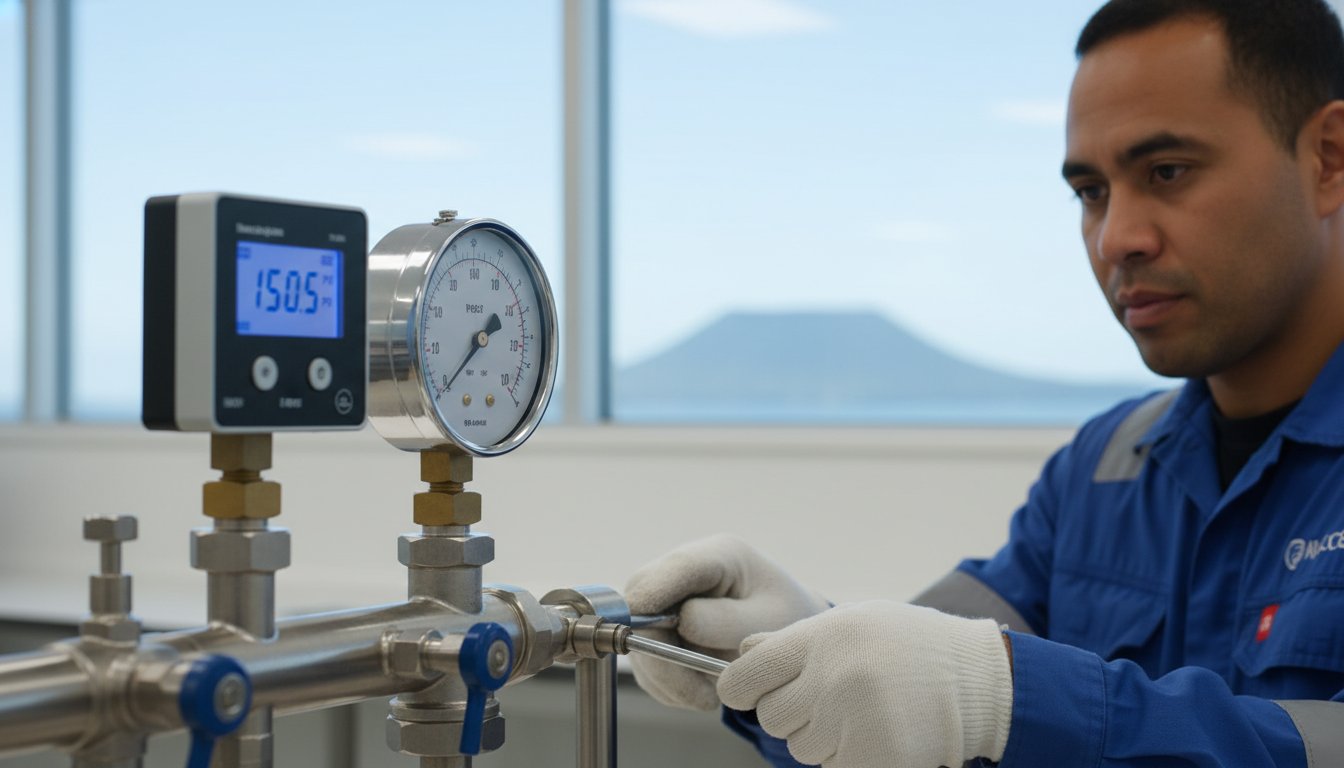
Calibration isn't a mere administrative hurdle. It's the technical process of comparing an instrument's readings against a reference standard of known accuracy to determine its deviation. In 2026, simply having a sticker on a pressure gauge or handheld meter isn't enough to satisfy rigorous quality audits. Modern standards demand documented proof that your instruments perform within specific tolerances. This requirement is especially critical in New Zealand's primary export sectors, such as dairy and horticulture, where a minor measurement error can compromise an entire shipment's safety or quality.
Understanding the nuances of accredited vs traceable calibration NZ is essential for any facility manager or quality controller. You have two primary paths to choose from: traceable calibration, which provides a chain of comparison back to national standards, and accredited calibration, which adds a layer of independent verification regarding the laboratory's technical skill. Both rely on Metrology, the scientific study of measurement, to ensure consistency across the supply chain. Choosing the wrong path can leave your business vulnerable during high-stakes compliance reviews.
The difference between ISO 9001 and ISO 17025 certification status often dictates your market access. While ISO 9001 focuses on general management systems, ISO 17025 specifically validates the technical competence of the people and equipment performing the calibration. Relying on unverified measurements carries significant legal and insurance risks. If a safety relief valve fails because of an improper calibration, your insurance provider may scrutinize whether the service provider was formally accredited. Engineering New Zealand professional standards also emphasize the use of verified data to maintain structural and operational integrity in industrial environments.
New Zealand maintains a tiered system to ensure measurement accuracy. At the top sits the Measurement Standards Laboratory (MSL), which maintains the national standards for SI units. International Accreditation New Zealand (IANZ) operates under the Ministry of Business, Innovation, and Employment to oversee the quality of commercial labs. International Accreditation New Zealand (IANZ) is the independent auditor of laboratory competence. By choosing an IANZ-accredited provider for your temperature and pressure devices, you're ensuring that the laboratory's quality management system, equipment, and technician training have been rigorously evaluated against international benchmarks. This verification provides the confidence needed for high-stakes regulatory compliance.
Traceability serves as the foundational paper trail for any measurement. It's defined as an unbroken chain of comparisons that links your specific instrument back to a national or international standard. When evaluating accredited vs traceable calibration NZ, think of traceability as the "what" and accreditation as the "how." While a traceable certificate proves your equipment was compared to a higher standard, it doesn't inherently guarantee the laboratory's technical competence or environmental controls. This distinction is anchored in the New Zealand Measurement Legislation, which establishes how units of measurement are maintained and disseminated across the country.
The Traceability Pyramid illustrates this hierarchy clearly. Every measurement you take sits at the base of a structure that reaches all the way to international science. Understanding this flow is vital for quality managers:
The international "gold standard" for all measurements.
Maintained by the Measurement Standards Laboratory in New Zealand.
High-accuracy tools used by calibration labs to check their own gear.
The master equipment used to calibrate your tools.
Your everyday pressure gauges, meters, and valves.
Every link in this chain must be documented. If one link is broken or undocumented, the traceability of the entire system is lost. This is why a simple "traceable certificate" might not satisfy a strict auditor who requires proof of the laboratory's competence, not just their equipment's history.
To keep this chain intact, the laboratory's master equipment must have its own valid, accredited certificate. Precise record-keeping is non-negotiable. For many internal quality checks or low-risk manufacturing processes, a standard traceable certificate provides sufficient evidence that a tool is within its expected range. It's a cost-effective solution for non-critical assets where safety or export compliance isn't at stake. If you're unsure if this level meets your needs, you can consult our technical specialists for guidance on your specific application.
Traceability alone is simply a statement of lineage. It doesn't prove that the technician performed the test correctly or that the lab's uncertainty calculations are accurate. Without an independent IANZ audit, there's no external verification of the lab's environment. Factors like temperature or humidity controls can significantly skew results in high-precision work. A "traceable" lab might follow a manual but lack the expertise to identify a subtle calculation error. This leaves your business with a certificate that might fail a regulatory audit, potentially leading to product recalls or safety failures. If a lab doesn't correctly account for measurement uncertainty, your equipment might be declared "in tolerance" when it's actually failing.
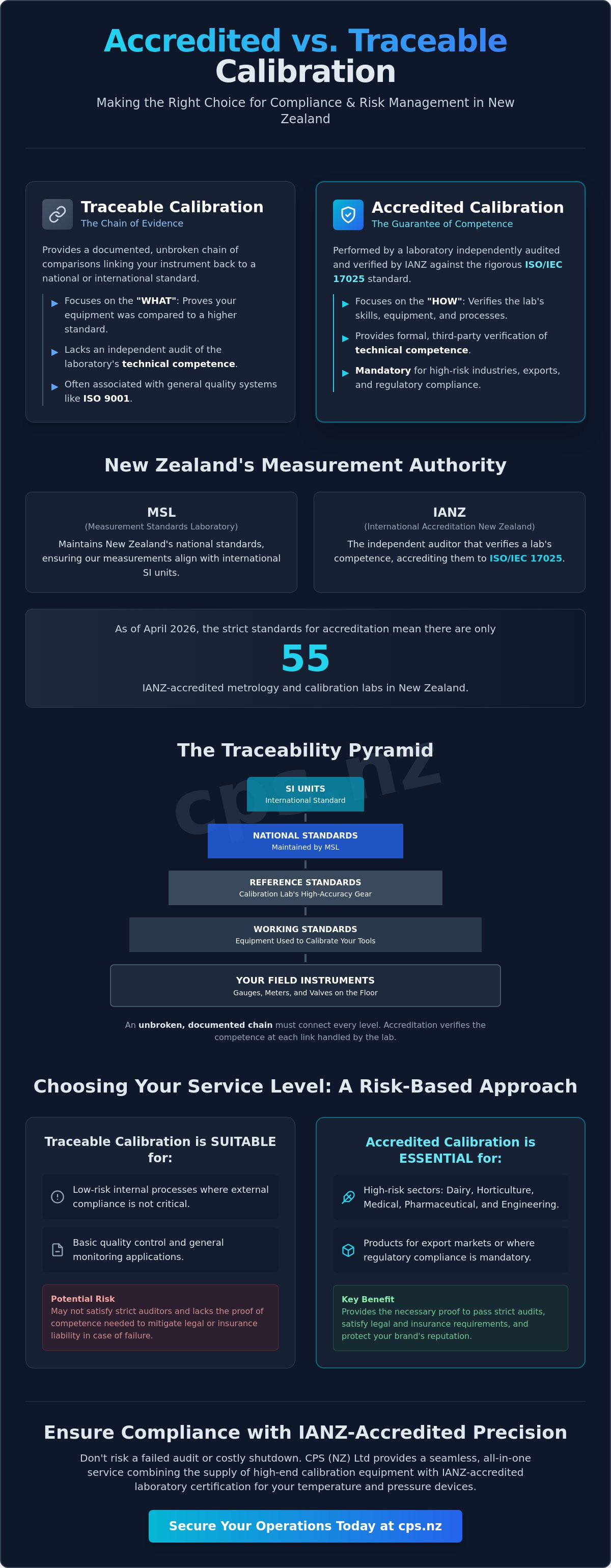
The primary distinction in accredited vs traceable calibration NZ lies in the level of external verification. While traceability ensures a link to national standards, accreditation proves the laboratory possesses the technical competence to perform the work correctly. International Accreditation New Zealand (IANZ) regularly audits accredited laboratories to verify their adherence to ISO/IEC 17025. This process involves rigorous on-site assessments where technical experts observe technicians performing calibrations. It's not enough for a lab to follow a manual; they must demonstrate they understand the physics behind the measurement and the nuances of the equipment they're testing.
Accredited certificates also include a mathematically proven uncertainty budget. This provides a specific margin of error for every measurement taken. Without this calculated uncertainty, a measurement is merely an estimate. Because IANZ is a signatory to the International Laboratory Accreditation Cooperation (ILAC) Mutual Recognition Arrangement (MRA), certificates issued by accredited NZ labs are recognized globally. This international acceptance is vital for New Zealand exporters who must prove their product quality to overseas regulators without repeating expensive tests in every target market.
Choosing the right path requires understanding how these two levels differ in practice. The following table breaks down the core features of each service level:
| Feature | Traceable Calibration | Accredited Calibration (IANZ) |
|---|---|---|
| Audit Status | Internal or customer audits only | Regular, independent IANZ audits |
| Technician Testing | Self-verified competence | Formally assessed technical skill |
| Uncertainty Reporting | Often omitted or estimated | Mathematically proven margin of error |
| Environmental Controls | Variable laboratory conditions | Strictly monitored temperature/humidity |
| Cost | Lower initial investment | Higher due to rigorous compliance |
The IANZ logo on a certificate serves as the hallmark of a valid accredited service in New Zealand. It confirms that the laboratory's environmental controls, such as temperature and humidity, are strictly monitored to prevent atmospheric conditions from skewing measurement results. In high-precision environments, even a two-degree shift in room temperature can alter the expansion of metal components in a pressure gauge, leading to inaccurate readings.
ISO/IEC 17025 is the internationally recognized baseline for instrumentation calibration services. Many businesses confuse this with ISO 9001, but the two serve very different purposes. ISO 9001 is a management standard that ensures a company has organized processes and customer service. In contrast, ISO/IEC 17025 is a technical competence standard, not just a management one. It requires the laboratory to prove its ability to produce precise and accurate data. For industries where measurement accuracy is a matter of safety or regulatory compliance, relying on an ISO 9001 company without specific ISO 17025 accreditation for their lab is a significant risk that could lead to failed audits or equipment failure.
Deciding on the appropriate service level for your facility requires a clear-eyed assessment of your operational risk. While the debate of accredited vs traceable calibration NZ often centers on price, the real metric is the cost of failure. High-risk industries, such as aviation, medical, and export food production, operate under strict regulatory oversight where IANZ accreditation is non-negotiable. For these sectors, the Ministry for Primary Industries (MPI) or the Civil Aviation Authority (CAA) typically require certificates that bear the IANZ hallmark to ensure global compliance. These bodies don't just look for a paper trail; they look for a guarantee of technical competence that only a formally audited laboratory can provide.
Medium-risk environments include general manufacturing where precision impacts product quality but doesn't present an immediate safety hazard. In these cases, traceable calibration may be sufficient for certain assets. However, any tool that directly influences a Critical Control Point (CCP) in a food safety plan should remain within the accredited category. Low-risk workshop tools used for 'ballpark' measurements can safely utilize traceable certificates without compromising the broader quality management system. MPI auditors specifically look for an unbroken chain of competency when reviewing food safety records. If your calibration provider hasn't been independently audited by IANZ, the auditor may challenge the validity of your temperature logs, which can lead to non-compliance reports that stall export permits.
New Zealand's dairy and food export markets rely on the trust of international buyers. Meeting the stringent requirements of overseas regulators often means providing proof of ISO 17025 compliance to satisfy audit mandates. In the medical and pharmaceutical sectors, the necessity of accredited temperature mapping and calibration ensures the integrity of the cold chain and patient safety. Similarly, in aviation and defense, pressure gauge calibration must be accredited to guarantee flight safety and equipment reliability under extreme conditions. Using an unverified lab for these critical instruments isn't just a risk; it's a liability that could void your operational certifications.
The financial impact of a single product recall far outweighs the investment in an IANZ certificate. Beyond risk mitigation, accredited calibration often reduces long-term maintenance costs by identifying subtle instrument drift before it leads to a total failure. Smart businesses often employ a strategic mix of service levels. They reserve IANZ accreditation for critical instruments while using traceable services for non-essential tools. This approach optimizes the maintenance budget without exposing the company to audit failures. It's about being efficient with your resources while maintaining absolute confidence in your data. If you need assistance categorizing your equipment by risk level, contact our technical team for a site-wide calibration audit to ensure you're meeting your specific regulatory obligations.
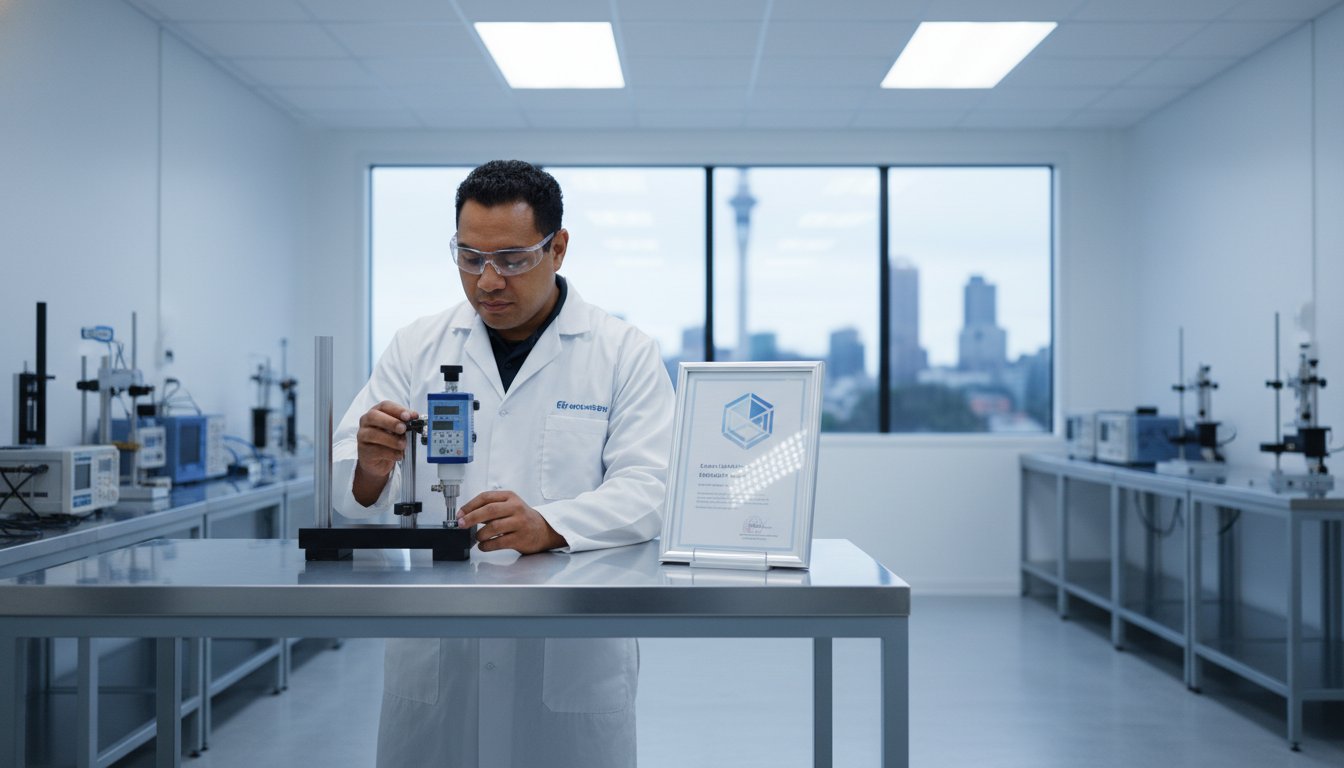
CPS (NZ) Ltd operates a premier Auckland-based laboratory specifically accredited by IANZ for temperature and pressure measurements. Our facility isn't just a service center; it's a hub of technical excellence where we've spent decades navigating the unique regulatory landscape of New Zealand. When you're weighing the choice of accredited vs traceable calibration NZ, you need a partner that understands the specific demands of local auditors and international export requirements. We've invested heavily in state-of-the-art technology, including Additel precision controllers, to ensure we provide the lowest possible measurement uncertainty for your critical assets. This commitment to high-end instrumentation allows us to deliver results that meet the most stringent global standards.
Our role extends beyond simple certification. We provide a comprehensive service model that integrates the supply of calibration equipment with the technical expertise required to maintain it. By acting as a single-source provider, we eliminate the gaps often found when dealing with multiple vendors. You receive the hardware, the installation, and the IANZ-accredited certificate from a single team that stands behind every measurement. This "all-in-one" approach is designed to give facility managers peace of mind, knowing their compliance is handled by seasoned specialists who understand the physics of the tools they sell.
We distinguish ourselves by offering deep-level technical backing that generic importers simply cannot match. While transactional resellers focus on profit margins, our focus remains on long-term reliability and customer support. Our clients benefit from direct access to seasoned NZ experts who provide personalized attention to every project. Whether you're managing a complex dairy processing line or a high-precision medical lab, we offer the stability of a partner with a multi-decade history in the region. We don't just ship products; we provide the maintenance, training, and recalibration services that keep your operations running without interruption.
Establishing a reliable calibration schedule doesn't have to be a source of stress. When you request a quote from our team, we'll help you specify the correct level of accreditation for each tool in your inventory. This prevents you from overpaying for unnecessary certifications while ensuring your high-risk instruments remain fully compliant with IANZ and MPI standards. We offer both lab-based services for maximum precision and on-site calibration for larger installations that cannot be moved. Whether you need to calibrate a single pressure gauge or an entire plant's worth of sensors, we provide the technical evidence you need to pass your next audit with confidence. Contact the CPS team today for a professional assessment of your measurement needs and let us help you optimize your compliance strategy.
Navigating the nuances of accredited vs traceable calibration NZ is a strategic decision that impacts your audit readiness and global market access. You now understand that while traceability provides a documented history, IANZ accreditation offers the verified competence required by regulators like MPI and the CAA. Choosing the correct service level ensures you don't overspend on non-critical tools while maintaining absolute precision where it matters most. This balance is key to operational efficiency.
CPS (NZ) Ltd brings over 30 years of industry experience to your facility. As an official Additel and pressure equipment distributor with a fully accredited IANZ laboratory, we provide the technical backing that transactional resellers cannot offer. We're committed to helping you maintain a seamless calibration schedule that protects your reputation and your bottom line. Accuracy is the foundation of your success, and our team is ready to provide the certainty your business demands.
Get an IANZ-Accredited Calibration Quote Today to secure your equipment's accuracy. We look forward to supporting your business's growth and compliance goals with our specialized expertise.
No, these terms represent fundamentally different levels of quality assurance. Traceability provides a documented paper trail linking an instrument back to a national standard, such as those held by the Measurement Standards Laboratory. In contrast, accredited calibration includes this traceability but adds an independent audit of the laboratory's technical competence by IANZ. While traceability shows where the standard came from, accreditation proves the technician actually performed the work correctly.
Yes, IANZ accreditation is not a lifetime award and requires ongoing verification. Accredited laboratories undergo regular surveillance visits and full reassessments to ensure they continue to meet the ISO/IEC 17025:2017 standard. If a lab fails to maintain its equipment, technician training, or environmental controls, IANZ can suspend or withdraw its accreditation. This rigorous cycle ensures that the 55 accredited metrology labs currently operating in New Zealand maintain the highest levels of precision.
Yes, many businesses find that a non-accredited lab providing traceable results is sufficient for ISO 9001 compliance. This standard focuses on general quality management systems and usually only requires that equipment is calibrated against standards linked to national benchmarks. However, if your specific industry or contract mandates ISO 17025, a standard traceable certificate will not be enough to pass your audit. You must evaluate the risk of your specific application before choosing a service level.
The higher cost of an IANZ-accredited service reflects the significant investment required to maintain a formally audited laboratory. Accredited facilities must participate in regular proficiency testing, maintain strictly controlled environments, and invest in high-end reference standards with lower uncertainty. These laboratories also pay annual fees to IANZ for the 2025/2026 period to support independent oversight. This investment provides you with a mathematically proven margin of error that standard traceable services cannot offer.
You must look for the official IANZ logo and the laboratory's unique accreditation number prominently displayed on the document. A valid accredited certificate will also include a statement of measurement uncertainty and confirm that the specific test falls within the lab's formal scope of accreditation. If the certificate only mentions traceability without the IANZ hallmark, it is not an accredited document. Always verify that the signature belongs to an authorized signatory recognized by the accreditation body.
The frequency of calibration depends on the instrument's stability, its environment, and how critical the measurement is to your safety or product quality. Most New Zealand businesses adopt a 12-month interval as a standard baseline for pressure gauges and temperature sensors. However, if an instrument is used daily in a harsh manufacturing environment, you may need to shorten this cycle to six months. Monitoring for "drift" over time helps you determine the most cost-effective schedule for your specific tools.
Aviation, medical device manufacturing, and the food export sector are the primary industries where IANZ-accredited results are mandatory. When evaluating accredited vs traceable calibration NZ, exporters must consider that IANZ-accredited certificates are recognized globally through the ILAC Mutual Recognition Arrangement. This recognition is vital for companies selling dairy or horticultural products to international markets. Without an accredited certificate, your technical data may be rejected by overseas regulators, leading to expensive delays or rejected shipments.
Yes, we offer both traceable and IANZ-accredited calibration services from our Auckland facility to suit your specific operational needs. Our laboratory is formally accredited for pressure and temperature devices, but we recognize that not every tool in your workshop requires this high level of certification. We help you categorize your equipment by risk so you can apply accredited services where they are legally required and use traceable services for non-critical assets. This balanced approach helps you manage your maintenance budget while ensuring total compliance during audits.