


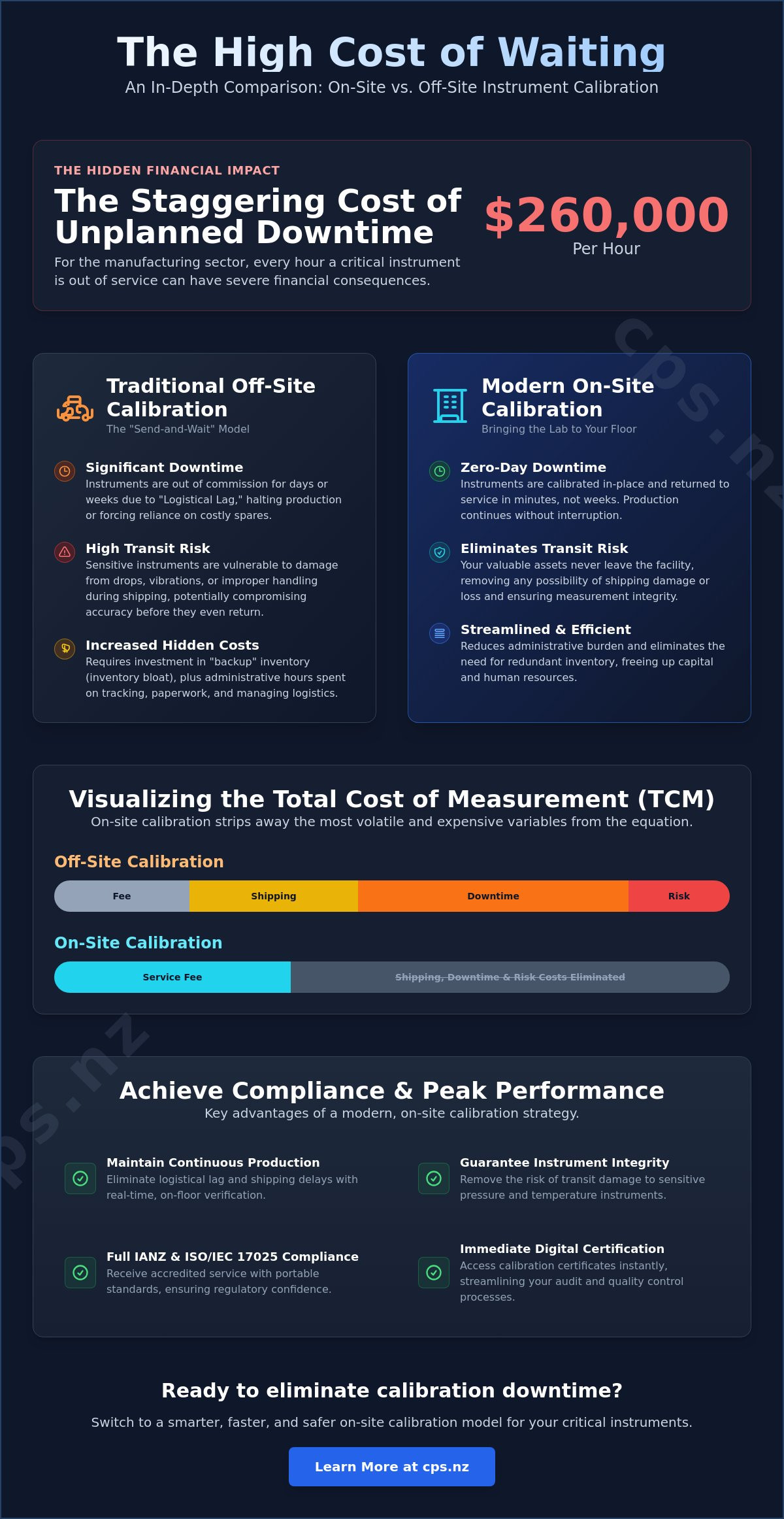
Did you know that the average cost of unplanned downtime in the manufacturing sector has reached approximately $260,000 per hour? For New Zealand industrial leaders, every day a critical instrument spends in a courier van is a day of lost productivity and unnecessary risk. You're likely tired of the administrative burden that comes with tracking off-site assets and the constant worry that your precision tools might be damaged during transit.
It's time to shift your strategy. This guide focuses on reducing downtime with on-site calibration, a method that allows you to maintain IANZ-standard precision without pausing your production line. We'll show you how to achieve zero-day downtime for your temperature and pressure instruments while ensuring full compliance with ISO/IEC 17025:2017. You'll learn how to secure immediate access to calibration certificates and eliminate logistical bottlenecks, keeping your facility running at peak performance through our comprehensive, on-site service model.
• Identify the hidden financial impacts of "logistical lag" and eliminate the risk of transit damage to sensitive pressure and temperature instruments.
• Learn the strategic advantages of reducing downtime with on-site calibration by replacing shipping delays with real-time, lab-grade verification.
• Develop a triage system to prioritize which critical assets require field service to maintain continuous production cycles.
• Streamline your next calibration visit by implementing pre-visit asset tagging and preparing a stable environment for portable precision standards.
• Maintain full compliance with ISO/IEC 17025:2017 through IANZ-accredited services that provide immediate access to digital calibration certificates.
Many New Zealand industrial firms view calibration as a simple line item on a maintenance budget. However, the true cost often hides beneath the surface. When you send a critical pressure gauge or temperature sensor off-site, the invoice from the lab is only a fraction of the total expense. You're also paying for the "Logistical Lag," which is the period where an asset is unproductive, untraceable, and potentially at risk.
Shipping sensitive equipment involves inherent liabilities. Standard courier services aren't always designed for high-precision instruments. If a gauge is dropped or subjected to extreme vibrations in transit, its accuracy is compromised before it even reaches the bench. This creates a cycle of uncertainty; you're paying for a certificate for a device that might have been knocked out of tolerance during its return journey. By focusing on reducing downtime with on-site calibration, you eliminate this transit risk entirely.
There's also the issue of inventory bloat. To combat the time lost during lab rotation, companies often invest in "backup" inventory. This is capital tied up in instruments that sit on a shelf for most of the year. It's an inefficient use of resources that stems directly from the inability to perform real-time verification on the shop floor. Furthermore, if a lab return is delayed, you face the regulatory risk of using unverified equipment or halting production, both of which are costly choices.
Geography plays a decisive role in operational efficiency for New Zealand facilities. For a plant in Southland or the West Coast, shipping a device to a metropolitan lab isn't just a "standard turnaround." It involves transit through rural networks where delays are common. Administrative teams also spend hours tracking these assets and managing paperwork. These hidden hours represent a significant drain on human resources. On-site service bridges this gap by bringing the expertise directly to your door, regardless of your coordinates.
To understand the true impact on your bottom line, you should look at the Total Cost of Measurement (TCM). This framework defines the real expense as the calibration fee plus shipping, downtime, and technical risk. When you prioritize reducing downtime with on-site calibration, you effectively strip away the most volatile variables in that equation. You no longer need a deep pool of redundant equipment because your primary instruments never leave the facility. On-site visits eliminate the "instrument-in-a-box" productivity drain, ensuring your assets move from verification back to operation in minutes rather than weeks.
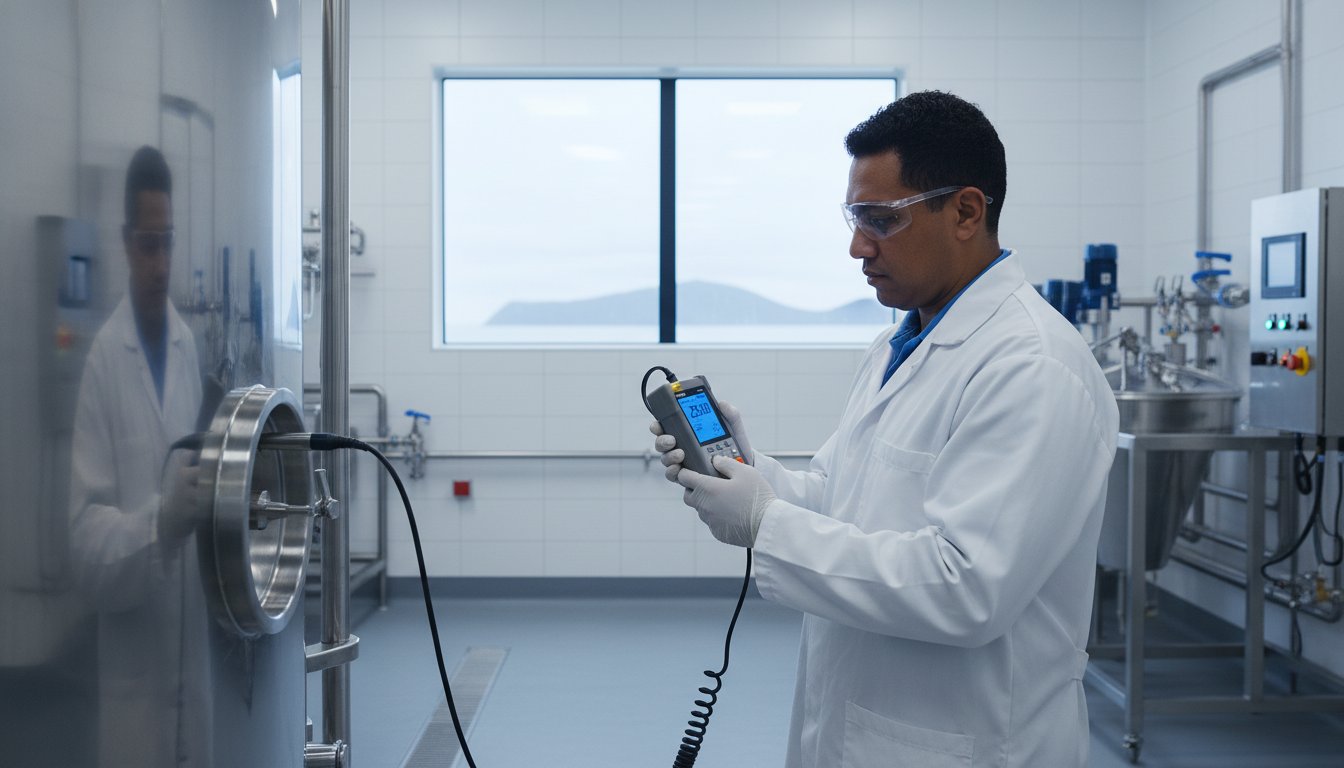
Reducing downtime with on-site calibration starts with a fundamental shift in how we view precision. Instead of removing the instrument from its environment, we bring the laboratory standards to the instrument. This approach eliminates the weeks of waiting typically associated with traditional lab rotations and courier networks. Our technicians utilize specialized mobile workstations designed to maintain lab-grade accuracy in an industrial setting, ensuring that your production schedule remains uninterrupted.
Managing environmental variables is a critical component of field accuracy. Technicians monitor ambient temperature, humidity, and atmospheric pressure to ensure they align with the requirements of ISO/IEC 17025:2017. If conditions aren't ideal, we utilize localized environmental controls or compensatory algorithms to maintain the integrity of the measurement. This level of technical oversight ensures that the results you receive on the shop floor are as reliable as those produced in a fixed laboratory environment.
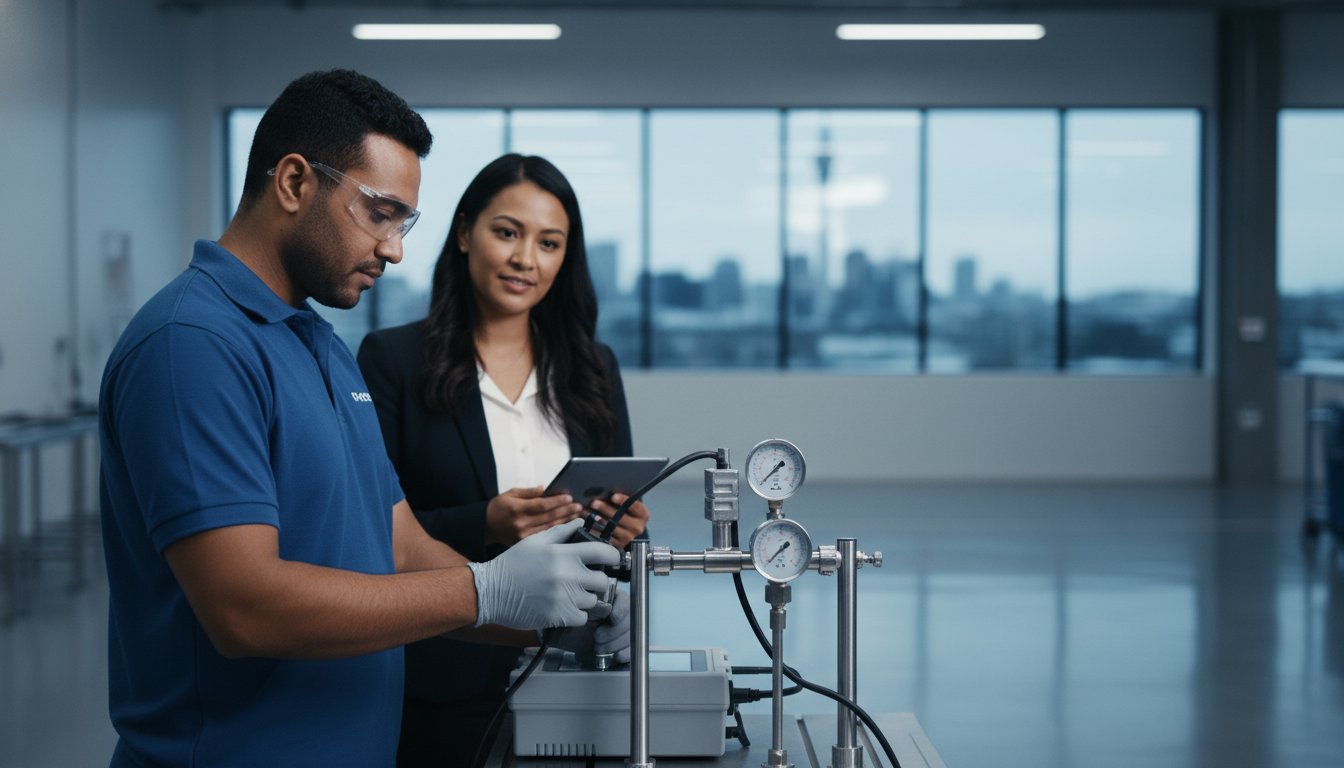
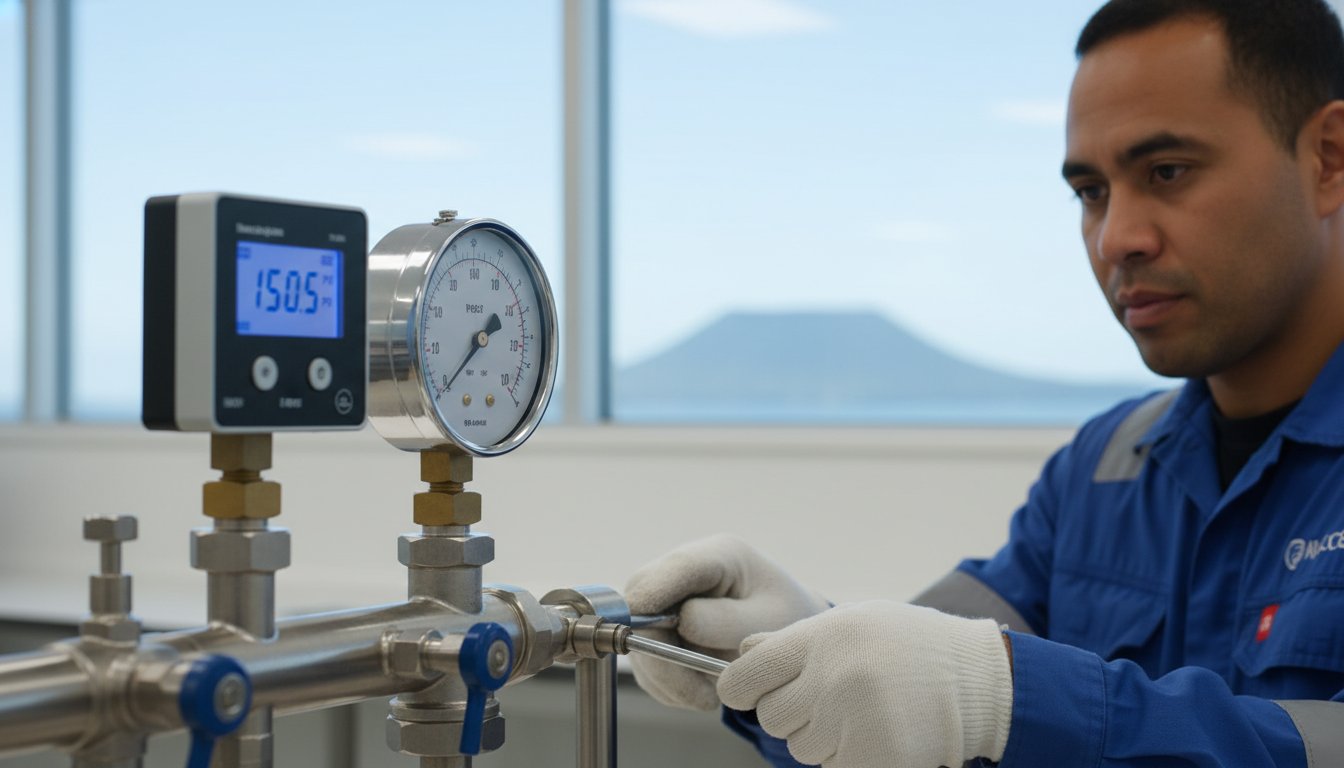
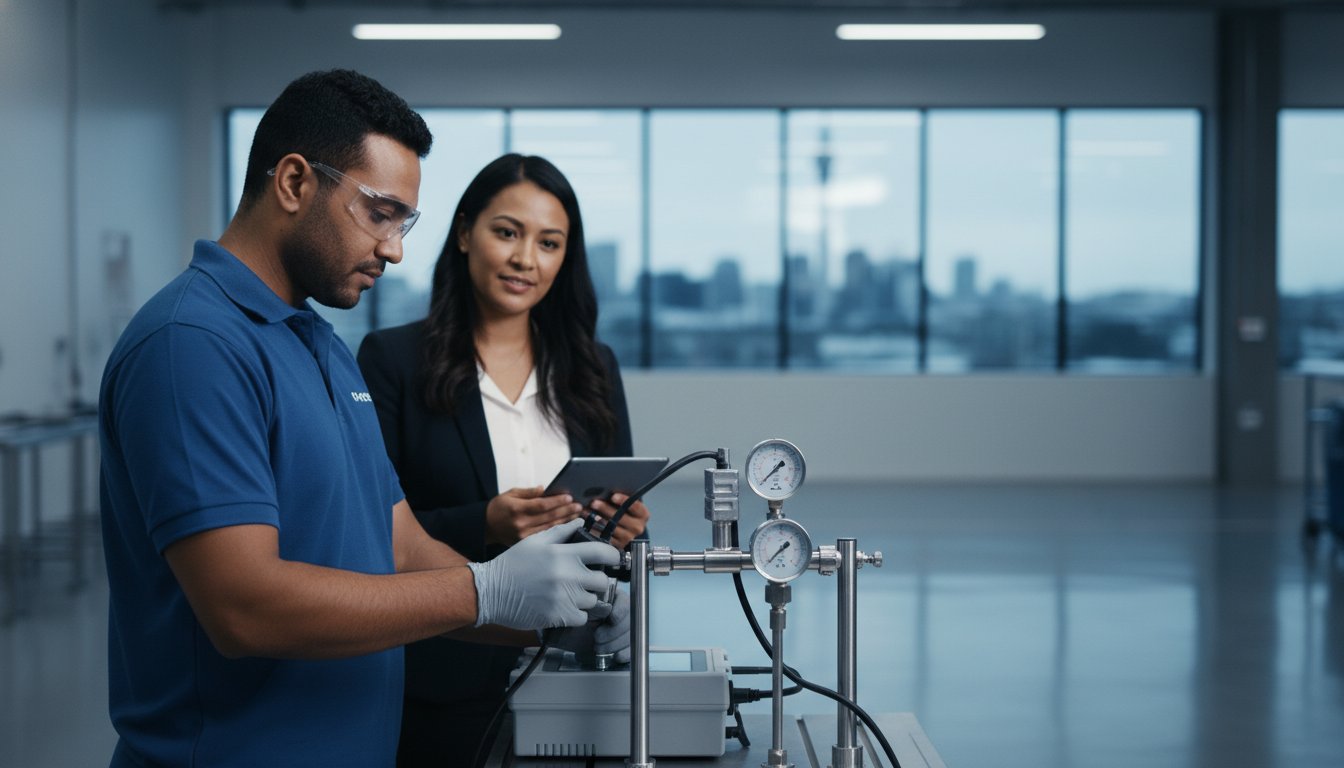
Master calibrators are the backbone of this process. Mobile technicians utilize high-precision portable standards that are regularly verified against primary laboratory equipment. This methodology ensures NIST-traceable on-site calibration and maintains full compliance with IANZ and NATA standards. We often deploy automated pressure calibrators in the field because they significantly reduce human error and provide repeatable, high-speed verification. These devices allow us to cycle through multiple test points quickly, providing a comprehensive view of instrument performance without the wait times of manual hand pumps.
A primary advantage of field service is the ability to test equipment in its actual operating context. When a technician verifies a pressure gauge in its mounting position, they account for factors like vibration, orientation, and process temperature. Lab isolation often misses these variables, leading to "ghost" inaccuracies that only appear when the instrument is reinstalled. Testing in situ allows us to identify system-wide issues, such as leaking manifolds or faulty thermal wells, which a lab test would never detect. This contextual insight allows for immediate adjustments and minor repairs, ensuring your assets return to service at peak performance. If you're looking to streamline your compliance schedule, you can explore our full range of on-site calibration services to see how we integrate with your specific facility requirements.
The process concludes with real-time data entry and immediate certification. We close the loop on compliance before the technician even leaves your site. By digitizing the results instantly, you gain immediate access to calibration certificates, satisfying auditor requirements and internal quality protocols without the administrative lag of physical paperwork. This real-time verification ensures that your production line stays compliant and operational every hour of the day.
Deciding between field service and a fixed laboratory is a strategic choice that directly impacts your operational throughput. While reducing downtime with on-site calibration is the primary goal for most New Zealand manufacturers, it's essential to understand which assets are best suited for each environment. You don't want to compromise precision for speed, but you also shouldn't lose production time to unnecessary logistics.
A thorough cost-benefit analysis often favors on-site service because it eliminates the massive costs of unplanned outages. Research indicates that the average cost of downtime in the manufacturing industry is approximately $260,000 per hour. When you weigh a technician’s call-out fee against even one hour of halted production, the ROI of on-site service becomes clear. Additionally, digital on-site records offer superior audit readiness compared to paper-based lab returns. You receive your data instantly, whereas lab-based returns can take days to process administratively.
We recommend creating a triage list based on asset criticality and environmental factors. Use these criteria to guide your planning:
High-volume batches of pressure gauges, critical path instruments that can't be spared, or large, fragile assets like safety relief valves that are difficult to transport.
Instruments requiring ultra-high precision that exceeds portable standards or those located in hazardous environments where spark-risk equipment is prohibited.
You can maximize value by bundling services. Our technicians can verify temperature sensors, pressure gauges, and hand-held meters in a single visit, reducing the total "per-instrument" cost of the call-out. This approach ensures that your facility remains operational while maintaining the highest levels of accuracy across your entire asset list.
The most critical step in this comparison is verifying your provider's credentials. An on-site certificate is only as valid as the accreditation behind it. In New Zealand, auditors expect certificates to meet ISO/IEC 17025:2017 standards. This ensures that the measurements are traceable to the International System of Units (SI) and that the laboratory’s competency has been formally verified by IANZ.
It's also vital to ensure that on-site certificates align with Engineering New Zealand standards. Always check the provider’s "Scope of Accreditation." This document specifies exactly which types of instruments and ranges a lab is authorized to calibrate in the field. If a provider offers on-site service for a range outside their scope, the resulting certificate may not satisfy your quality management system or external auditors.
Achieving the full benefit of reducing downtime with on-site calibration requires proactive site management. While our technicians bring the laboratory to you, your preparation ensures that every minute of the visit is spent on high-precision verification rather than searching for assets. Streamlining the workflow begins long before the technician arrives at your gate. A well-prepared site allows for a seamless transition from testing to production, reinforcing the reliability of your measurement systems.
Pre-visit asset tagging is a simple but effective strategy to eliminate operational friction. By clearly marking all instruments due for service, you prevent missed calibrations and ensure the technician moves systematically through your facility. This level of organization directly translates to a faster return to full production capacity. You should also consider the physical environment; precision instruments are sensitive to extreme fluctuations. Providing a clean, stable area with adequate power is essential for maintaining the integrity of our portable standards.
To ensure a productive visit, we recommend completing a final walkthrough the day before the service. High-performing facilities typically use the following checklist to maintain momentum:
• Ensure all calibration equipment and process instruments are accessible, clean, and free from industrial debris.
• Assign a dedicated site contact who understands the instrument locations to assist the technician.
• Confirm that the designated mobile lab area has stable power and is shielded from extreme drafts or temperature spikes.
• Verify that all safety permits and site inductions are arranged in advance to avoid "gate-lag" delays.
Modern compliance demands immediate data availability. You can accelerate this by setting up dedicated digital folders for immediate certificate uploads before the technician arrives. This preparation allows for the instantaneous integration of data into your asset management system. During the visit, take the time to review "As-Found" and "As-Left" data with the technician. This real-time review helps identify drifting instruments early, allowing you to make informed decisions about maintenance or replacement before a failure occurs.
Finally, use the momentum of the visit to schedule your next interval. Establishing a recurring schedule ensures you never fall out of compliance with IANZ or ISO standards. If you're ready to eliminate logistical bottlenecks and secure your production timeline, you can book your on-site calibration visit with our technical team today. Closing the loop on your calibration needs before the technician departs provides the peace of mind that your facility is fully verified and audit-ready for the year ahead.
Reducing downtime with on-site calibration requires a partner who understands the rigorous demands of the New Zealand regulatory environment. At CPS (NZ) Ltd, we don't just provide a technician; we deliver a complete, IANZ-accredited laboratory experience directly to your facility. Our commitment to maintaining ISO/IEC 17025:2017 standards in the field ensures that your compliance is never in question. While generic equipment importers often leave you to manage your own verification, we operate as a single-source provider for every stage of the technical process.
Our "All-in-One" service model distinguishes us as a market leader. We handle the initial supply of high-quality instruments, manage the onsite installation of equipment, and provide ongoing accredited calibration services for temperature and pressure devices. This comprehensive approach eliminates the need to coordinate multiple vendors, significantly simplifying your asset management. We've invested heavily in state-of-the-art portable technology to ensure our field measurements match the precision of our fixed Auckland laboratory, providing you with absolute confidence in your data.
Our reputation is built on a multi-decade history of serving the Onehunga and Auckland industrial hubs. We've spent years refining our processes to meet the specific needs of New Zealand’s primary industries. Technical leaders choose us because we offer deep expertise in pressure and thermometer calibration that few can match. Unlike transactional resellers, we prioritize a customer-centric approach that focuses on long-term reliability and technical support. We understand the nuances of IANZ accreditation versus other international bodies, ensuring your certificates are always recognized by local auditors and global export partners alike.
Planning your maintenance schedule in advance is the most effective way to ensure continuous production. Our technical team is currently coordinating 2026 site visits for facilities across the country. We recommend integrating your on-site instrument service with your existing pressure relief valve maintenance to further streamline your shutdown periods. This synchronized strategy ensures all critical safety and measurement assets are verified in a single, efficient window.
Requesting a tailored quote for your facility is a straightforward process. By providing our Auckland-based experts with your asset list, we can develop a service plan that maximizes your uptime and satisfies your quality management protocols. Whether you require verification for a handful of hand-held meters or a full-scale plant audit, we're ready to provide the professional, confident, and service-oriented support your operation deserves. Contact us today to secure your position in our 2026 schedule and take the final step in reducing downtime with on-site calibration.
Industrial efficiency in New Zealand no longer depends on how fast you can ship an instrument; it depends on how effectively you can verify it in place. By prioritizing reducing downtime with on-site calibration, you replace the risks of transit damage and inventory bloat with the certainty of immediate, lab-grade results. You've seen how a well-prepared facility and a clear decision matrix can transform calibration from a logistical burden into a streamlined operational advantage.
As an IANZ Accredited Laboratory with over 30 years of NZ industrial expertise, CPS NZ provides the authoritative support needed to maintain global standards on your shop floor. Our comprehensive supply-to-service model ensures that your pressure and temperature assets are always verified, compliant, and ready for audit. Don't let logistical lag dictate your production schedule.
Reduce your downtime today; book an accredited on-site calibration with CPS NZ
Your facility deserves the precision that only a seasoned technical specialist can provide. We look forward to helping you achieve a more resilient and efficient operation.
On-site calibration achieves lab-grade accuracy when performed by qualified technicians using portable standards traceable to national authorities. We monitor ambient conditions like temperature and humidity to ensure they meet ISO/IEC 17025 requirements. While some ultra-high precision instruments still require a fixed lab, the vast majority of industrial pressure and temperature devices can be verified in situ with no loss of precision.
Manufacturing, dairy processing, and the petrochemical sector see the greatest benefits from this service. These industries rely on continuous production cycles where even a few hours of halting a line results in significant financial loss. By reducing downtime with on-site calibration, facilities in these sectors maintain their IANZ compliance without the weeks of logistical delay associated with shipping critical sensors to a metropolitan laboratory.
You should expect only minimal downtime, typically ranging from 15 to 45 minutes per instrument depending on the complexity of the test points. Unlike laboratory calibration which removes the asset for days, on-site service allows the technician to verify the device and return it to service immediately. This approach effectively eliminates the logistical lag and ensures your production continues with only brief, scheduled interruptions.
CPS (NZ) Ltd provides IANZ-accredited calibration certificates for on-site work performed within our authorized scope of accreditation. These certificates meet all the requirements of ISO/IEC 17025:2017 and are recognized by auditors and regulatory bodies across New Zealand. We digitize the results instantly, providing you with immediate access to compliant documentation before our technician even leaves your facility.
Technicians can often perform immediate adjustments or minor repairs if an instrument is found to be out of tolerance. If the device requires more extensive work that cannot be completed in the field, we provide clear As-Found data to help you decide on a replacement or a lab-based repair. This real-time feedback allows you to address the failure instantly rather than discovering the issue weeks later upon a lab return.
Our technical teams are equipped to calibrate safety relief valves, pressure gauges, and temperature sensors during the same site visit. We utilize a comprehensive service model that allows for the verification of diverse asset groups in one window. This multi-discipline approach maximizes the value of the technician's time and is a core strategy for reducing downtime with on-site calibration across your entire facility.
Preparation involves ensuring all target instruments are clean and easily accessible for the technician. You should assign a site contact to assist with location and provide a stable area with reliable power for our portable standards. Arranging safety inductions and work permits in advance is also essential to prevent delays at the gate and ensure the service begins as scheduled.
The Total Cost of Measurement (TCM) is a framework that accounts for the calibration fee, shipping expenses, administrative hours, and the cost of production downtime. It matters because focusing only on the service fee ignores the much larger financial impact of having an instrument out of service. On-site calibration typically offers a lower TCM by eliminating the most expensive variables in the equation, such as unplanned outages and shipping risks.