



An IANZ logo on a laboratory's website is a recognized mark of quality, but it isn't a blanket approval for every service they provide. You've likely felt the frustration of deciphering technical jargon in an accreditation schedule while trying to avoid the risk of an invalid calibration certificate. It's a high-stakes task because a mismatch in range or uncertainty can lead to major non-conformances during your next audit. This guide provides the IANZ scope of accreditation explained in clear, professional terms to help you navigate these complex documents with absolute certainty.
We know that your operational integrity depends on precise, verifiable measurement. You'll learn how to accurately interpret a scope of accreditation to ensure your critical instruments, from safety relief valves to pressure gauges, are calibrated by a laboratory with the specific technical competence you require. We'll examine the difference between general accreditation and specific technical boundaries. We will also show you how to evaluate Calibration and Measurement Capability (CMC) values so you can compare providers and maintain compliance with confidence.
• Understand that IANZ accreditation is limited to specific technical boundaries rather than being a blanket approval for all laboratory activities.
• Learn to identify critical components like "Measurement Range" and "Field of Accreditation" to ensure your pressure gauges and safety relief valves are legally certified.
• This guide provides the IANZ scope of accreditation explained so you can confidently verify a laboratory’s capabilities and avoid invalid certificates.
• Follow a practical 5-step process to locate a provider’s accreditation number and access their most current schedule via the official IANZ directory.
• Secure your audit compliance by understanding how laboratories may offer both accredited and non-accredited services simultaneously.
An IANZ scope of accreditation is the formal document that defines the specific technical boundaries of a laboratory's expertise. It isn't enough to know that a provider is "accredited." You must understand exactly what they're accredited to do. This document serves as the legal boundary of recognized competence, detailing the precise tests, calibrations, and measurements the laboratory has proven it can perform to an international standard. Having the IANZ scope of accreditation explained is vital because it prevents the costly mistake of assuming a lab's general status covers your specific pressure gauge or safety relief valve.
In New Zealand, this accreditation is the primary method for demonstrating compliance with ISO/IEC 17025:2017. This international standard governs the general requirements for the competence of testing and calibration laboratories. While ISO/IEC 17025 provides the framework for quality management and technical requirements, the IANZ scope provides the granular detail. It lists the specific instruments, ranges, and uncertainties that have been rigorously assessed. Without a defined scope, an accreditation claim is effectively hollow, as it lacks the technical evidence required for high-level quality assurance.
A critical distinction exists between being an "Accredited Laboratory" and performing an "Accredited Calibration." Many facilities maintain IANZ accreditation for a specific set of services while simultaneously offering non-accredited commercial services. If a laboratory calibrates a hand held meter outside the ranges specified in their scope, that certificate cannot carry the IANZ logo. It doesn't meet the requirements for a formal audit. You must verify that the specific service you're purchasing falls within the laboratory's recognized capabilities to ensure your equipment remains compliant with industry regulations.
International Accreditation New Zealand is the nation's authority for the accreditation of laboratories and inspection bodies. As a full signatory to the ILAC Mutual Recognition Arrangement (MRA), IANZ ensures that New Zealand businesses meet global measurement standards. This international connection means that an IANZ-accredited certificate is recognized by over 120 signatories worldwide. The accreditation process is exhaustive, involving on-site assessments by technical experts who verify everything from staff proficiency to the precision of the calibration equipment used.
The Accreditation Certificate is a high-level document, often framed on a wall, confirming that a laboratory meets the required standards. However, the Schedule to the Certificate, or the "Scope," is the multi-page technical document that contains the actual data you need. It lists the "Field of Accreditation," such as Pressure or Metrology, and defines the minimum and maximum values the lab can legally certify. An auditor won't just look for a certificate; they'll demand to see the schedule to confirm the laboratory was competent to calibrate your specific device at its operational range.
The "Schedule to the Certificate of Accreditation" is the technical heart of any laboratory's claim to competence. To have the IANZ scope of accreditation explained effectively, we must look past the logo and into the specific data tables. Each schedule is categorized into specific fields, such as Pressure, Metrology, or Mechanical. Within these fields, the document details the precise technical parameters the laboratory is authorized to certify. This includes the measurement range, the Calibration and Measurement Capability (CMC), and the specific reference standards or equipment the lab utilizes to achieve those results.
Identifying the correct "Field of Accreditation" ensures your equipment is handled by specialists with the right expertise. For instance, a facility accredited for general mechanical testing might not possess the specific pressure accreditation required for your safety relief valves. The official directory provided by International Accreditation New Zealand (IANZ) allows you to search for facilities, but the technical entries require careful reading. The scope also lists reference standards, such as deadweight testers or high-precision digital manometers. This transparency allows you to verify that the lab uses equipment superior to the tools they're calibrating, which is essential for maintaining measurement traceability.
You must confirm that your tool’s full operating range fits within the lab’s accredited scope. If your pressure gauge reads up to 700 bar, but the laboratory is only accredited up to 600 bar, they cannot provide an IANZ-endorsed certificate for that device. Common pitfalls often involve units of measure. A scope might list ranges in kilopascals (kPa) while your equipment uses PSI or bar. If a laboratory calibrates a point outside their accredited range, the resulting certificate is technically non-accredited for that specific point. This can lead to significant issues during a quality audit. Before sending your equipment, it's wise to review our current IANZ scope to ensure your specific temperature or pressure requirements are fully covered.
CMC is the best measurement a lab can achieve under ideal conditions. This value represents the smallest uncertainty the laboratory can claim when calibrating a nearly perfect instrument. The CMC directly impacts the "Uncertainty of Measurement" reported on your final certificate. A smaller CMC value indicates a more precise and often better-equipped laboratory. When you compare providers, looking at their CMC values helps you identify which facility has invested in the high-end technology required for superior accuracy. It's a clear indicator of a lab's technical ceiling.
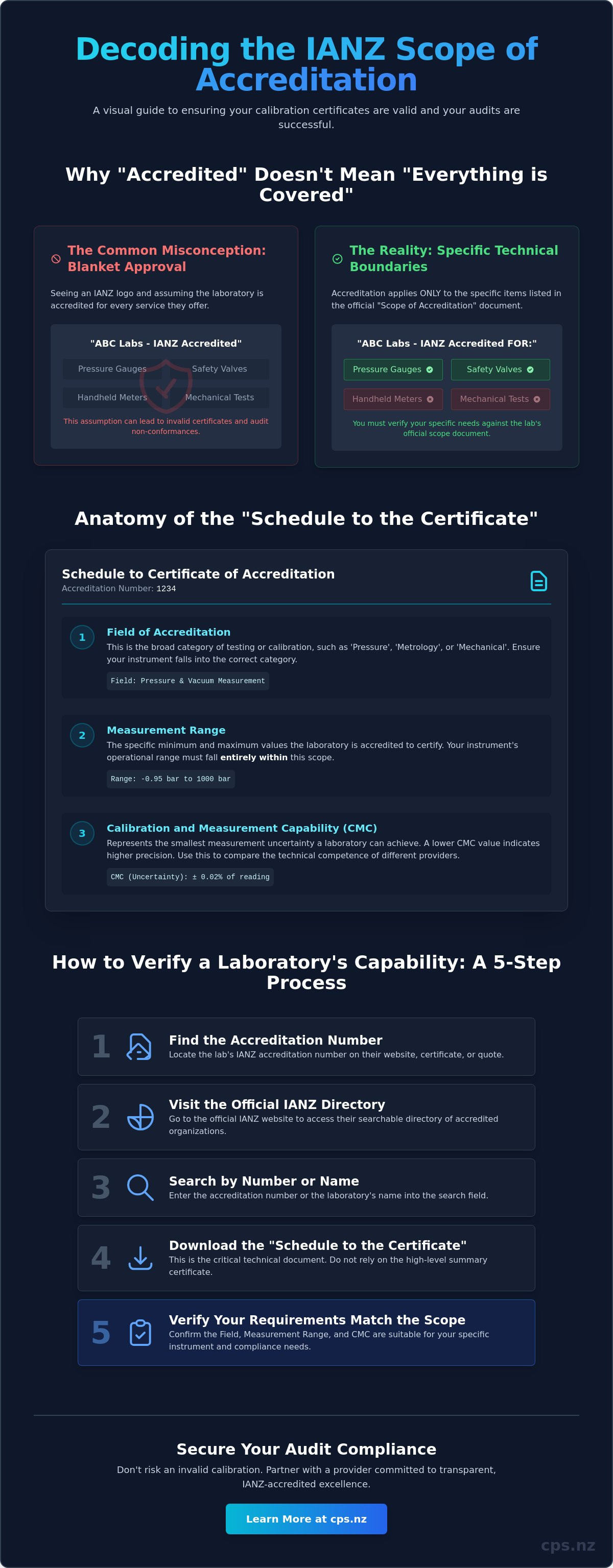
Many facility managers mistakenly believe that hiring an accredited laboratory guarantees an accredited result for every instrument they send. This is a dangerous assumption that can lead to significant compliance failures. In reality, a laboratory can maintain a high-level status while performing work that falls outside their technical boundaries. Having the IANZ scope of accreditation explained in this context reveals that accreditation is an activity-based recognition, not an organizational one. You must look for the IANZ logo on your specific calibration report. If the logo is missing, the work was likely performed as a non-accredited service, even if the lab itself is listed in the IANZ accredited organisation directory.
The legal and quality implications for ISO-certified businesses are significant. An unaccredited calibration for a critical instrument can invalidate your entire quality management process. For example, if a lab calibrates a high-pressure gauge beyond its accredited range, the measurement lacks the formal oversight of an IANZ assessment. This oversight gap creates a liability. Auditors are trained to spot these discrepancies. They will check if the specific range on your certificate matches the laboratory's official schedule. If there's a mismatch, the certificate is effectively worthless for proving technical competence during a high-stakes audit.
Laboratories might perform work outside their scope when they lack the necessary reference standards or when a customer's specific range exceeds their current capability. Accepting such a certificate might lead to a major non-conformance during an Engineering New Zealand audit or a formal quality system review. You can protect your business by requesting a "Scope Check" before every service. Simply ask the lab to confirm that the specific model and range of your equipment are currently covered under their accreditation schedule. This proactive step ensures you don't receive an invalid certificate after the work is already complete.
When IANZ accreditation isn't available for a niche instrument, you must still ensure the measurement is "traceable to national standards." This means the laboratory's own reference equipment was calibrated by an accredited body. While this is acceptable for secondary equipment with lower risk profiles, it doesn't offer the same level of assurance as a fully accredited service. The hierarchy of measurement is clear: IANZ Accredited services provide the highest level of trust, followed by Traceable services. Always prioritize accredited options for critical safety relief valves and primary pressure gauges to maintain the highest safety standards.
Verifying a facility's technical competence requires a systematic approach. You shouldn't rely on a verbal assurance of quality or a simple logo on a homepage. Instead, follow this structured process to have the IANZ scope of accreditation explained through verified data. This ensures your equipment is handled by a team with the specific, assessed capability to perform the work.
This unique identifier is typically found on their website or on previous calibration reports. It's the key to finding their official records.
These documents are updated frequently. You must always check the live version to ensure you're viewing the most current technical boundaries.
Whether you need calibration for a digital pressure gauge or a temperature sensor, the specific instrument class must appear in the "Instrument" or "Component" column.
Confirm that the laboratory's accredited range covers your tool's full operational scale. The CMC value should meet or exceed your internal quality requirements for precision.
Check the directory to ensure the accreditation is listed as "Accredited." You must avoid any facility currently marked as "Suspended" or "Withdrawn."
Searching the directory by the specific accredited facility name is usually more efficient than using broad keywords. Once you locate the entry, pay close attention to the "Status" column. If a laboratory is undergoing a technical review or an equipment upgrade, their status might change. You should always download and save the PDF version of the scope for your quality records. This provides timestamped proof of competence that you can present during your next audit to demonstrate due diligence.
Technical competence isn't uniform across all accredited facilities. You can use CMC values to directly compare the precision of two different laboratories. A lab with a lower CMC for pressure calibration likely utilizes more advanced calibration equipment, such as high-accuracy deadweight testers. Consider whether an "all-in-one" service model fits your needs better than using multiple niche providers. A comprehensive laboratory can often manage your entire inventory, from hand held meters to safety relief valves, ensuring a consistent quality standard. If you need a partner with a transparent and robust technical scope, book your accredited calibration service with us today.
CPS (NZ) Ltd operates a premier IANZ accredited laboratory in Auckland, providing high-precision calibration for pressure, temperature, and torque instrumentation. We believe that technical competence should be transparent and easily verified by our clients. Our approach ensures that you never have to guess whether your equipment is covered. Having the IANZ scope of accreditation explained through our service model means you receive clear, documented proof of our technical boundaries with every calibration. We serve industrial leaders across New Zealand and Fiji, providing the technical assurance required for high-stakes operations in energy, manufacturing, and primary industries.
Our role as a single-source provider distinguishes us from simple resellers. We don't just supply pressure gauges and hand held meters; we provide the end-to-end support required to keep them accurate throughout their service life. This comprehensive model includes everything from initial supply to maintenance and accredited verification. By prioritizing transparency in our instrumentation calibration services, we help our clients maintain perfect audit trails and avoid the risks associated with out-of-scope certificates.
We've made significant investments in world-class reference standards, including precision equipment from Fluke and Additel. These high-end tools allow us to maintain the low CMC values necessary for superior accuracy. Our technical specialists are seasoned experts who help you interpret our scope to ensure your specific operational needs are met. With decades of operational history, CPS (NZ) Ltd provides a level of stability and reliability that transactional competitors cannot match. We take pride in our formal laboratory accreditations and our continuous reinvestment in the latest measurement technology.
Critical industrial assets often cannot be transported to a lab without causing significant downtime. We address this by offering robust on-site calibration services across remote New Zealand locations and Fiji. Our mobile capabilities ensure that your pressure relief valve testing and installation meet local safety standards and regulatory requirements. Whether you require the controlled environment of our Auckland laboratory or the convenience of on-site verification, our team delivers a scope-verified solution. Contact our specialists today to receive a precise quote for your entire fleet of instruments, ensuring every device is calibrated within our accredited technical boundaries.
We've navigated the complexities of technical schedules and the risks associated with out-of-scope certificates. You now have the IANZ scope of accreditation explained in a way that empowers you to make informed decisions for your facility. Remember that verifying a laboratory's accredited range and CMC values is the only reliable method to ensure your results are valid. This diligence protects your business from the costly consequences of non-conformance during critical quality audits.
CPS (NZ) Ltd stands as a leading IANZ Accredited Laboratory with decades of experience in Auckland. We are proud to be trusted by major NZ and Fiji industrial players who demand the highest standards of measurement accuracy. Our commitment to technical excellence and transparent reporting ensures that your pressure gauges, safety relief valves, and temperature sensors are always handled by verified specialists. We invite you to view our full IANZ Scope of Accreditation or request a calibration quote today. Protecting your operational integrity starts with choosing a partner that values precision and technical authority as much as you do.
ISO 9001 is a general management standard that focuses on business processes and customer satisfaction. In contrast, IANZ accreditation specifically assesses technical competence through the ISO/IEC 17025 framework. While ISO 9001 proves a company has a consistent management system, IANZ accreditation proves the laboratory possesses the specialized equipment, environmental controls, and technical skills required to produce accurate and reliable measurement results.
An IANZ scope does not have a fixed expiration date like a traditional license. It remains valid as long as the laboratory successfully passes its scheduled annual assessments and periodic surveillance visits. You should always verify the current status in the official directory to ensure the accreditation hasn't been suspended or withdrawn. Regular assessments confirm the laboratory maintains its high standards for staff training and equipment maintenance.
Yes, laboratories can hold specific accreditation for on-site calibration services. This capability is clearly detailed within their scope document, often listed under a separate section for field activities. This is essential for large, fixed assets like safety relief valves or industrial pressure gauges that are difficult to transport. Choosing an on-site accredited provider ensures the same level of technical rigor is applied at your facility as in the laboratory.
If your instrument or required range is missing from the scope, the laboratory cannot issue an IANZ-endorsed certificate for that specific service. You must find an alternative provider whose technical boundaries cover your equipment. Understanding the IANZ scope of accreditation explained in the lab's schedule prevents you from accepting a certificate that won't pass an audit. Always confirm these technical limits before sending critical hardware for service.
You can locate the accreditation number on the laboratory's website, their official letterhead, or on any previous calibration reports they've issued. This number is typically a three or four-digit identifier. Once you have it, enter the number into the IANZ online directory to access their full technical schedule. This allows you to verify their current capabilities and ensures they're authorized to handle your specific pressure or temperature devices.
IANZ accreditation is the gold standard for measurement in Fiji and across the Pacific. Because IANZ is a full signatory to the ILAC Mutual Recognition Arrangement (MRA), its certificates are recognized globally as technically equivalent to those from other leading bodies. This international recognition is vital for Pacific-based industrial players who must meet global safety and quality standards for their instrumentation and safety relief valves.
CMC stands for Calibration and Measurement Capability, representing the highest level of precision a lab can achieve. It matters because it defines the laboratory's technical limit. If you have a high-accuracy digital pressure gauge, you need a laboratory with a CMC value significantly smaller than the gauge's own tolerance. A lower CMC indicates superior reference standards and more refined calibration processes, providing you with greater confidence in your results.
You can use an overseas laboratory if they're accredited by a body that is also a signatory to the ILAC MRA. However, using a local New Zealand provider often eliminates the logistical risks and high shipping costs associated with international transit. Local labs also have a deeper understanding of New Zealand's specific regulatory environment and can offer on-site calibration and installation services that overseas providers simply cannot match.