


Did you know that the global pressure gauge market is estimated to reach a value of 1.6 billion USD in 2026, driven largely by the urgent shift toward digital precision? You've likely felt the pressure of maintaining IANZ-traceable accuracy while your equipment battles New Zealand's unique environmental stresses. It's a common struggle to find the best digital pressure gauge for industrial use that doesn't just look good on a shelf but actually survives the rigours of a local dairy plant or geothermal site.
We understand that an inaccurate reading isn't just a technical glitch; it's a safety risk and a potential audit failure. This 2026 buyer's guide provides the clarity you need to choose gauges that offer long-term reliability and easy-to-read digital displays. We'll preview the latest ATEX guideline updates from January 2026, break down the 296 to 892 dollar price range for advanced models, and show you how a total package approach ensures your new instrumentation integrates perfectly with your existing calibration kits.
• Understand why digital gauges have replaced traditional Bourdon tubes as the 2026 industrial standard by offering superior accuracy and eliminating parallax errors.
• Learn how to select the best digital pressure gauge for industrial use by matching accuracy classes like 0.05% FS with essential IP67 ratings for harsh New Zealand sites.
• Compare top-performing models such as the Additel 681 and 680 series to find the right balance between high-precision field reliability and general monitoring efficiency.
• Discover why tailored equipment selection is vital for New Zealand's primary sectors to prevent premature gauge failure caused by "one size fits all" solutions.
• Recognize the importance of the "total solution" approach, ensuring your instrumentation remains a reliable asset through IANZ-accredited calibration and technical support.
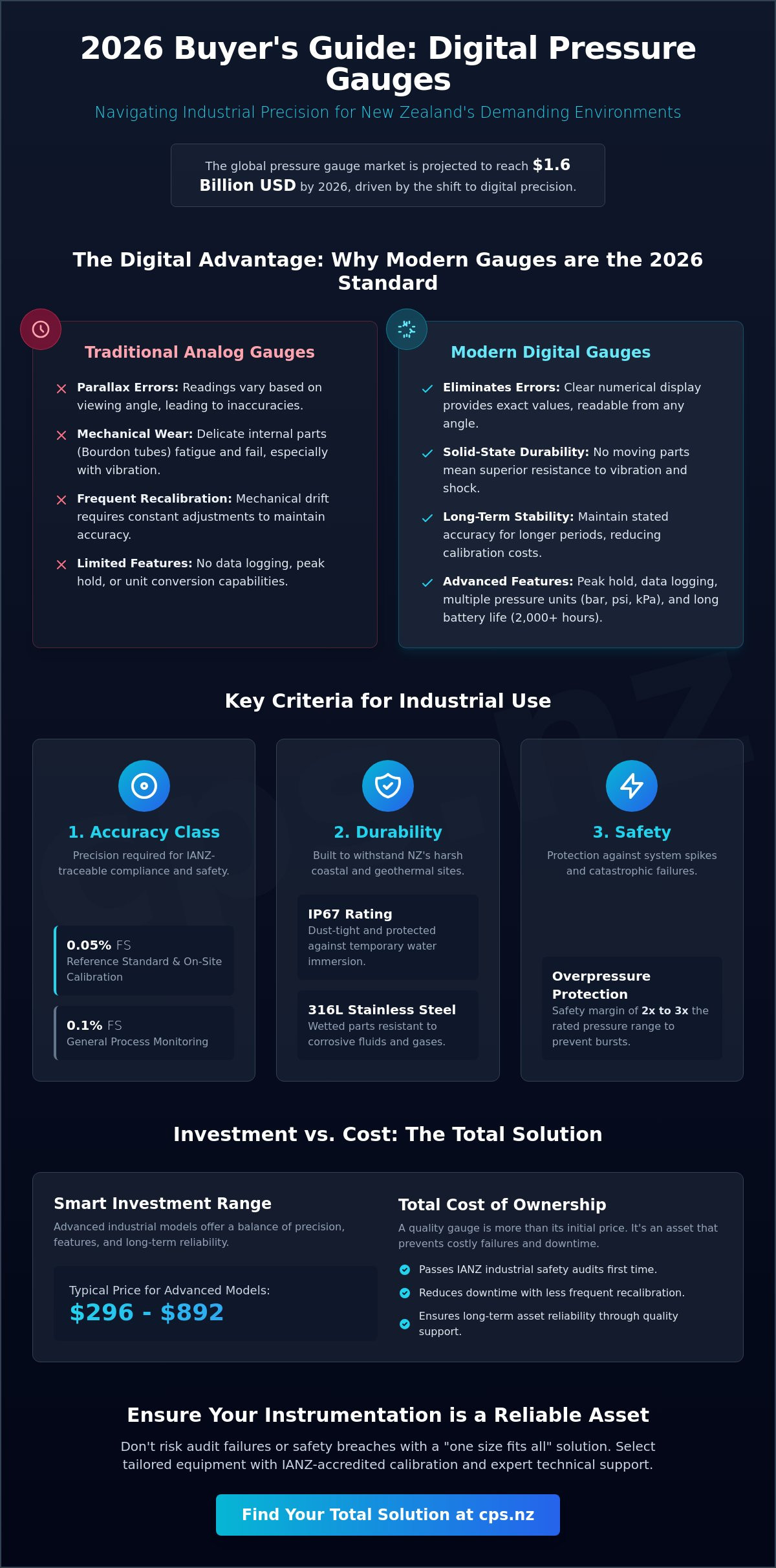
Modern industrial environments demand more than just a rough estimate of system pressure. By 2026, the transition from mechanical Bourdon tubes to high-precision digital instrumentation has become a requirement for regulatory compliance and operational safety. Selecting the best digital pressure gauge for industrial use involves understanding why these tools have surpassed their analog predecessors in every measurable category. While analog gauges rely on delicate mechanical linkages that wear over time, digital models utilize solid-state sensors with no moving parts. This design choice significantly enhances durability, especially in high-vibration NZ environments where mechanical needles often fail or lose calibration.
Accuracy is the primary driver of this shift. High-resolution digital displays eliminate parallax errors, which occur when a technician reads an analog dial from an angle. In critical applications, a misreading of even a few psi can lead to equipment damage or safety breaches. Digital gauges provide a clear, numerical value that remains consistent regardless of the observer's position. Understanding the fundamental pressure measurement principles allows engineers to see why solid-state sensors provide superior long-term stability. Furthermore, 2026 models come equipped with advanced features that analog dials simply cannot match, including peak hold functions to capture pressure spikes, integrated data logging for trend analysis, and the ability to switch instantly between units like bar, psi, and kPa.
Precision is the cornerstone of Engineering New Zealand professional standards. Digital gauges support these benchmarks by providing the high-resolution data required for modern preventive maintenance programs. Instead of waiting for a visible leak or failure, technicians use digital precision to identify minute pressure drops that signal internal seal wear or pump fatigue. This proactive approach reduces human error in high-pressure safety environments, ensuring that NZ sites remain compliant with the latest 2026 safety protocols.
While the initial cost of a digital gauge is higher than a basic analog dial, the long-term ROI is undeniable. Reliable digital gauges require less frequent recalibration because their sensors don't suffer from mechanical fatigue. We often see cheap, unbranded imports fail IANZ industrial safety audits because they can't maintain their stated accuracy under real-world stress. Investing in quality instrumentation ensures your equipment passes audits the first time. Modern 2026 models also feature advanced power management, with battery lives often exceeding 2,000 hours, which minimizes maintenance downtime and ensures the gauge is always ready for service.
Finding the best digital pressure gauge for industrial use means looking past the digital screen to the engineering within. Your choice must reflect the specific demands of your application, from the precision of the sensor to the resilience of the housing. In 2026, the global market offers a wide range of options, but only a few meet the rigorous standards required for heavy industrial sectors.
Accuracy classes are the first point of comparison. Following the 2022 ASME B40.100 standard, high-end industrial gauges typically offer accuracy between 0.05% and 0.1% of Full Scale (FS). While a 0.1% rating is often sufficient for general process monitoring, 0.05% is essential if you're using the gauge as a reference standard for on-site calibrations. You'll find that advanced models in the $296 to $892 price range usually provide this higher level of precision along with better long-term stability.
New Zealand's coastal and geothermal sites are notoriously hard on equipment. An IP67 rating is essential to ensure the gauge is dust-tight and protected against moisture or temporary immersion. You should also verify that the wetted parts, typically 316L stainless steel, are compatible with any corrosive fluids or gases in your system. If you don't match the materials to the media, you risk premature sensor failure and costly downtime.
Burst pressure is your final safety net. High-quality gauges include overpressure protection, often up to 2x or 3x the rated range, to prevent catastrophic failure during a system spike. This safety margin is a critical selection criterion that distinguishes professional-grade instrumentation from hobbyist tools. Our experts can guide you to the ideal pressure measurement equipment for your specific operating environment.
An IANZ-accredited gauge provides the legal and technical traceability required for NZ audit compliance. While factory calibration proves the gauge worked when it left the manufacturer, IANZ certification ensures it meets local standards under controlled, verifiable conditions. This process aligns with international NIST calibration standards to guarantee measurement reliability. To maintain measurement integrity, your reference gauge must be at least four times more accurate than the device under test.
Stainless steel housings outperform polycarbonate in coastal NZ industries because they resist salt-air corrosion and physical impacts. Heavy machinery applications also require internal shock and vibration resistance to prevent sensor drift over time. Temperature compensation is another essential feature; it ensures the gauge remains accurate across the -10°C to 50°C range common in local outdoor installations. Without this, ambient temperature swings could cause your readings to fluctuate outside of your required tolerance bands.
Selecting the right equipment requires a balance of technical capability and environmental resilience. Based on our 35 years of industry experience, we've identified the leading models that define the 2026 market. Whether you need a reference standard for your lab or a rugged tool for the field, these selections represent the best digital pressure gauge for industrial use available today. Each model we recommend has been vetted for its ability to maintain accuracy under the specific stresses found on New Zealand work sites.
The Additel 681 Series remains the gold standard for field reliability. It offers accuracy options from 0.1% down to an impressive 0.02% of full scale. For those needing a more cost-effective solution for general monitoring, the Additel 680 Series provides a robust entry point starting around $296. These models include Bluetooth connectivity, which is vital for sites following the updated March 18, 2026 international standards for explosion-protected equipment. If your work involves laboratory-grade precision, the Additel 672 Digital Pressure Calibrator functions as a total reference solution, combining gauge reading with current measurement. We don't just supply the gauge; we provide the total package including the fittings and hoses needed for immediate deployment.
Remote monitoring has seen a massive surge in 2026. Wireless-enabled gauges allow staff to monitor hazardous zones from a safe distance. This reduces exposure to risks and aligns with the 6th Edition ATEX guidelines released in January 2026. We ensure the connectivity and cybersecurity protocols of these devices meet your specific site requirements so you aren't left stranded with incompatible technology. Using the best digital pressure gauge for industrial use means choosing a tool that fits into your wider digital ecosystem.
Technicians across New Zealand favor the 681 for its versatility. It's not just about the 0.05% accuracy; it's about survival. The IP67 rating ensures this is the best pressure gauge for outdoor use in rain-swept dairy farms or coastal energy plants. It features self-contained data logging. This is essential for providing proof of compliance during IANZ audits. You don't need a laptop in the field. The gauge stores the data you need for later analysis.
Cleanroom and HVAC applications require a different level of sensitivity. Standard industrial gauges often lack the resolution for these low-pressure environments. Compound gauges are the solution here. They allow you to measure both pressure and vacuum in a single unit without swapping tools. These specialized instruments are designed to integrate seamlessly with other Fluke precision instruments, ensuring your entire calibration kit maintains a consistent standard of traceability and professional performance.
Applying a one size fits all approach to instrumentation is a primary cause of premature equipment failure. The best digital pressure gauge for industrial use in a climate-controlled laboratory is vastly different from one required on a Taranaki oil rig or a Waikato dairy farm. In 2026, high-risk industries must navigate the 6th Edition ATEX guidelines released in January to ensure their equipment remains compliant. Failure to match the gauge to the specific environmental and regulatory demands of your sector doesn't just risk inaccurate data; it risks the safety of your entire operation.
We recommend consulting with our technical team to develop bespoke calibration equipment setups. With over 35 years of experience, we understand the nuances of local regulations and the physical toll New Zealand's geography takes on sensitive sensors. We don't just sell you a product; we provide a total solution that ensures your instrumentation remains an asset rather than a liability. Choosing the best digital pressure gauge for industrial use requires an expert understanding of how these devices perform under real-world stress.
Hygiene is non-negotiable in the dairy sector. Gauges in these environments must feature sanitary seals and 316L stainless steel wetted parts to withstand aggressive Clean-in-Place (CIP) chemicals and high-pressure washdowns. Accuracy is critical for monitoring pasteurization and sterilization processes, where even a minor deviation can compromise food safety. Digital gauges provide the high-resolution readout necessary to meet these stringent standards without the risk of glass breakage or dial fogging common in traditional mechanical units.
Coastal industries face the constant threat of salt-air corrosion. Protecting your investment requires specialized fluid fittings that resist oxidation and maintain a leak-proof seal. When monitoring hydraulic systems on vessels or port cranes, vibration is a significant factor. A common myth is that digital gauges require glycerine filling to handle vibration. In reality, modern digital sensors use electronic dampening and solid-state technology to provide stable readings where analog needles would bounce uncontrollably. This technology ensures long-term reliability for critical marine infrastructure.
If you're unsure which specifications your site requires, contact our experts for a technical consultation today.
Purchasing the best digital pressure gauge for industrial use is only the first step toward operational excellence. Many businesses fall into the "buy and forget" trap, treating high-precision instrumentation as a static tool rather than a dynamic asset that requires ongoing care. Accuracy isn't a permanent state. Without regular verification in an IANZ accredited lab, even the most expensive digital sensors can drift. This turns a once-reliable gauge into a liability that can lead to safety risks, equipment damage, and failure to meet strict audit requirements.
We focus on the total solution. We don't just ship a box and leave you to figure out the connections. Our approach integrates your gauges into custom-built, "plug and play" calibration kits. These kits are tailored to your specific onsite requirements, ensuring you have everything needed to maintain traceability from day one. By providing technical training and after-sales support, we ensure your team knows how to maximize the value of your investment. Measurement integrity is about more than a single reading; it's about the confidence that your data is correct every time you power on the device.
A gauge is only as effective as the system it's connected to. Ensuring a leak-free environment requires high-quality instrumentation fittings and durable hoses that match your system's pressure rating. In many high-pressure systems, a correctly specified pressure relief valve is a critical companion to your digital gauge. This provides an essential safety layer for both personnel and equipment. We also provide custom carry cases that organize and protect your tools during field work. This prevents physical damage and ensures that all components, from adaptors to seals, are always within reach.
With over 35 years of expertise in the New Zealand market, we've seen how the right support prevents costly downtime. We aren't a company that just imports and sells stuff to make a buck. We've invested heavily in our IANZ accredited labs and world-class reference equipment because we believe in the total package. From supply and initial calibration to onsite installation and long-term support, we are here to ensure you aren't left stranded. Our technicians understand the best digital pressure gauge for industrial use is the one that stays accurate and compliant throughout its entire service life. View our full range of digital pressure gauges to see how we can support your precision requirements.
Choosing the best digital pressure gauge for industrial use requires a shift from viewing instrumentation as a simple purchase to seeing it as a long-term commitment to accuracy. We've explored how solid-state sensors and IP67-rated housings provide the durability needed for New Zealand's dairy and marine sectors. However, the hardware is only one half of the equation. True reliability comes from maintaining IANZ-traceable standards and ensuring your equipment is supported by experts who understand the total package.
As an official Additel and Fluke partner with over 35 years of NZ industry expertise, we don't just supply gauges. We provide the fittings, hoses, and accredited calibration services that keep your site compliant and safe. Our IANZ Accredited Calibration Laboratory is equipped with world-class reference standards to ensure your devices perform as expected under the most demanding conditions. Don't leave your measurement accuracy to chance. Request a Professional Consultation for Your Calibration Needs and let us help you build a solution that stands the test of time. We look forward to supporting your next project with precision and confidence.
Most industrial digital pressure gauges require calibration every 12 months to maintain their accuracy and IANZ traceability. If the gauge is used in a high-vibration environment or as a reference standard for other equipment, you should consider a 6-month interval. Regular verification ensures that your measurements remain within the manufacturer's stated tolerance and meet local safety audit requirements.
You can use a digital gauge for oxygen service only if the manufacturer has specifically cleaned the wetted parts to remove hydrocarbons. Standard gauges often contain residual oils that can cause spontaneous combustion when exposed to high-pressure oxygen. Always look for a certificate of cleanliness and specific Oxygen Service labeling to ensure the unit is safe for your application.
Gauge pressure measures the difference between the system pressure and the local atmospheric pressure, while absolute pressure is measured relative to a perfect vacuum. Differential pressure specifically tracks the difference between two separate pressure ports. Most NZ industrial sites use gauge pressure for standard monitoring, but absolute gauges are necessary for tasks like barometric measurement or altimeter calibration.
Digital pressure gauges are generally more robust than analog models because they lack the delicate mechanical linkages found in Bourdon tube designs. While a mechanical gauge can be permanently damaged by a single vibration spike or drop, a solid-state digital sensor is resistant to shock. However, you must still protect the LCD screen and internal electronics from extreme impacts or moisture ingress.
An IP67 rating is the minimum requirement for a gauge used in an outdoor dairy shed to protect against high-pressure washdowns and heavy rain. This rating ensures the device is dust-tight and can survive temporary immersion in water up to 1 meter deep. Choosing an IP67-rated unit is a key factor when looking for the best digital pressure gauge for industrial use in harsh agricultural settings.
A digital gauge can replace a pressure transmitter if it includes a 4-20 mA or 0-10 V output for integration into a control system. Many modern gauges function as both a local display and a signal source for PLC systems. This dual functionality simplifies your instrumentation layout and provides a visible readout for technicians directly at the measurement point.
Most professional digital gauges include overpressure protection that allows them to withstand 1.5 to 3 times their full-scale range without permanent damage. If you exceed the burst pressure rating, the internal sensor will likely fail or shift out of calibration. Always check the manufacturer's data sheet for the specific overpressure limit to avoid compromising the accuracy of your device.
Choose a battery-powered gauge for portable testing and manual checks where no external power source is available. If you require continuous 24/7 monitoring and data transmission to a central control room, a loop-powered gauge is the correct choice. Selecting the best digital pressure gauge for industrial use depends on whether you need portability or permanent system integration.