


A single degree of inaccuracy in your temperature readings can be the difference between a successful audit and a costly compliance failure that halts your production for days. For professionals operating in New Zealand's demanding industrial sectors, an unreliable instrument is more than a nuisance; it is a liability. You likely already know that a cheap, off the shelf tool often ends up costing more when it fails in a rugged site environment or lacks the necessary certification for your quality management system. At CPS (NZ) Ltd, we've seen how these hidden costs impact a business's bottom line over our 35 years in the instrumentation industry.
This guide helps you select a precision handheld temperature meter NZ that meets local industrial standards and ensures IANZ-traceable accuracy for your operations. We'll show you how to choose a durable meter that arrives ready for professional use, tailored to your exact onsite requirements. You will gain a clear understanding of which probe type fits your specific application, from food processing to heavy manufacturing, and see why the "total solution" approach is the only way to guarantee results you can trust.
• Understand the critical performance differences between RTD, thermocouple, and infrared sensors to select the right technology for your specific accuracy and temperature range requirements.
• Learn how to evaluate a professional handheld temperature meter NZ based on total cost of ownership and ergonomic design to support technicians performing high-volume daily checks.
• Discover why IANZ-accredited calibration is the non-negotiable standard for industrial traceability and how it differs from standard factory certificates of conformity.
• Identify the key distinctions between basic consumer thermometers and industrial-grade instruments that utilize interchangeable probes for versatile site applications.
• Explore the advantages of a "total solution" approach, featuring custom-configured plug-and-play kits that ensure your equipment is ready for immediate, accredited use.
A professional handheld temperature meter NZ businesses use for critical operations is a sophisticated, battery-operated instrument. Unlike basic consumer tools, these meters are engineered for high-accuracy spot-checks in rigorous industrial environments. While a standard thermometer might provide a general reading, an industrial meter offers the precision, repeatability, and durability required for professional engineering and scientific standards. It serves as a primary tool for technicians who cannot afford the risks associated with inaccurate data.
In New Zealand, these instruments play a vital role in quality management systems. Compliance with ISO 9001, HACCP food safety protocols, and MPI (Ministry for Primary Industries) regulations requires more than just a digital readout. It demands equipment that can be calibrated to IANZ standards to ensure full traceability. Many "box-shifting" retailers sell meters as simple commodities, but they often fail to meet the technical needs of NZ industry. They don't provide the after-sales support or the calibration certificates necessary for a site to pass an audit. At CPS, we focus on the total solution, providing equipment that meets specific NZ engineering requirements.
The base unit, or indicator, is the core of the system. It determines the processing speed and resolution, with high-end models offering resolution as fine as 0.01°C. Modern units also include data logging capabilities, allowing users to store thousands of data points for later reporting. Interchangeable probes are equally important. By using different sensors like K-type thermocouples or PT100 RTDs, you can match the meter to the medium, whether it is a corrosive liquid or a high-temperature furnace.
Ruggedisation is another factor that distinguishes professional gear. NZ outdoor and wash-down environments are harsh on electronics. An IP67 rating is often a baseline requirement for dairy and meat processing plants to ensure the meter survives moisture and dust ingress. A meter that fails during a shift because of a few water splashes is a liability, not an asset.
Monitoring critical control points is mandatory for safety compliance. These meters ensure that cooking, cooling, and storage temperatures stay within legal limits.
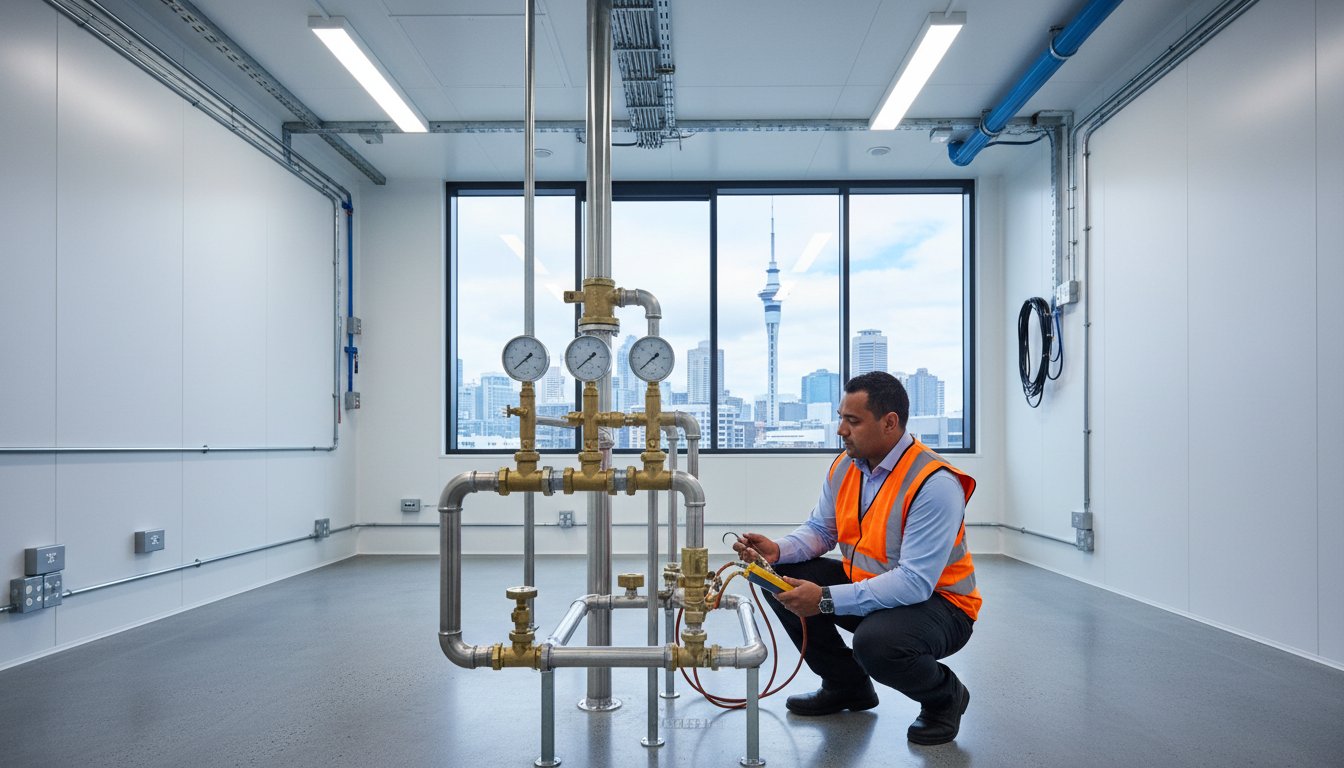
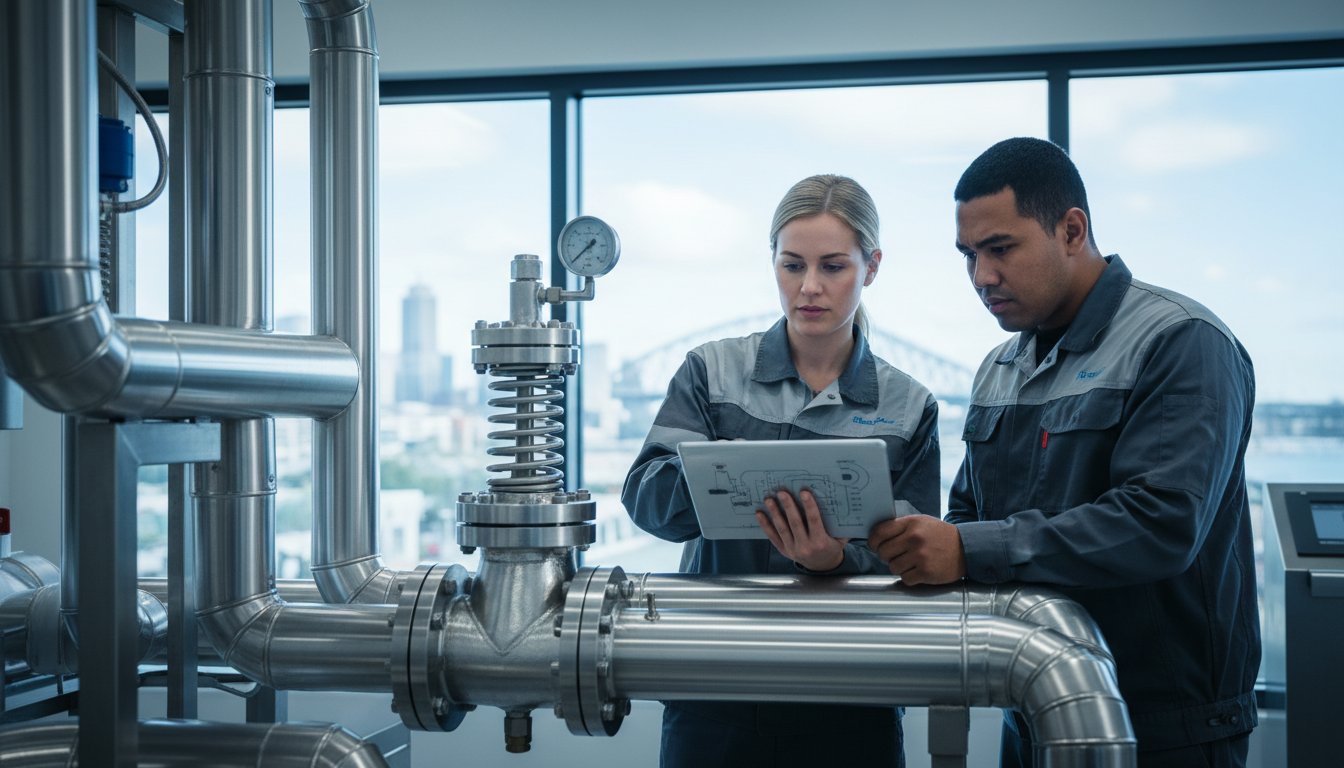
Technicians use a handheld temperature meter NZ wide to balance complex systems and troubleshoot heat exchangers in commercial buildings.
High-precision monitoring is required for climate-sensitive materials. In these settings, even a minor variance can compromise the integrity of a sample or a batch of medicine.
Selecting a handheld temperature meter NZ professionals can rely on requires balancing precision against environmental demands. You're choosing between the stability of an RTD, the rugged speed of a thermocouple, or the non-contact convenience of infrared. Each technology serves a distinct purpose within a facility, and the "total solution" often involves a combination of these tools to ensure both safety and compliance.
RTDs, specifically Platinum Resistance Thermometers (PRTs), utilize the predictable electrical resistance of platinum to measure temperature. They offer the highest stability, maintaining accuracy over years of service without significant drift. In high-accuracy food processing where a 0.5°C deviation can impact safety protocols, RTDs provide the necessary certainty. RTD technology is the gold standard for repeatability in NZ labs. While they're more fragile than other sensors, their precision is unmatched for liquid immersion and stable air temperature monitoring.
Thermocouples are the workhorses of NZ heavy industry. Type K is the standard for general industrial use, while Type T is frequently selected for refrigeration due to its superior accuracy at sub-zero temperatures. These sensors handle extreme environments, such as 1,200°C timber kilns or metal foundries, where other sensors would fail. When comparing RTD vs. Thermocouple, the thermocouple wins on response time; it often provides a stable reading in less than 2 seconds. This speed is vital for fast-moving production lines where technicians must take dozens of readings per hour.
Infrared (IR) thermometers measure thermal radiation, making them essential for scanning electrical busbars or rotating machinery from a safe distance. They're perfect for quick surface scans, but they have physical limitations. You must understand the spot-to-distance ratio; for example, a 12:1 ratio means at a 1.2-meter distance, the meter averages the temperature of a 10cm circle. IR readings are also affected by emissivity, so shiny metals may give false low readings. Because of this, IR should be used for screening, while critical measurements should be verified with a contact probe.
Finding the "sweet spot" for your facility means matching the sensor to your specific workflow. If you're managing a laboratory, precision is your priority. If you're in a high-heat manufacturing plant, durability and range take precedence. If you're unsure which technology fits your specific NZ compliance requirements, the experts at CPS (NZ) Ltd can help you configure a kit that ensures your measurements are accurate and traceable.
Best for labs and food safety (±0.1°C accuracy).
Best for kilns, furnaces, and rapid checks (-200°C to +1,300°C).
Best for moving parts and high-voltage electrical assets.
Choosing a professional handheld temperature meter NZ technicians can rely on requires looking past the initial price tag. We see many businesses purchase low cost units only to find that IANZ calibration requirements and frequent probe failures double the total cost of ownership within the first 12 months. A professional tool is a long term investment in your facility's accuracy and compliance. Our experience since 1985 shows that a high quality meter reduces downtime and prevents the data errors common with inferior equipment.
Ergonomics play a vital role for staff performing 200 or more daily checks in demanding environments like food processing or HVAC maintenance. A meter that's difficult to hold or operate with one hand leads to fatigue and potential drops. For remote site work in rural New Zealand, battery management is a non negotiable factor. Technicians working in the Waikato or Central Otago need units with 500 to 1,000 hours of battery life. We recommend instruments that use standard AA or AAA batteries, ensuring you aren't stranded at a remote pump station with a proprietary dead battery.
Alongside reliable equipment, effective communication is crucial for these remote teams. Ensuring field technicians have robust connectivity for safety and data transmission is another key part of a complete operational toolkit, a specialty of firms like Mobile Systems.
Modern compliance demands digital traceability. Advanced meters now feature data logging and software integration to eliminate manual paper logs. This is essential for ISO 9001 and HACCP reporting, where 100 percent data integrity is the standard. We don't just sell you a device; we provide the total solution including the software and calibration support needed to meet these strict audit requirements.
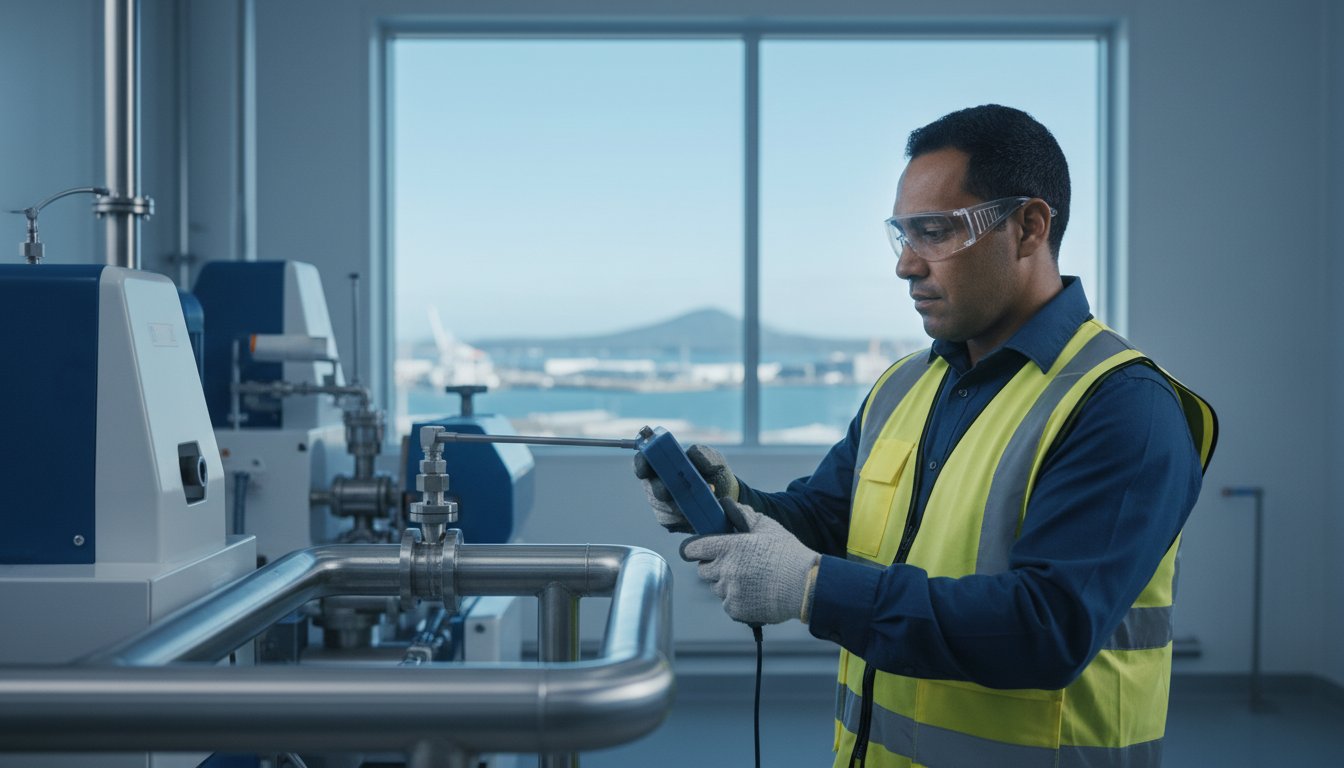
The probe is the most critical component for measurement speed and accuracy. Immersion probes are designed specifically for liquids and gases. Penetration probes are mandatory for food safety to reach internal core temperatures without bending or breaking. For pipework and motors, surface probes using ribbon technology offer significantly faster response times and more accurate readings than standard flat sensors by maximizing the contact area.
Visibility is often overlooked until a technician is in a dark dairy shed or a cramped mechanical room. Backlit LCDs are essential for these conditions. We look for units with Min/Max/Hold functions, which are vital tools for troubleshooting temperature spikes in real time. Dual-channel inputs are another professional requirement, allowing HVAC technicians to measure temperature differentials, known as Delta T, across heat exchangers or cooling coils with a single instrument.
We provide the meter, the custom case, and the IANZ calibration in one package.
Professional units are built to withstand the 1.5-meter drops common in industrial settings.
Every handheld temperature meter NZ professionals use should be backed by a clear calibration history.
Accuracy is the foundation of any professional temperature measurement. For a handheld temperature meter NZ professionals use in food safety, pharmaceuticals, or industrial manufacturing, precision isn't just about the device. It's about the verification behind it. IANZ (International Accreditation New Zealand) is the country's national authority for accreditation. It ensures that the laboratory testing your equipment meets rigorous ISO/IEC 17025 standards.
Many meters arrive with a "Certificate of Conformity" from the factory. Don't confuse this with an IANZ-accredited calibration. A factory certificate often only confirms the device met its original specs at the time of manufacture. In contrast, an IANZ calibration provides a documented, traceable link to international primary standards. This traceability is your legal shield during WorkSafe NZ investigations or food safety audits under the Food Act 2014. If your readings are challenged, an IANZ report provides the objective proof needed to protect your business and your reputation.
Our Auckland-based laboratory utilizes world-class reference equipment to provide the highest level of measurement certainty. We don't just check your meter; we establish a total chain of traceability. This process links your handheld temperature meter NZ directly to international benchmarks. Our technicians have over 35 years of experience handling complex instrumentation and understand the nuances of thermal drift. For a deeper look at how sensor types impact these results, see our Industrial Thermometer Guide.
Most NZ regulations require annual or bi-annual instrument verification to maintain compliance. You should seek recalibration immediately if you notice any of the following:
Readings become inconsistent or slow to stabilize over time.
The meter has been dropped or exposed to extreme moisture.
Your industry standards demand a current, dated certificate for quality assurance.
CPS (NZ) Ltd offers onsite calibration services for large-scale facilities to minimize downtime. We also help you manage your instrument fleet's compliance status by tracking expiry dates and sending proactive reminders. This total solution approach ensures you're never caught with an expired certificate during an unexpected audit.
CPS (NZ) Ltd stands apart from companies that simply import and sell products to make a quick buck. For 35 years, we've built a reputation as New Zealand's leading instrumentation experts. Shipping a handheld temperature meter NZ is only the first step; we don't just move on to the next sale. Our team understands the local regulatory environment and the technical demands of NZ industries, including dairy processing, food safety, and HVAC. Providing the total package means your gear is ready to use the moment it arrives on site. Our deep investment in our own IANZ accredited labs means we verify the performance of the equipment we sell. Precision and traceability are the languages we speak every day.
We combine world-class technology from brands like Additel and Center with our own CPS-verified probes. This creates a plug and play system where every fitting, hose, and accessory is guaranteed to be compatible. You won't find yourself stuck with a meter that doesn't connect to your existing sensors or calibration manifolds. We pack everything into custom-designed carry cases to protect your investment during transport to remote sites. These kits are tailored to your specific site requirements, meaning you get a solution that fits your workflow perfectly. For a broader view of how we select these components, read our Practical Guide to Selecting Calibration Equipment in NZ.
Our technical team operates out of Auckland, providing direct support that overseas retailers can't match. We help you specify the right handheld temperature meter NZ for complex tasks. This ensures you don't overspend on features you don't need or miss out on critical accuracy requirements for IANZ audits. We offer training and guidance on best practices for field measurements, so your staff feel confident using the equipment. If you run into a technical hitch, we're a local phone call away. We won't leave you stranded with a tool you don't know how to use. Our after-sales support is a core part of the CPS value proposition, reflecting our commitment to long-term partnerships rather than one-off transactions. Contact CPS today for a personalised quote on your next temperature measurement solution.
Choosing the right handheld temperature meter NZ professionals rely on involves more than just picking a device off a shelf. You must match the specific sensor technology, like RTD or Thermocouple, to your unique industrial environment. Accuracy isn't optional; it's a requirement backed by IANZ accreditation. At CPS, we've spent over 35 years refining our expertise to ensure you aren't just buying a tool, but a fully calibrated solution. We don't just sell equipment and leave you to figure out the rest. Our IANZ accredited laboratory provides the precise calibration and ongoing support required to maintain peak performance. By choosing a total solution provider, you secure the supply, technical expertise, and traceability your business demands. We're ready to help you upgrade your measurement capabilities with equipment that meets New Zealand's highest standards.
View our range of professional handheld temperature meters and request a quote
Your team deserves the confidence that comes with world-class instrumentation and local support.
High-precision Platinum Resistance Thermometers (PRTs) paired with a high-accuracy handheld temperature meter NZ professionals trust, such as the Additel 273Ex, provide the highest accuracy. These devices offer laboratory-grade performance with accuracies as fine as ±0.01°C. While standard thermocouples work for general tasks, these reference-grade meters are essential for critical process validation where every fraction of a degree affects your compliance or product quality.
Most New Zealand industries require calibration every 12 months to maintain IANZ compliance and operational integrity. High-use meters in harsh environments, such as dairy processing plants or heavy manufacturing, often benefit from a 6 month cycle to catch sensor drift early. You should follow your internal quality management system, which typically dictates an annual check to ensure measurement traceability back to national standards.
You shouldn't use a standard food thermometer for industrial HVAC tasks because they lack the necessary temperature range and probe durability. Food meters typically peak at 300°C, while HVAC applications often require measuring flue gases or steam lines exceeding 600°C. Industrial meters also feature interchangeable Type K or T thermocouple inputs, providing the versatility needed for diverse mechanical systems that a fixed food probe cannot match.
Resistance Temperature Detectors (RTDs) provide superior accuracy and long-term stability, making them the preferred handheld temperature meter NZ technicians use for precision work. Thermocouples offer a much wider temperature range and faster response times, which is ideal for high-heat industrial furnaces. While RTDs are more fragile and expensive, they eliminate the drift issues often seen with thermocouples during prolonged use in sensitive environments.
CPS (NZ) Ltd provides IANZ-accredited calibration services for the vast majority of instrumentation in our catalog through our dedicated laboratory. We've invested over 35 years into building a world-class facility to ensure your equipment meets international standards. Every calibrated meter comes with a full certificate, providing the documented traceability your auditors require. We don't just sell equipment; we provide a total solution including ongoing technical support.
IR thermometers are excellent for non-contact screening, but they aren't sufficient for verifying internal temperatures during a formal food safety audit. They only measure surface temperature, which is often affected by emissivity and packaging. Food safety standards in New Zealand require a calibrated probe thermometer to confirm internal temperatures. Use the IR for quick checks and the probe for your official compliance records.
If your meter fails calibration, our technicians first attempt to adjust the device to bring it back within the manufacturer's specified tolerances. When an adjustment isn't possible, we provide a detailed report and a quote for repair or a replacement unit from our extensive stock. We won't leave you stranded with a non-compliant tool. Our team ensures you understand the "as-found" data to assess any impact on your previous measurements.
CPS provides comprehensive onsite calibration services across Auckland and the wider New Zealand region for clients with large equipment inventories. This service minimizes downtime by eliminating the need to ship your tools to our laboratory. Our mobile technicians bring high-precision reference equipment directly to your facility to perform the checks. It's part of our commitment to being a total package provider for the local industry since our establishment in 1988.