


A single undersized pressure relief valve nz can turn a standard maintenance cycle into a NZ$250,000 emergency shutdown in less than sixty seconds. Many site managers across New Zealand find themselves overwhelmed by the technical nuances of the PECPR regulations and the high stakes of incorrect valve sizing. You likely recognize that a "near miss" is actually a warning sign that your current safety systems need professional validation. We understand that you need more than just a part; you need the assurance that your equipment is calibrated to the highest local standards.
We agree that navigating IANZ accreditation and regulatory audits shouldn't feel like a guessing game. This guide delivers the total solution for mastering technical selection, NZ regulatory compliance, and essential calibration requirements. You'll learn how to align your site with 2026 safety audits and prevent catastrophic overpressure events through precise instrumentation management. We'll walk you through the exact steps to ensure your pressure systems remain compliant, certified, and operational without the risk of unexpected failure.
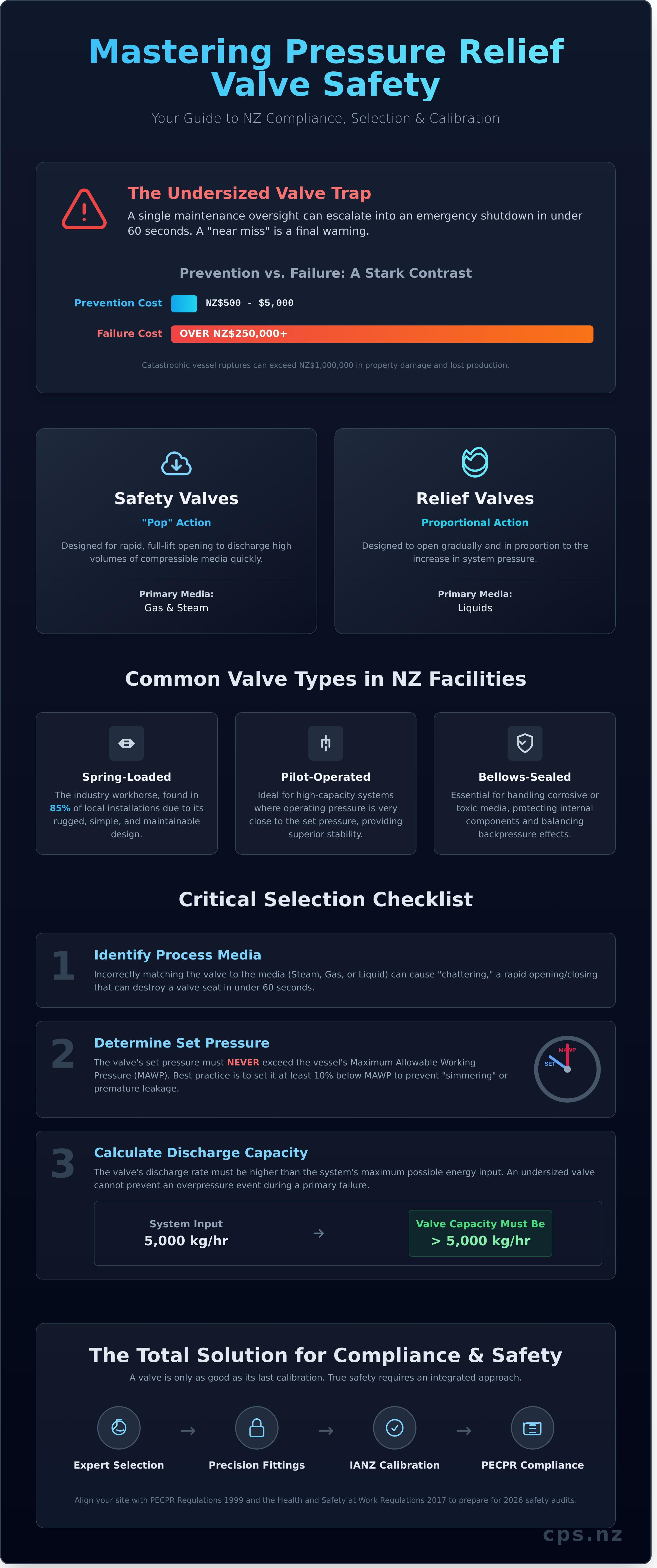
In New Zealand's industrial sector, a pressure relief valve (PRV) serves as the final line of defense. It's the critical component that prevents system overpressure from turning into a disaster. For a pressure relief valve nz technician, understanding the distinction between Safety Valves and Relief Valves is foundational. Safety valves are designed for gas or steam, featuring a "pop" action for rapid pressure release. Relief valves operate on a proportional basis, opening gradually as liquid pressure increases. Mixing these up in a dairy shed or a geothermal plant isn't just a technical error; it's a significant safety risk.
New Zealand industries rely on these devices every day. In dairy processing plants, which contribute roughly NZ$20 billion to the national economy annually, PRVs protect pasteurizers and massive storage tanks. Geothermal power stations in the Central North Island use specialized valves to handle high-temperature brine. HVAC systems in Auckland high-rises and compressed air lines in Canterbury workshops all depend on these mechanical sentinels. Since the Health and Safety at Work (Hazardous Substances) Regulations 2017 took effect, the focus on documented compliance has never been higher.
We don't view a valve as a simple piece of hardware. Our "Total Solution" approach recognizes that a valve is only as good as its last calibration. Hardware quality and IANZ accredited testing are inseparable. You can't just buy a valve and forget it. You need a partner who provides the fittings, the hoses, and the documented traceability to ensure performance when it counts. We don't just sell you a product; we provide the assurance that your system remains within safe operating limits.
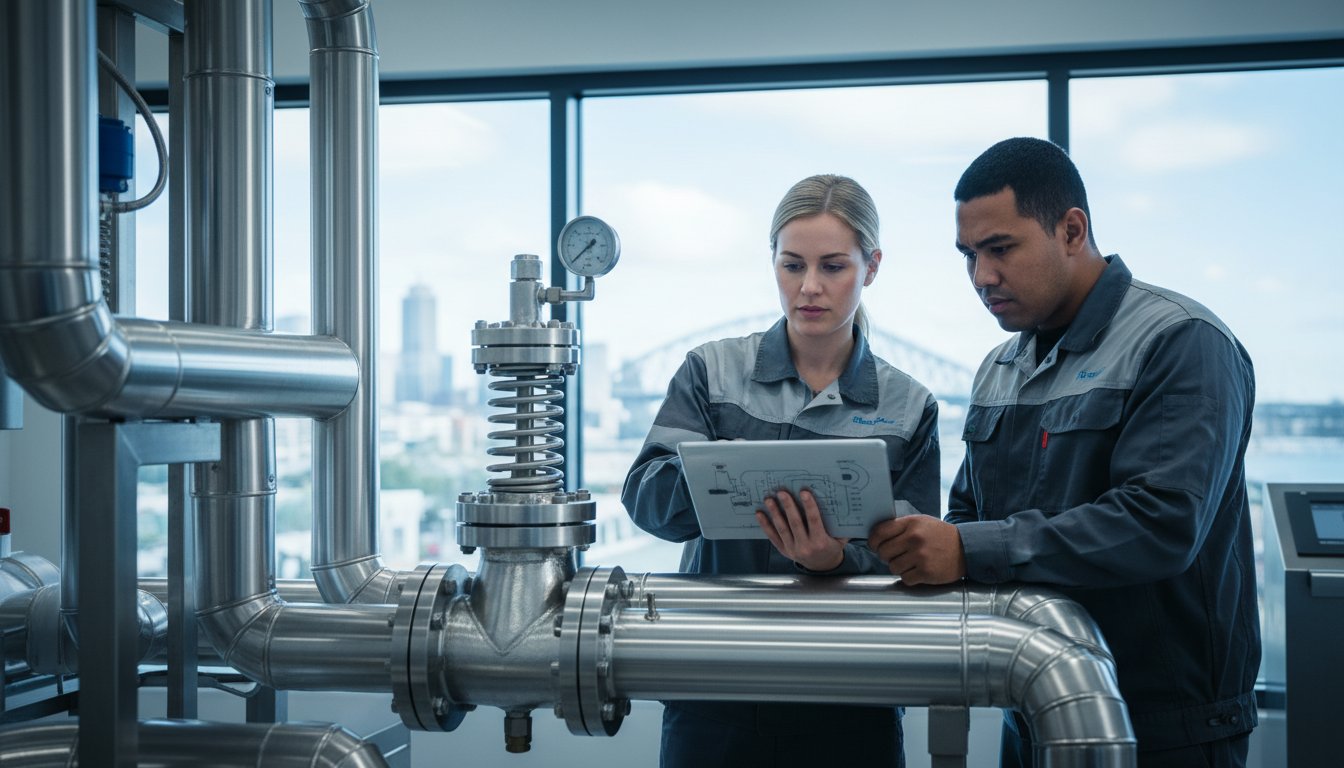
The mechanical trigger of a PRV is a study in reliability. Most units use a spring-loaded mechanism where the spring force keeps the disc closed against the system pressure. When the process pressure exceeds the spring's force, the valve lifts. The cost of failure is staggering. While a high-quality pressure relief valve nz might cost between NZ$500 and NZ$5,000, a catastrophic vessel rupture can result in property damage exceeding NZ$1,000,000 and months of lost production. Set Pressure is the specific PSI or kPa at which the valve begins to lift.
Choosing the right type is only the first step. Proper sizing and selection must account for the specific media, temperature, and required discharge capacity of the New Zealand site. Whether it's a small workshop compressor or a multi-stage steam turbine, the valve must be matched to the potential energy of the system. Reliability is built on this technical precision, backed by decades of local expertise and a commitment to world-class calibration standards.
Selecting a pressure relief valve nz engineers can trust involves more than matching a pipe diameter. You must first identify the process media. Steam, gases, and liquids each behave differently under pressure. Compressible gases require specific trim designs compared to non-compressible liquids to prevent "chattering." This phenomenon can destroy a valve seat in under 60 seconds if the valve is improperly matched to the media type.
Your set pressure must never exceed the Maximum Allowable Working Pressure (MAWP) of the vessel. In New Zealand, the Health and Safety at Work (Hazardous Substances) Regulations 2017 dictate strict adherence to these limits. We recommend setting the valve at least 10% below the MAWP. This gap prevents "simmering," where the valve leaks slightly before reaching the full pop pressure. Discharge capacity is equally vital. The valve must vent at a rate higher than the system's maximum energy input. If your boiler produces 5,000 kg of steam per hour, a valve rated for only 4,200 kg won't stop a pressure excursion during a primary failure.
Environmental conditions in regions like Taranaki or the Auckland coast introduce high salt spray and humidity. These factors accelerate atmospheric corrosion. For these coastal sites, 316 stainless steel is the standard choice over brass to prevent component seizure. Since 1985, we've observed that local temperature extremes, ranging from -10°C in Central Otago to 35°C in Northland, also impact spring tension and seal elasticity. We don't just sell you a valve and leave you to figure out the environmental variables; we ensure the build matches your specific NZ location.
New Zealand industries typically use British Standard Pipe (BSP) threads, but US-made machinery often arrives with National Pipe Thread (NPT) fittings. Mixing these is a significant safety risk. A 1/2 inch NPT male fitting will partially thread into a 1/2 inch BSP female socket, but it won't seal correctly under high pressure. You also need to look beyond the "line size." A 50mm pipe might only require a "G" orifice valve to meet safety standards. Using the API 526 "D" through "T" orifice designations ensures your valve provides the correct flow area regardless of the physical inlet size.
Choosing between brass and stainless steel depends on the chemical nature of your media. For potable water or inert gases, brass is cost-effective. However, for corrosive chemicals or high-temperature steam above 200°C, stainless steel is mandatory. Soft seats using Viton or Teflon offer superior leak-tightness for gas applications. Metal-to-metal seats are required for extreme heat. Many older NZ plants still utilize legacy Ajax valves. While these were robust, finding replacement parts is difficult in 2024. Upgrading to modern equivalents ensures you can maintain IANZ Accredited Calibration standards for your annual safety audits. If you're unsure which trim suits your setup, our team provides a total solution for valve selection and technical support.
Compliance isn't a suggestion in New Zealand; it's a legal mandate. The Health and Safety in Employment (Pressure Equipment, Cranes, and Passenger Ropeways) Regulations 1999, commonly known as PECPR, dictates every aspect of how you manage a pressure relief valve nz. These regulations apply to any person who designs, manufactures, sells, or operates pressure equipment. If your system operates above 50 kPa, you fall under this umbrella. Failing to meet these standards doesn't just risk a mechanical failure. It invites WorkSafe NZ intervention, potential prosecution, and massive liability for your company directors.
The PECPR framework relies on two critical figures: the "Competent Person" and the "Inspector." A Competent Person is someone with the specific knowledge and training to perform maintenance or basic testing. However, they don't have the final say on statutory compliance. That role belongs to an independent Inspector, who must be employed by an accredited inspection body. This Inspector verifies that your pressure relief valve nz is fit for service and that your entire safety chain is robust. We see many businesses struggle because they confuse these roles, leading to gaps in their safety audits.
Your documentation is your shield against liability. You must maintain a comprehensive folder for every valve, containing manufacturer certificates, material test reports (MTRs), and commissioning records. Without a clear paper trail, an Inspector cannot certify your equipment. This isn't just bureaucracy. It's about ensuring that the valve sitting on your vessel matches the design specifications required for that specific hazard level. If you can't prove the valve's origin or its set pressure history, it's effectively a paperweight in the eyes of the law.
In New Zealand, inspection intervals aren't arbitrary. They follow AS/NZS 3788, which categorizes equipment by hazard levels from A to E. High-hazard Level A equipment requires much more frequent intervention than Level E. You must understand that a "factory set" label isn't the same as a "certified test" in a local lab. Valves can drift during international shipping or sit in a warehouse for months before installation. Because of this, many NZ plants require a verification test on a calibrated bench before the valve is ever commissioned. This ensures the valve lifts at the exact pressure your process demands.
Every valve must have a legible nameplate. This plate is the DNA of your safety system, listing the serial number, set pressure, and flow capacity. If a nameplate is painted over or corroded, the valve loses its traceability and must be replaced or re-certified. CPS (NZ) Ltd helps you manage this through a dedicated valve registry, ensuring you never miss a testing deadline. CPS (NZ) Ltd relies on IANZ Accreditation as the gold standard for measurement traceability. This accreditation means our testing equipment is linked back to primary national standards, giving you total confidence during a WorkSafe NZ audit. We don't just supply a part; we provide a total solution that keeps your plant legal and your people safe.
Maintaining these records is a full-time job. Our team manages the scheduling, testing, and documentation for hundreds of sites across the country. We ensure your registry is always up to date, so when an Inspector walks through your door, you have every report ready. This proactive approach prevents the 15% to 20% downtime often caused by last-minute compliance scrambles.
The constant pressure to manage such meticulous details can be demanding for anyone. For professionals who also navigate challenges with executive function, like those with ADHD, this aspect of the job can be particularly stressful. If you're looking for support in this area, you can check out Collins Psychology.
Testing your pressure relief valve nz isn't just a maintenance task; it's a fundamental safety requirement under the Health and Safety at Work (Pressure Equipment, Cranes, and Passenger Ropeways) Regulations 1999. At CPS, we follow a rigorous five-step process to ensure every valve leaving our facility performs exactly when required. Reliability is the only metric that matters when a system overpressurises.
IANZ is the sole authority in New Zealand responsible for ensuring that measurements are traceable to international standards. Choosing a non-accredited tester might save a few dollars today, but it exposes your business to massive legal liability under the Health and Safety at Work Act 2015. IANZ accreditation proves the laboratory has the technical competence and equipment to perform the test accurately. Without this, your test results lack the legal weight required for high-risk pressure systems.
While some valves can be tested on the vessel, workshop calibration at our Auckland lab remains the gold standard for precision. In-situ testing often lacks the controlled environment needed for high-accuracy adjustments. Our workshop uses world-class reference equipment that eliminates external variables like vibration or temperature fluctuations. CPS understands that downtime costs money. We've optimized our workflow to provide a 48-hour turnaround for critical safety valves, ensuring your plant remains operational without compromising on safety. We don't just test; we provide the total solution to keep your site compliant. Your pressure relief valve nz deserves the highest level of technical scrutiny available in the country.
Protect your people and your plant by ensuring your safety valves meet New Zealand's strict compliance standards.
Book your IANZ accredited valve calibration todayEstablished in 1988, CPS (NZ) Ltd has spent over 35 years as the technical backbone of New Zealand's instrumentation and calibration sector. We don't operate like standard importers who simply shift boxes to make a buck; we function as a dedicated engineering partner for local industry. When you source a pressure relief valve nz from our Auckland facility, you gain access to a level of technical depth that ensures your plant remains safe, compliant, and efficient. We understand the specific pressures of the NZ market, from dairy processing in the Waikato to heavy manufacturing in South Auckland.
Our "Total Solution" approach distinguishes us from competitors. Most suppliers stop at the sale. We don't. We provide the fittings, specify the correct hoses, and perform the high-precision calibration required for immediate site integration. This end-to-end service eliminates the common headache of receiving a valve only to realize you lack the specialized connectors or the certification needed for your safety audit. Our investment in world-leading Additel calibration technology allows us to provide reference-level accuracy that many smaller shops simply cannot match. This technology ensures that your set points are exact, reducing the risk of premature "simmering" or total valve failure.
We believe in technical transparency. Our team doesn't just hand over a piece of hardware; we provide the data and the documentation that backs up its performance. This commitment to quality is why we maintain long-standing relationships with NZ's largest industrial players. We prioritize reliability because we know that in high-pressure environments, there is no room for "near enough."
Safety is a system, not a single component. We specialize in integrating high-accuracy Pressure Gauges with your relief valves to provide real-time visual monitoring of your system's health. This allows your operators to spot pressure spikes before the relief valve is ever forced to lift. To further support your site, we offer custom "Plug and Play" kits. These valves arrive fully assembled, calibrated, and packed in custom cases, ready for immediate installation. We also provide technical support to help your team identify the subtle signs of a failing valve, such as seat leakage or spring fatigue, before they become critical issues.
Don't wait for a safety inspection to find a gap in your documentation. Our Auckland-based experts are ready to review your current setup and provide a detailed quote for equipment that meets modern NZ standards. The CPS promise is simple: we won't leave you stranded with uncertified or incompatible gear. Every piece of equipment we supply is backed by our local technical support and decades of calibration expertise. Whether you need a single replacement or a full plant upgrade, we provide the confidence that your pressure systems are protected by the best in the business. Request a Quote for Pressure Relief Valves and Calibration today to secure your site.
Maintaining industrial safety in 2026 requires more than just hardware; it demands a rigorous adherence to New Zealand's PECPR regulations. Choosing the correct pressure relief valve nz isn't just about the initial purchase. It's about ensuring your systems are protected by equipment that matches your specific operational pressures and flow rates. Inaccurate calibration can lead to costly downtime or safety breaches that compromise your entire site. We've seen how precise IANZ accredited testing provides the necessary traceability to satisfy WorkSafe inspectors and protect your team.
CPS (NZ) Ltd has spent over 35 years building a reputation as a total solution provider. We don't just sell components. We operate IANZ Accredited Pressure and Temperature Labs to ensure every valve performs exactly when it's needed. Our team provides the technical support, fittings, and calibration kits that keep your operations running without interruption. Don't leave your site's safety to chance or unverified suppliers who lack local expertise and merely import products to make a quick profit.
Contact NZ’s Leading Experts for Relief Valve Supply & Calibration today to secure your facility. We're ready to help you navigate the complexities of pressure safety with confidence.
In New Zealand, you must test pressure relief valves every 12 to 24 months according to the AS/NZS 3788:2006 standard for pressure equipment. While some low-risk systems allow for a 5 year interval, most industrial steam or air applications require annual verification to maintain compliance. We recommend checking your specific equipment's design life and service history to determine the exact frequency required for your site.
A pressure relief valve is a safety device that opens to prevent over-pressurisation, while a pressure reducing valve is a control device that maintains a constant downstream pressure. You use a relief valve to protect your plant and personnel from catastrophic failure. Conversely, a reducing valve ensures your tools or processes receive a steady, lower pressure than the main supply line regardless of inlet fluctuations.
You shouldn't adjust the set pressure yourself because it requires specialised calibration equipment and validation by a competent person to ensure accuracy. Any unauthorised adjustment to a pressure relief valve nz based system voids the existing certification and could lead to system failure. We perform these adjustments in our IANZ accredited laboratory to ensure the valve opens precisely at the required limit every time.
Simmer refers to the audible or visible escape of fluid just before the valve reaches its set pressure, whereas a pop action is the sudden, full opening of the valve. Most liquid service valves exhibit a simmer characteristic starting at 90% of the set pressure. In contrast, safety valves designed for steam or gas are engineered to pop open instantly to provide immediate, high-volume pressure relief.
Your valve is likely weeping because the operating pressure is too close to the set pressure or there's debris trapped on the valve seat. For a standard metal-seated valve, you should maintain an operating margin of at least 10% or 70 kPa below the set point. If the leakage persists at lower pressures, the internal seals or seats are likely damaged and require professional resurfacing or replacement.
While the law requires verification by a competent person, an IANZ certificate provides the highest level of traceability and legal protection for your business. Over 85% of New Zealand industrial sites insist on IANZ certification to satisfy WorkSafe inspectors and insurance requirements. We provide these certificates as part of our total solution, ensuring your documentation is audit-ready and meets all local regulatory standards.
You need to provide the required set pressure, the type of media, the operating temperature, and the required flow capacity. It's also vital to specify the inlet and outlet connection sizes, such as a 25mm BSP or flanged fitting. Having the original manufacturer's nameplate data helps us supply the exact pressure relief valve nz requirements for your specific application without any guesswork.
If a relief valve fails to open, the internal pressure will continue to rise until the weakest point in the system ruptures. This can lead to catastrophic vessel failure, which has caused significant industrial accidents and equipment loss globally. Regular testing prevents "stiction," where the valve internals bond together due to corrosion or mineral buildup, ensuring the valve functions during an over-pressure event.