


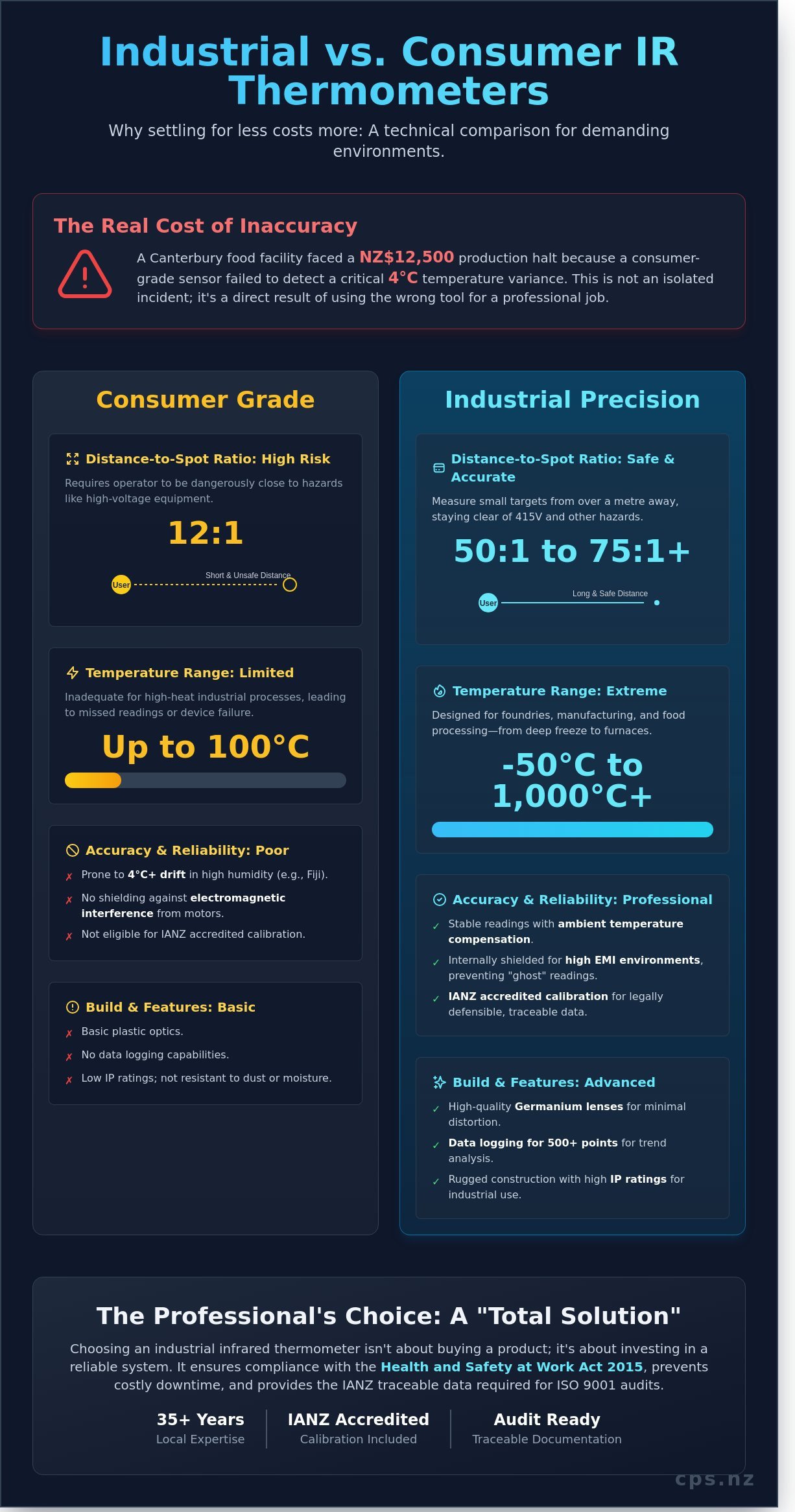
Last Tuesday, a food processing facility in Canterbury faced a NZ$12,500 production halt because a consumer-grade sensor failed to detect a 4-degree variance on a stainless steel line. It's a frustrating but common reality. Using a basic infrared thermometer for demanding industrial applications often leads to inconsistent readings and failed audits that compromise your bottom line. You already understand that precision is the backbone of your operational safety. However, the technical gap between a tool that merely displays a number and one that provides IANZ-traceable accuracy is often wider than most operators realize.
We're here to help you bridge that gap. This guide will teach you how to master the science of non-contact temperature measurement and show you exactly how to select, calibrate, and deploy industrial-grade tools for maximum accuracy. We'll break down the critical role of emissivity for different materials and provide a professional framework for reducing downtime through superior thermal monitoring. You'll gain the confidence to ensure your facility remains compliant with IANZ or local regulations while maintaining the high standards your clients expect from a leader in the field.
• Understand the critical engineering differences between consumer "point-and-shoot" devices and industrial-grade precision instruments designed for New Zealand’s demanding environments.
• Master the technical nuances of emissivity and distance-to-spot ratios to ensure your infrared thermometer provides consistent, repeatable data across diverse material surfaces.
• Evaluate a comprehensive framework for selecting high-performance instrumentation based on ruggedness, IP ratings, and the specific operational needs of the NZ and Fiji industrial sectors.
• Learn how to leverage over 35 years of local expertise and IANZ accredited calibration to move beyond simple product sourcing toward a reliable "total solution" for your facility.
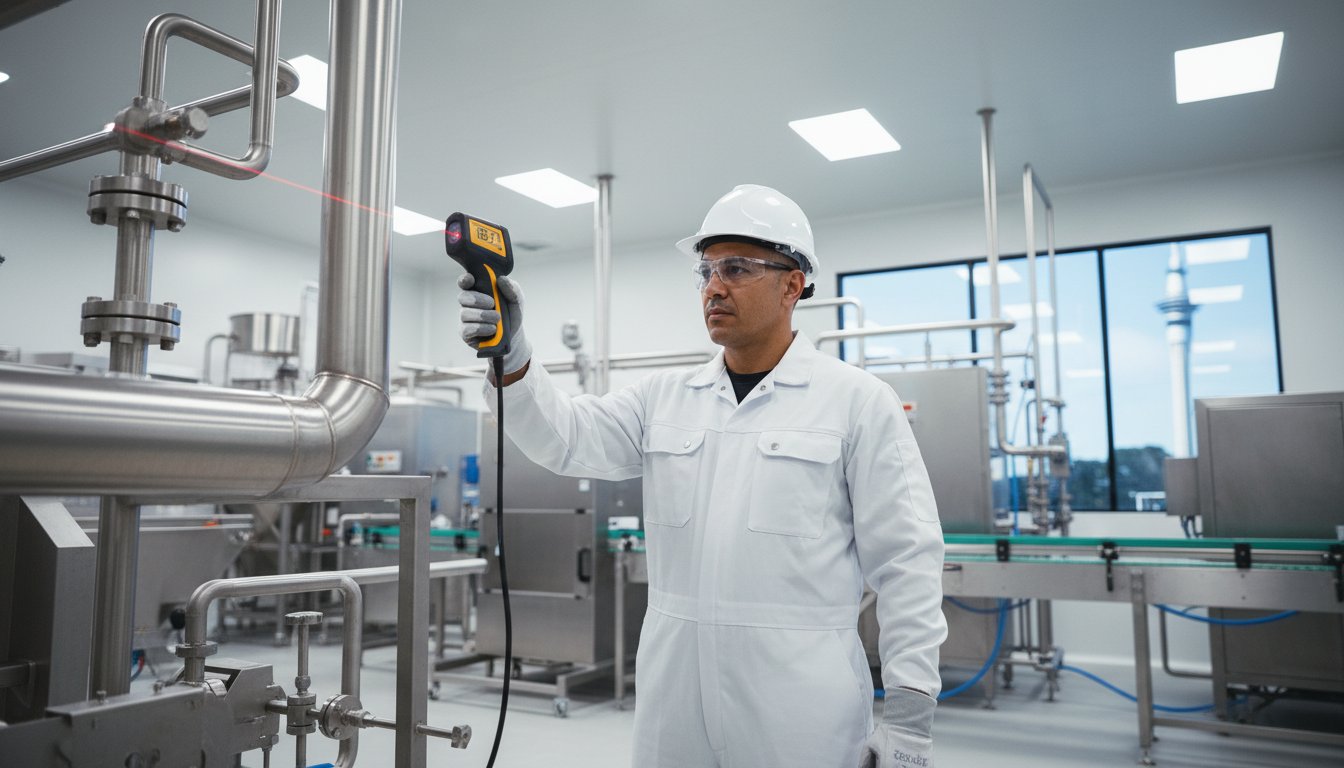
An industrial What is an Industrial Infrared Thermometer is a non-contact bolometer that measures the thermal radiation emitted by a surface. While many people became familiar with "point-and-shoot" retail thermometers during the 2020 pandemic, those consumer models are inadequate for professional environments. A retail unit typically has a 12:1 distance-to-spot ratio, which forces a technician to stand dangerously close to high-voltage equipment. In contrast, a professional infrared thermometer often features a 50:1 or 75:1 ratio. This allows an inspector to accurately measure a 20mm hotspot from over a metre away, staying well clear of 415V electrical hazards or moving conveyor parts.
Medical or DIY thermometers fail in high-heat environments because they aren't designed for extreme temperature spans. A consumer device might only read up to 60°C or 100°C, whereas industrial-grade sensors regularly measure from -50°C to over 1,000°C. Using a cheap tool in a Fiji sugar mill or a New Zealand manufacturing plant leads to "ghost" readings. These inaccuracies happen because consumer-grade internal sensors lack the shielding required to resist electromagnetic interference from heavy motors and transformers. When accuracy is the difference between a routine check and a catastrophic fire, retail gadgets are a liability.
High-level precision starts with the optical system. Professional units use high-quality glass or germanium lenses to focus infrared energy onto the detector with minimal distortion. The detector, often a thermopile, converts this thermal energy into a micro-voltage electrical signal. Advanced processing electronics then apply emissivity corrections and ambient temperature compensation in milliseconds. Unlike basic models, these professional tools include data logging for 500 or more points and min/max features. This allows for long-term trend analysis rather than just a single, isolated snapshot of a machine's temperature.
In New Zealand, the Health and Safety at Work Act 2015 requires businesses to use reliable equipment to prevent workplace accidents. For electrical inspections, this means using tools that provide verifiable data. In Fiji's food processing and sugar industries, the tropical climate presents a unique challenge. High humidity and ambient temperatures exceeding 30°C cause "cheap" sensors to drift by as much as 4°C during a single shift. This drift can lead to spoiled food batches or missed mechanical friction in bearings. We've seen cases where a $60 uncalibrated sensor led to a $25,000 equipment failure because it couldn't handle the tropical heat.
At CPS (NZ) Ltd, we provide a "Total Solution" that bridges the gap between hardware and compliance. This means your infrared thermometer doesn't just arrive in a box; it comes as a complete package with IANZ accredited calibration. We've been the leading experts for over 35 years, ensuring that every tool we supply meets international traceability standards. We don't just sell you a device and leave you stranded. We provide the fittings, the rugged carry cases, and the certified documentation required for ISO 9001 audits. This comprehensive approach ensures your measurements are legally defensible and technically sound from day one.
Every object with a temperature above absolute zero emits infrared energy as part of the electromagnetic spectrum. This energy sits between visible light and radio waves. An infrared thermometer works by collecting this emitted radiation through a lens and focusing it onto a detector called a thermopile. The device converts this thermal energy into an electrical signal, which is then displayed as a temperature reading. Understanding The Science of Accuracy requires looking past the digital display to the physics of the surface being measured.
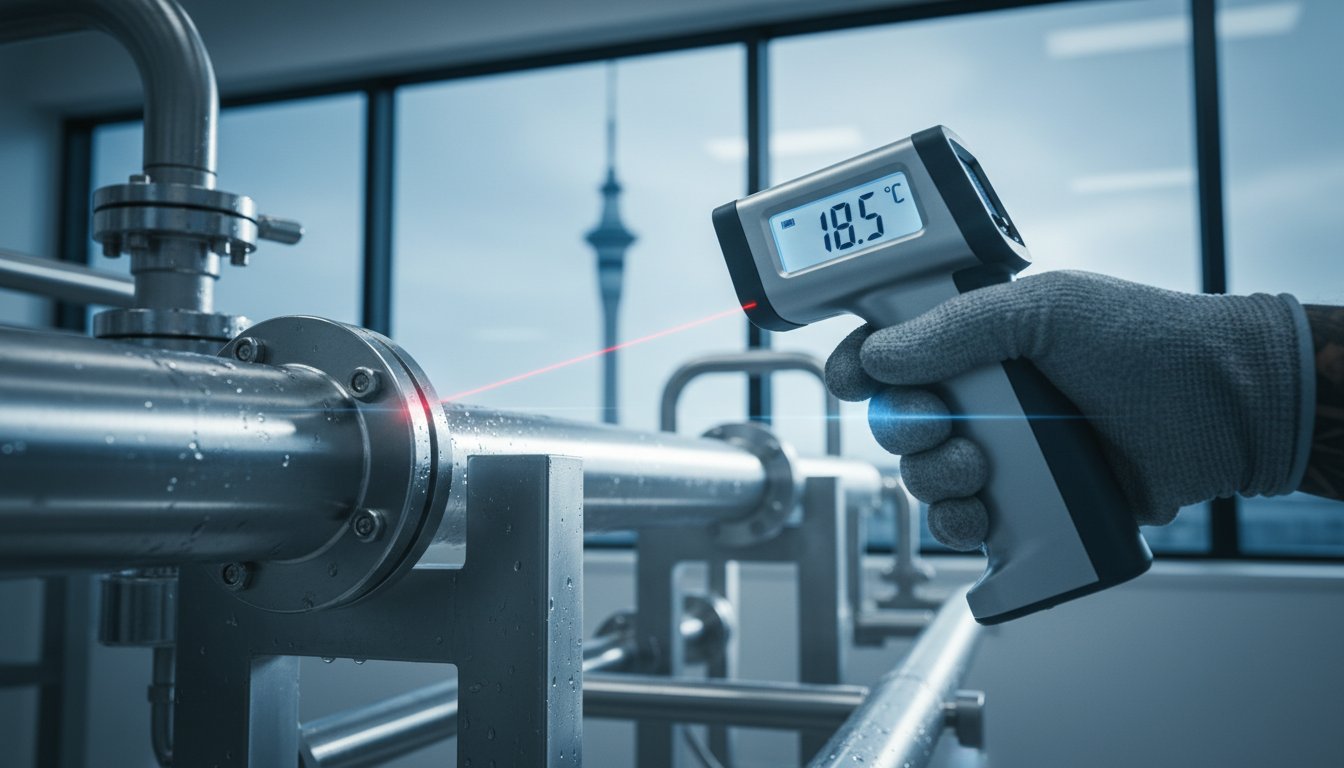
Emissivity, denoted by the Greek letter epsilon (ε), represents a material's effectiveness in emitting energy as thermal radiation. It's a ratio ranging from 0.0 to 1.0. A "perfect" blackbody has an emissivity of 1.0, while highly reflective surfaces have much lower values. If you attempt to measure a polished stainless steel tank with a fixed-emissivity tool, your data will be significantly flawed. The sensor picks up reflected ambient heat rather than the actual surface temperature. This leads to dangerous errors in industrial environments where precision is non-negotiable.
Distance-to-Spot (D:S) ratios define the size of the measurement area relative to the distance from the target. Think of it as a cone of vision. If the spot size is larger than the object you're measuring, the infrared thermometer will average the temperature of the target and the background. This "background noise" often causes technicians to miss critical hot spots in electrical panels or engine components.
Professional grade tools must feature adjustable emissivity to be effective in diverse environments. Standard entry-level sensors are often hard-coded to 0.95, which is suitable for organic materials but fails on the metals common in Fiji shipping or NZ dairy manufacturing. For instance, oxidized copper has an emissivity of approximately 0.65, while polished stainless steel can be as low as 0.10. Our calibration experts recommend using the "Electrical Tape Trick" for high-accuracy requirements on shiny surfaces. By applying a piece of black electrical tape (ε 0.95) to the metal and allowing it to reach thermal equilibrium, you create a reliable target for your sensor.
The D:S ratio is a fundamental specification that dictates how far you can stand from a target while maintaining data integrity. A standard 12:1 ratio means that at a distance of 120cm, the sensor measures a spot 10cm in diameter. In contrast, a high-precision 50:1 ratio allows you to measure that same 10cm spot from 5 metres away. This is vital for safety when monitoring high-voltage transformers or moving machinery. You must remember that laser pointers are only for aiming. The actual measurement area is a circle around or adjacent to the laser dot. If your target is a 20mm pipe and your measurement spot is 50mm, your reading is essentially useless for technical reporting.
Best for close-range electrical maintenance and food safety checks.
Essential for high-temperature kilns, boilers, and distant overhead lines.
Only suitable for rubber, wood, cloth, and matte painted surfaces.
Required for all professional maritime and heavy industrial applications.
At CPS (NZ) Ltd, we've spent over 35 years ensuring that New Zealand and Pacific industries don't just "import and sell stuff," but actually understand the technical nuances of their equipment. We provide the total solution, including IANZ accredited calibration, to ensure your thermal data stands up to international standards.
Choosing the right tool requires looking past the initial NZ$60 price tag of a retail device. In professional Fiji environments, the "total solution" involves evaluating equipment based on its ability to perform under pressure. A budget infrared thermometer designed for home use lacks the internal component shielding and high-grade optics required for heavy industrial zones. We evaluate tool quality through a framework of response speed, environmental sealing, and thermal stability. While a consumer device might take over 1,000 milliseconds to provide a reading, industrial-grade sensors deliver results in under 250 milliseconds. This speed is critical when measuring moving parts or scanning large electrical panels where heat signatures change rapidly.
This principle of selecting professional-grade equipment over consumer models is true in many specialized fields. For example, just as industrial thermometers provide critical data for safety, leading facility managers use professional people counting systems to gather analytics on customer flow and occupancy. Major suppliers like Footfall Australia offer these specialized solutions, which are far more reliable than basic, consumer-level counters.
Data logging is another major separator. Professional units store thousands of data points for trend analysis, whereas retail tools offer a simple "point and shoot" display. To truly grasp why these differences exist, it is useful to understand how infrared thermometers work regarding the distance-to-spot ratio and sensor sensitivity. High-end tools allow for adjustable emissivity, which is vital for accurate readings on the varied metallic surfaces found in Fiji’s manufacturing plants. Without this adjustment, your readings could be off by as much as 20 percent, leading to missed faults or unnecessary shutdowns.
Fiji’s industrial sites present a unique challenge with humidity levels often exceeding 80 percent and ambient temperatures hitting 35°C. Consumer electronics frequently suffer from "fogging" or internal corrosion in these conditions. Our industrial range features IP65 or IP67 ratings, ensuring the infrared thermometer remains dust-tight and water-resistant. These tools are built with reinforced ABS plastic and rubber overmoulding to survive 3-meter drops onto concrete floors. Battery life is also prioritised; professional units use high-capacity cells designed for 12-hour shifts, whereas cheap alternatives often fail after just two hours of continuous use in the field.
In preventative maintenance, repeatability is more important than a single accurate reading. You need to know that if you measure the same bearing three times, you will get the exact same result. Industrial tools provide a repeatability of +/- 0.5 percent, while retail tools often drift by several degrees between scans. This inconsistency makes it impossible to track the slow degradation of equipment over time. Furthermore, retail tools are usually non-adjustable "black boxes" that cannot be calibrated to national standards. This creates a significant liability for companies following ISO protocols or safety regulations.
The hidden cost of using non-calibrated tools is the risk of catastrophic equipment failure due to inaccurate data. We provide Accredited Calibration Services that offer IANZ-certified peace of mind for New Zealand and Pacific businesses. Our 35 years of experience ensures that your instrumentation is not just "close enough" but traceable to international standards. We don't just sell you a device and leave you stranded; we provide the total package, including the certifications required to satisfy auditors and safety inspectors. Investing in a traceable, professional-grade tool ensures your maintenance team makes decisions based on facts rather than hardware-store guesswork.
Selecting the right infrared thermometer requires more than a glance at a spec sheet. In the South Pacific, industrial environments face unique challenges, including high humidity in Suva and salt-laden air at shipping ports. These factors demand robust equipment that delivers repeatable results. Whether you are managing a sugar mill or a commercial kitchen, the tool must match the specific thermal characteristics of your environment. We provide the total solution by ensuring your hardware is not just a standalone purchase but a calibrated part of your safety system.
Fiji’s heavy industries, particularly the sugar mills in Lautoka and Labasa, rely on continuous operation. An unexpected motor failure can halt production for days. Technicians use non-contact thermometers to identify "hot spots" in switchboards and motor bearings before they reach a critical failure point. This preventative approach is vital for electrical safety. It allows for inspections without the risk of arc flash exposure that comes with contact-based probes.
For precision work, dual-laser technology is a requirement. When you are scanning a crowded electrical cabinet, a single laser only points to the center of the measurement area. Dual lasers show you the exact diameter of the spot being measured. This ensures you are reading the temperature of a specific circuit breaker rather than the background busbar. In HVAC applications, this precision helps in checking duct temperatures and cooling coils across large warehouses in 60 seconds or less.
Maintaining the cold chain in the heat of Lautoka or Suva is a constant battle. Food safety protocols require frequent surface temperature checks during transport and storage. Non-contact measurement is the preferred method here because it eliminates the risk of cross-contamination. You can verify the temperature of incoming stock on a pallet without ever piercing the packaging.
Compliance with HACCP standards requires high levels of accuracy. It isn't enough to have a reading; you need a reading you can prove. For detailed regional requirements, consult our Fiji Guide to Accredited Instrument Calibration. This resource helps you align your equipment with the specific traceability standards required by local inspectors and international export partners. We don't just supply the thermometer; we provide the calibration data that keeps your facility compliant.
The most frequent question we encounter is: "Can I trust this for my safety audit?" Many operators worry that non-contact tools aren't as reliable as traditional probes. This concern usually stems from using uncalibrated equipment or failing to account for emissivity. A professional-grade infrared thermometer is an essential tool for an audit, provided it comes with a current calibration certificate.
At CPS (NZ) Ltd, we've spent over 35 years building a reputation for reliability. We understand that a tool is only as good as the lab that backs it. If your safety audit requires IANZ traceability or equivalent standards, a "shelf-bought" device won't suffice. You need a total package that includes the instrument, the correct fittings, and the accredited certification to prove its accuracy. This level of detail is what separates a professional operation from one that is just guessing.
Don't leave your facility's safety to chance with unverified equipment. Contact our technical team today to secure an accredited calibration solution for your industry.
Success in Fiji’s industrial landscape requires more than just high-end hardware; it demands a partnership built on technical certainty. Since 1988, CPS (NZ) Ltd has served as the authoritative voice in instrumentation across New Zealand and the Pacific. We don't just import and sell products to make a quick profit. We've spent over 35 years investing in the infrastructure and expertise required to support every tool we provide. This commitment ensures that when you purchase an infrared thermometer, you're receiving a verified instrument backed by decades of engineering experience. We provide the total package, ensuring your equipment performs correctly from day one.
Buying a device off the shelf doesn't guarantee accuracy. Every professional infrared thermometer should undergo calibration before its first use to account for drift or manufacturing variances. At CPS, our IANZ accredited laboratory represents the gold standard in New Zealand. We don't settle for basic checks. Our technicians verify accuracy across at least three specific temperature points tailored to your operational range. This process provides the traceability and documentation essential for meeting ISO 9001 standards and passing strict industry audits in Fiji’s food and energy sectors.
Our calibration process involves comparing your device against world-class reference equipment. We provide a comprehensive certificate that details the exact performance of your sensor. This data is critical for quality control managers who need to prove their thermal monitoring systems are reliable. We remove the guesswork, ensuring your readings are consistent whether you're measuring a cold storage unit at -20°C or a high-voltage electrical transformer at 150°C. Our lab's accreditation means your results are internationally recognised and legally defensible.
We pride ourselves on being a technical resource, not just a warehouse. Our Auckland-based team provides direct support for our Fiji clients, ensuring that distance never compromises service quality. If a piece of equipment fails or requires re-adjustment, you're talking to experts who understand the physics of the measurement, not a call center agent reading a script. We offer a total solution that includes everything from the initial supply and custom fittings to staff training and scheduled re-calibration cycles. We won't leave you stranded with a tool you don't know how to use.
Our approach is grounded in the belief that instrumentation is an investment in safety and efficiency. We provide the hoses, the custom carry cases, and the technical advice that turns a simple tool into a complete monitoring system. This end-to-end service model is why 92% of our major industrial clients have remained with us for over a decade. We're here to ensure your operations remain compliant and your data remains beyond reproach. To see how we can support your specific requirements, Explore our range of Hand Held Meters and Calibration Services today.
Precision in temperature measurement isn't just about the hardware; it's about the technical support and calibration that back it up. Selecting the right industrial infrared thermometer requires a deep understanding of emissivity and distance-to-spot ratios to ensure your data is reliable in demanding New Zealand environments. We've seen too many businesses settle for consumer-grade tools that fail when accuracy is non-negotiable. At CPS (NZ) Ltd, we provide more than just equipment. We deliver a total solution backed by our IANZ Accredited Laboratory and 35+ years of industry expertise. Whether you're managing a plant in Auckland or a facility in Fiji, you need instrumentation that's ready for immediate use. We don't just sell products; we provide comprehensive after-sales support and training so your team stays confident. Don't leave your critical measurements to chance with a supplier that just imports and sells. Partner with a team that's invested in your long-term success. Get the Total Solution for Your Temperature Measurement Needs. Your facility deserves the reliability that only seasoned experts can provide.
Infrared thermometers provide surface accuracy within plus or minus 1.0% to 2.0% of the reading, whereas a calibrated probe thermometer can achieve higher precision within 0.1 degrees Celsius. It's important to remember that an infrared thermometer only measures the surface temperature of an object. For food safety or liquid processing in Fiji, you'll still require a probe to verify the internal core temperature of the product.
No, an infrared thermometer cannot measure the temperature of air or transparent gases because the sensor requires a solid surface to reflect thermal radiation. The device will simply pass through the gas and measure the temperature of the first solid object it encounters, such as a wall or machinery. If you need to monitor ambient conditions in a Suva warehouse, we recommend using a dedicated digital hygrometer or a calibrated ambient probe.
Emissivity is a value between 0.0 and 1.0 that represents how effectively a surface emits thermal energy. It matters because shiny or reflective materials like polished stainless steel have low emissivity and can reflect the heat of surrounding objects into the sensor. This often results in a false reading. Most organic materials have a fixed emissivity of 0.95, but for industrial applications, you'll need an instrument with adjustable settings to get the total solution for accuracy.
The maximum distance depends on the distance-to-spot (D:S) ratio of your specific device, such as a common 12:1 or 50:1 rating. A 12:1 ratio means that at a distance of 120 centimeters, the thermometer measures a circular area with a diameter of 10 centimeters. If you stand too far away, the measurement spot becomes too large and averages the temperature of the background. This leads to data errors that can compromise your quality control processes.
Yes, your infrared thermometer must undergo professional calibration every 12 months to maintain IANZ traceability and ensure measurement integrity. Over time, optical lenses can become clouded and internal sensors can drift by more than 2 degrees Celsius. Our laboratory has provided these essential services for over 35 years, ensuring your equipment meets the rigorous standards required for Fiji's export markets and local regulations.
You shouldn't use an industrial unit for human medical screening because they're designed for a broad temperature range with a typical error margin of plus or minus 2 degrees Celsius. This margin is far too wide to detect a fever accurately. Medical thermometers are specifically calibrated for the narrow 32 to 42 degree Celsius range. Using the wrong tool can lead to dangerous misdiagnoses in a workplace health and safety environment.
A single laser identifies the approximate center of the measurement area, while a dual laser system highlights the actual outer edges of the spot being measured. This distinction is vital because the dual laser shows you exactly what surface area is contributing to the temperature reading. It's a superior choice for technicians who need to avoid measuring the background when checking small components in crowded electrical cabinets or the complex engine bays worked on by performance tuning shops like ANTZ Performance.
High humidity levels, often exceeding 80% in tropical regions like Fiji, can interfere with infrared energy as it travels through the air to the sensor. Water vapor and heavy condensation can scatter the signal, which often results in a reading that's lower than the actual surface temperature. To maintain accuracy, you should keep the lens clean and dry while performing measurements at the shortest safe distance possible to minimize atmospheric interference.