



A single uncalibrated pressure sensor can cost a Fiji-based manufacturing plant upwards of NZ$18,400 in rejected exports and emergency maintenance during a single 12-hour shift. You likely recognize that relying on "near enough" measurements is no longer a viable strategy as we head into 2026. It’s frustrating to face the constant uncertainty of whether your local standards will satisfy a rigorous international auditor or if a sudden equipment failure will compromise your operational safety.
Securing IANZ accreditation through CPS (NZ) Ltd provides the technical certainty and global compliance you need to compete on the world stage. This article explains how IANZ-certified calibration ensures your equipment remains accurate, safe, and ready for any audit without the stress of unexpected failures. We’ll examine the specific benefits for Fiji’s industrial sectors and why choosing a seasoned expert for your total calibration solution is the most reliable way to protect your margins and your reputation.
• Gain a competitive edge by understanding how ianz accreditation grants your Fiji-based business global recognition through the ILAC MRA.
• Identify the technical requirements of ISO/IEC 17025 and why traceability to the International System of Units (SI) is non-negotiable for industrial safety.
• Learn to distinguish between 'traceable' and 'accredited' calibration to avoid common compliance pitfalls that could compromise your operational integrity.
• Discover how to implement a robust, risk-based calibration schedule tailored to the specific environmental conditions in Suva and Lautoka.
• Explore the benefits of a total solution approach by leveraging CPS’s 35+ years of expertise and their specialized IANZ-accredited laboratories.
IANZ (International Accreditation New Zealand) serves as the national authority for the independent, third-party evaluation of testing and calibration laboratories. For a Fiji business, this isn't just a badge of honour; it's a critical requirement for operating in regulated markets. While many regional providers offer basic "checks," ianz accreditation signifies that a facility has undergone a rigorous assessment of its entire technical operation. This includes the qualifications of the staff, the suitability of the environment, and the validity of the measurement methods used. We've seen instances where unaccredited services resulted in measurement errors exceeding 12%, leading to costly production downtime and rejected export shipments.
It's vital to understand that this process accredits the competence of the lab, not just the equipment. You can buy the most expensive pressure calibrator in the world, but if the technician doesn't account for ambient temperature or gravitational corrections, the result is unreliable. IANZ ensures the lab has a robust quality system and the technical expertise to produce accurate data. This level of certainty is what separates a professional calibration from a simple equipment comparison. At CPS (NZ) Ltd, we've invested decades into maintaining these standards because we know our Pacific clients rely on our results to protect their infrastructure and their reputations.
Fiji's primary export sectors, including sugar, fisheries, and aviation, face strict international scrutiny. To enter the EU, US, or Australian markets, your technical data must be beyond reproach. The ILAC Mutual Recognition Arrangement (MRA) ensures that technical data generated by an IANZ-accredited facility is recognised as equivalent across 104 signatory economies, providing the essential 'traceability' required for Fiji's trade expansion by 2026. This global recognition means a Fiji exporter doesn't need to pay for expensive re-testing in Brisbane or Auckland. Using ianz accreditation effectively removes technical barriers to trade and slashes the commercial risk of having goods seized or rejected at a foreign border.
Alongside ensuring export compliance, many Fijian businesses also protect their supply chain by verifying goods sourced from Asia. Services from firms like The Inspection Company can be crucial for factory audits and pre-shipment inspections, preventing costly issues with imported materials.
The relationship between New Zealand's metrology framework and Fiji's industrial sector is built on proximity and decades of shared history. NZ standards are globally respected for their rigour, and the geographical closeness allows for faster turnaround times compared to European or North American labs. Since CPS (NZ) Ltd was established over 35 years ago, we've focused on being more than just a supplier; we provide the total solution. Many companies simply import and sell instruments to make a quick buck, but they can't support those tools with accredited service. We've built a legacy of trust with major infrastructure hubs in Suva and Nadi by ensuring their reference equipment is direct-traced to national standards.
Unlike non-accredited services, IANZ labs are audited by technical experts who understand the physics behind the measurement.
NZ's metrology infrastructure is a world leader, giving Fiji businesses a competitive edge in the Pacific Rim.
Choosing NZ-based accreditation means accessing a partner that understands Pacific operating conditions, from high humidity to remote site logistics.
By aligning with NZ-based accreditation, Fiji businesses gain access to a level of technical depth that isn't available from "box-droppers." It's about having a partner who does the fittings, the hoses, and the calibrations, ensuring your equipment arrives ready to work. This commitment to quality is what keeps Fiji's aviation and manufacturing sectors running safely and profitably.
At the heart of every reliable measurement is ISO/IEC 17025:2017. This international standard governs the general requirements for the competence of testing and calibration laboratories. It's the benchmark that separates a basic workshop from a world-class facility. For Fiji businesses, achieving or utilizing ianz accreditation means your data is recognized globally. This isn't just about following a checklist. It's about demonstrating technical proficiency in a way that satisfies the International Accreditation New Zealand (IANZ) assessors, who are often industry peers with decades of specialized experience.
One critical element often misunderstood is the uncertainty of measurement. A simple "pass" or "fail" result doesn't tell the whole story. Every measurement has a degree of doubt based on environmental factors, equipment resolution, and operator skill. IANZ-accredited labs must calculate and report this uncertainty. If your Fiji manufacturing plant operates on tight tolerances, knowing that a pressure reading is 100 psi ± 0.1 psi versus ± 2.0 psi is the difference between a safe batch and a total product recall. We don't just give you a sticker; we provide the data that proves your equipment performs within its required limits.
Traceability is the unbroken chain of comparisons from your Fiji facility back to the International System of Units (SI). If one link breaks, the entire calibration is void. CPS (NZ) Ltd maintains this chain by calibrating our reference equipment against primary standards held by national metrology institutes. We ensure every pressure and temperature device we service for Fiji clients has a documented pedigree. This prevents equipment rejection during 100% of rigorous external audits, as the lineage of every measurement is transparent and verifiable.
Compliance means following a manual; competence means understanding the physics behind the measurement. IANZ-accredited experts undergo stricter training and more frequent assessments than non-accredited technicians. While a standard lab might be checked once every three years, IANZ labs face detailed technical audits every 12 to 24 months. This includes rigorous checks on environmental controls, such as maintaining a stable 20°C (± 1°C) in the lab to prevent thermal expansion from skewing results. You can explore our full range of accredited services to see how this technical depth supports your operations.
The peer-review process is the final safeguard. During an IANZ assessment, technical experts from other accredited facilities scrutinize our methods, staff records, and equipment maintenance logs. They don't just look at the paperwork. They watch our technicians perform calibrations in real-time. This level of scrutiny ensures that when we sign off on a certificate, it carries the weight of international law and scientific integrity. For a Fiji business, this means your exports meet the entry requirements for markets in Australia, New Zealand, and Europe without the need for expensive re-testing. It's a rigorous system that has been refined over the last 35 years to ensure New Zealand's testing infrastructure remains among the best in the world. This culture of constant improvement means we are always looking for ways to tighten our measurement uncertainties and improve our service delivery for the Pacific region. Holding ianz accreditation is a commitment to this level of technical excellence every single day.
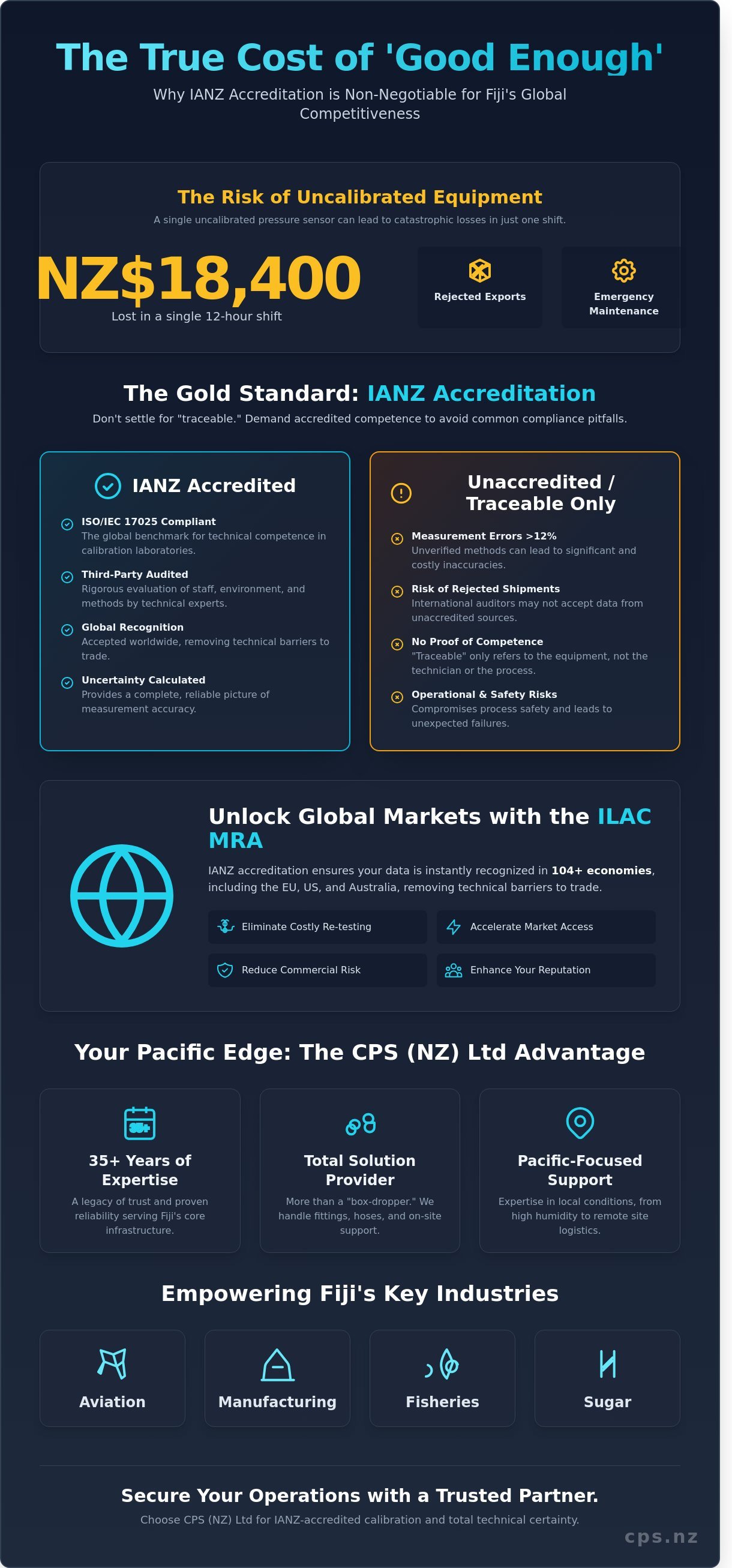
The most common misconception we encounter is the belief that 'traceable' calibration is equivalent to 'accredited' calibration. It's a mistake that can cost a Fiji business thousands in rejected exports or safety fines. Traceability simply means the reference tool used for the job was calibrated at some point. It doesn't verify the competency of the technician, the stability of the laboratory environment, or the validity of the specific method used. In short, traceability is a claim made by the lab; ianz accreditation is a guarantee verified by independent experts.
When you opt for a non-accredited service for critical assets like safety valves or high-pressure gauges, you're accepting a significant blind spot. If a boiler pressure gauge fails and causes an onsite incident, a 'traceable-only' certificate provides little protection during a forensic audit. It lacks the rigorous oversight required to prove the measurement was accurate under controlled conditions. Data from 2023 shows that up to 15% of non-accredited certificates fail to meet basic ISO requirements during external reviews. For high-risk applications, the total solution must include the certainty of an IANZ endorsed report.
You can use traceable-only calibration for non-critical measurements where the data stays internal and has no impact on safety or product quality. If you're monitoring a water tank level that isn't part of a regulated process, an accredited certificate might be overkill. A traceable check is typically 40% cheaper than an accredited one. However, Fiji's primary export industries, such as fish processing or mineral water bottling, can't afford this shortcut. For these sectors, 95% of primary instrumentation must be accredited to satisfy international buyers and regulatory bodies.
An authentic IANZ certificate is more than just a piece of paper; it's a legal document often used to resolve international contract disputes. You must look for the IANZ 'Endorsed' logo accompanied by a unique laboratory number. This logo signifies that the lab's technical competence has been audited against the ISO/IEC 17025 standard. This framework promotes international trade by ensuring your Fiji-based measurements are accepted by customs and quality auditors in over 100 countries through the ILAC Mutual Recognition Arrangement.
Always check the 'Scope of Accreditation' listed on the IANZ website for the specific lab. It's a common trap to assume a lab can calibrate everything just because they have the logo. For instance, a lab might be accredited for digital pressure gauges up to 600 bar but lack the authority for 1000 bar hydraulic systems. We've operated as NZ's leading experts for over 35 years. We know that checking the fine print on the scope is the only way to ensure your equipment is truly compliant. Don't settle for a provider that just imports and sells stuff; ensure they have the ianz accreditation for your specific required range.
Establishing a robust calibration schedule is a technical necessity for any Fiji business seeking to maintain international quality standards. It's not enough to calibrate equipment once and forget about it. You need a living document that accounts for the specific environmental stressors found in Suva’s high humidity or Lautoka’s industrial heat. A well-structured schedule ensures your ianz accreditation remains valid and your production data stays beyond reproach.
Start with a comprehensive audit of your facility. Walk through your production lines and storage areas to identify every device that influences product quality or safety. We've found that 12% of instruments in Fiji food processing plants are often missed during initial audits, particularly secondary pressure gauges on steam lines. Once identified, assign each asset a unique ID. Determine your calibration intervals by evaluating three factors: frequency of use, the criticality of the measurement, and the manufacturer’s recommendations. For high-risk equipment operating 24/7, a 6-month interval is often the baseline to prevent measurement drift.
Effective asset management begins with a master instrument list. This database must include your pressure gauges, digital thermometers, and relief valves. Don't just record the last calibration date; track the 'drift' or the specific deviation from the reference standard over several years. If a sensor consistently moves by 0.5% every year, you can predict its failure point before it impacts your batch quality. This level of detail is exactly what auditors look for when verifying your commitment to ianz accreditation. For more details on reading these technical results, see our Understanding Your Calibration Certificate: A Fiji Guide.
The logistical reality for Fiji businesses often involves a choice between on-site service and shipping to our Auckland laboratory. High-precision reference equipment is sensitive. When shipping from Nadi or Suva, use double-walled corrugated boxes and at least 50mm of high-density foam padding. We recommend using tracked international couriers to minimize time in transit. At CPS, we provide a 'Total Solution' that manages these logistics for you. We coordinate the pickup, the IANZ-accredited calibration in New Zealand, and the return delivery. This streamlined process typically targets a 10 to 14-day turnaround, which is vital for maintaining Fiji production schedules without lengthy downtime.
Documentation is your final hurdle before a regulatory audit. Keep every certificate in a centralized, digital system. Ensure your records show a clear chain of traceability back to national standards. If an auditor asks why a specific thermometer has a 12-month interval instead of 6, your documentation should cite the stable drift history you've recorded. This evidence-based approach proves you're in control of your measurement systems. It transforms calibration from a yearly chore into a strategic advantage for your business operations.
Ready to secure your equipment accuracy with NZ's leading experts? Contact CPS (NZ) Ltd today for a total calibration solution tailored to your Fiji facility.
CPS (NZ) Ltd has spent over 35 years building a reputation as the Pacific’s leading instrumentation experts. We don't just ship products across the water; we provide the technical backbone for industries that can't afford to fail. Our team understands the unique environmental challenges in Fiji, from high humidity to remote site access. This experience ensures that when you choose CPS (NZ) Ltd, you’re partnering with a team that has seen it all and solved it all before. We’ve worked with major utilities, food processors, and aviation firms across the islands, ensuring their systems remain accurate under pressure.
Our Auckland-based laboratories hold full IANZ accreditation specifically for pressure and temperature. This isn't a badge we wear for show. It represents a massive, ongoing investment in high-precision reference equipment and rigorous staff training. For a Fiji business, this means your critical gauges and sensors are verified against international standards by a laboratory that undergoes annual audits. We bridge the gap between New Zealand’s strict regulatory environment and your local operations in Suva, Nadi, or Lautoka.
We’ve built our business on the "Total Package" philosophy. Many competitors act as simple "box shifters" who disappear the moment the invoice is paid. CPS (NZ) Ltd is different. We don't just sell you a high-end digital pressure gauge. We calibrate it in our lab, fit the necessary hoses, and ensure it’s ready for immediate use upon arrival. If you need it installed or your staff trained on how to use a new calibrator, we do that too. It’s a complete end-to-end service designed to keep your facility compliant and your downtime at zero. This approach removes the guesswork for your maintenance teams. You receive a kit that is "plug and play," tailored specifically to your site’s pipework and pressure ranges.
Our labs utilize world-class reference equipment to ensure your measurements are beyond reproach. We supply and support industry-leading brands like Additel, providing them with full certificates that satisfy even the most demanding auditors. Whether you need a simple dial gauge or a complex multi-channel temperature logger, we provide the traceability you need. You can also explore our On-Site Calibration Services in Lautoka & Suva to see how we bring this expertise directly to your doorstep.
We believe in reinvesting. Every year, we pour capital back into the latest calibration technology and specialized training for our technicians. This commitment is why 95% of our long-term clients in the Fiji food and beverage sector report zero issues during their annual quality audits. One lead engineer from a major Suva-based bottling plant recently noted that "CPS (NZ) Ltd didn't just sell us a tool; they gave us a compliance solution that works every single time." We won't leave you stranded with a piece of gear you can't use or an IANZ accreditation certificate that doesn't pass muster.
Ready to secure your compliance? Contact CPS (NZ) Ltd for an IANZ-accredited calibration quote today.
As 2026 approaches, the distinction between simple traceable calibration and full ianz accreditation will define which Fiji businesses lead their industries. Relying on basic checks isn't enough when international compliance and ISO/IEC 17025 standards are on the line. CPS NZ Ltd has spent over 35 years supporting Pacific industry with precise instrumentation and technical expertise. We don't just sell you a tool and walk away. We provide a total solution that includes high-end supply, accredited calibration, and ongoing support from our IANZ Accredited Laboratory.
Choosing a partner with deep roots in the region ensures your equipment meets the most rigorous global benchmarks. We've invested heavily in world-class reference equipment so you don't have to guess about your data accuracy. It's about more than just a certificate; it's about the certainty that your measurements hold up under any audit or international trade requirement. We're ready to help you implement a compliant schedule that keeps your facility running at peak performance. Secure your technical certainty; Contact CPS for IANZ Accredited Calibration today.
Your business deserves the confidence that only decades of specialized experience can provide.
Yes, IANZ accreditation is fully recognized in Fiji through the ILAC Mutual Recognition Arrangement (MRA). This international agreement ensures that calibration certificates issued by IANZ accredited labs in New Zealand are accepted by Fijian regulators and industry bodies as equivalent to local certification. Since both nations are signatories to this arrangement, your equipment remains compliant with global standards like ISO/IEC 17025 without the need for additional local testing.
Most industrial pressure gauges require ianz accreditation testing every 12 months to ensure accuracy and safety. While your specific quality manual might dictate different intervals, a one-year cycle is the standard for 90% of our Pacific clients. High-use instruments or those operating in harsh tropical environments often benefit from 6-month checks to catch drift early. Regular scheduling keeps your data traceable and prevents costly errors during your annual audits.
ISO 9001 focuses on general management systems, while IANZ accreditation specifically confirms the technical competence of a laboratory under ISO/IEC 17025. While different, they work together. A company might have a quality management system certified under ISO 9001, and for this, they might seek guidance from a firm like Align Quality; similarly, for professional financial oversight, you can <visit Cairns Quality Accounting>. However, an ISO 9001 certificate doesn't prove a lab's measurements are accurate. For that, IANZ endorsement is required, meaning our technicians, methods, and reference equipment have passed rigorous technical assessments to ensure your readings are precise every time.
Yes, CPS provides on-site IANZ accredited calibration services across Fiji for a wide range of pressure and temperature instruments. We bring our high-precision reference equipment directly to your facility in Suva, Nadi, or Lautoka to minimize your operational downtime. This total solution approach means you don't have to ship heavy or sensitive gear overseas. Our technicians handle the entire process from setup to final certification right on your factory floor.
A typical turnaround for gear sent from Suva to our Auckland lab is 7 to 10 working days. This timeframe includes 3 days for international transit and 4 days for our technicians to perform the calibration and generate your formal reports. We offer expedited services for critical shutdowns if you need a faster return. Because we're a total package provider, we manage the logistics to ensure your gear returns to Fiji as quickly as possible.
An IANZ certificate carries a higher price because it reflects a significant investment in high-level traceability and rigorous external auditing. Standard reports often lack the documented proof of measurement uncertainty required by international export standards. You're paying for the assurance that your measurements are backed by NZ$500,000 worth of reference equipment and a laboratory that meets strict ISO/IEC 17025 requirements. It's a vital investment in risk mitigation for your business.
If your equipment fails to meet its specified tolerances, we'll immediately issue an "As Found" report and contact you with the results. Unlike simple resellers who just sell stuff to make a buck, our experts will attempt to adjust or repair the unit to bring it back into spec. If the instrument is beyond repair, we'll provide a quote for a high-quality replacement from our extensive stock. We don't just report the failure; we provide the solution to get you back online.
You don't need ianz accreditation for every single thermometer, only for those used at critical control points (CCPs) or for regulatory auditing. Most Fiji facilities find that 20% of their instruments require full IANZ endorsement to satisfy food safety or export regulations. The remaining 80% can often be managed with standard traceable calibrations to save costs. We help you identify which sensors are vital for your compliance so you don't overspend on unnecessary certifications.