


With 36 reported cases of listeriosis in 2024 resulting in 100% hospitalization rates, the margin for error in New Zealand's food safety sector is non-existent. You're likely aware that maintaining a Food Control Plan is more than a regulatory hurdle; it's the foundation of your brand's reputation. However, the anxiety of an impending MPI audit or the prospect of operational downtime while instruments are away for testing can make compliance feel like a burden. Precision in food industry temperature calibration NZ is the only way to bridge the gap between regulatory requirements and actual food safety.
This 2026 guide provides the expert technical insights required to ensure your business aligns perfectly with the Food Act 2014 and HACCP standards. We'll clarify the distinction between IANZ-accredited and non-accredited certificates while showing you how to maintain the ±1°C accuracy mandated by New Zealand Food Safety. You'll learn how to select high-precision equipment and utilize on-site calibration services to keep your production lines moving without compromising on safety or compliance. By the end of this article, you'll have a clear roadmap for achieving full compliance with minimal disruption to your daily operations.
• Understand how the Food Act 2014 mandates precise temperature verification to protect your business from audit failures and public health risks.
• Discover the technical advantages of dry block and liquid bath calibration methods for maintaining high-accuracy food probes and sensors.
• Learn how to balance operational efficiency and measurement precision by choosing between accredited laboratory services and convenient on-site calibration.
• Identify the critical features, such as ingress protection and drift resistance, that distinguish high-quality food industry temperature calibration NZ equipment from substandard alternatives.
• Explore the benefits of an "all-in-one" service model from CPS (NZ) Ltd that integrates equipment supply with ongoing maintenance and accredited calibration support.
Food industry temperature calibration NZ is the technical process of comparing a measurement device against a reference instrument of known accuracy. This comparison ensures that the readings on your handheld meters, fixed sensors, or probes remain within the specific tolerances required for food safety. All professional measurements are ultimately traceable back to the International Temperature Scale of 1990 (ITS-90), which provides a universal standard for accuracy. Without this formal verification, your temperature data is merely an estimate. In a high-stakes production environment, estimates don't satisfy the Ministry for Primary Industries (MPI).
The Food Act 2014 provides the legal framework for these requirements. As of 2026, the Food Act Improvement Programme (FAIP) continues to emphasize the need for verifiable data in every Food Control Plan. For businesses handling potentially hazardous food, maintaining a thermometer accurate to within ±1°C isn't optional; it's a mandatory operational standard. While some operators rely on basic "ice point" checks, these don't account for sensor drift across the full operational range. Professional calibration verifies performance across multiple points, ensuring your equipment is reliable whether it's in a blast chiller or a hot holding unit. This level of precision is especially critical for NZ exporters who must prove compliance to international buyers who demand rigorous documentation.
Your Hazard Analysis of Critical Control Points (HACCP) plan dictates the frequency of your calibration schedule. Most plans require a formal calibration every 6 to 12 months to account for the physical wear and tear of daily use in harsh environments. MPI mandates precise temperature logging for any business involved in cool chains or thermal processing. If an auditor discovers inaccurate records or uncalibrated instruments, the consequences range from formal warnings and increased audit frequency to significant financial penalties. Precise monitoring is the only way to prove you've kept food out of the 5°C to 60°C danger zone where bacteria multiply most rapidly.
International Accreditation New Zealand (IANZ) serves as the nation's authority for laboratory competence. When a laboratory holds IANZ accreditation for temperature calibration, it has undergone rigorous independent audits to prove its technical proficiency, equipment accuracy, and staff expertise. These endorsed certificates provide the high-level assurance required by international buyers and local MPI verifiers. IANZ-accredited laboratories provide a formally recognized chain of traceability and a calculated measurement of uncertainty, whereas non-accredited labs often lack the documented rigor to survive a high-stakes audit.
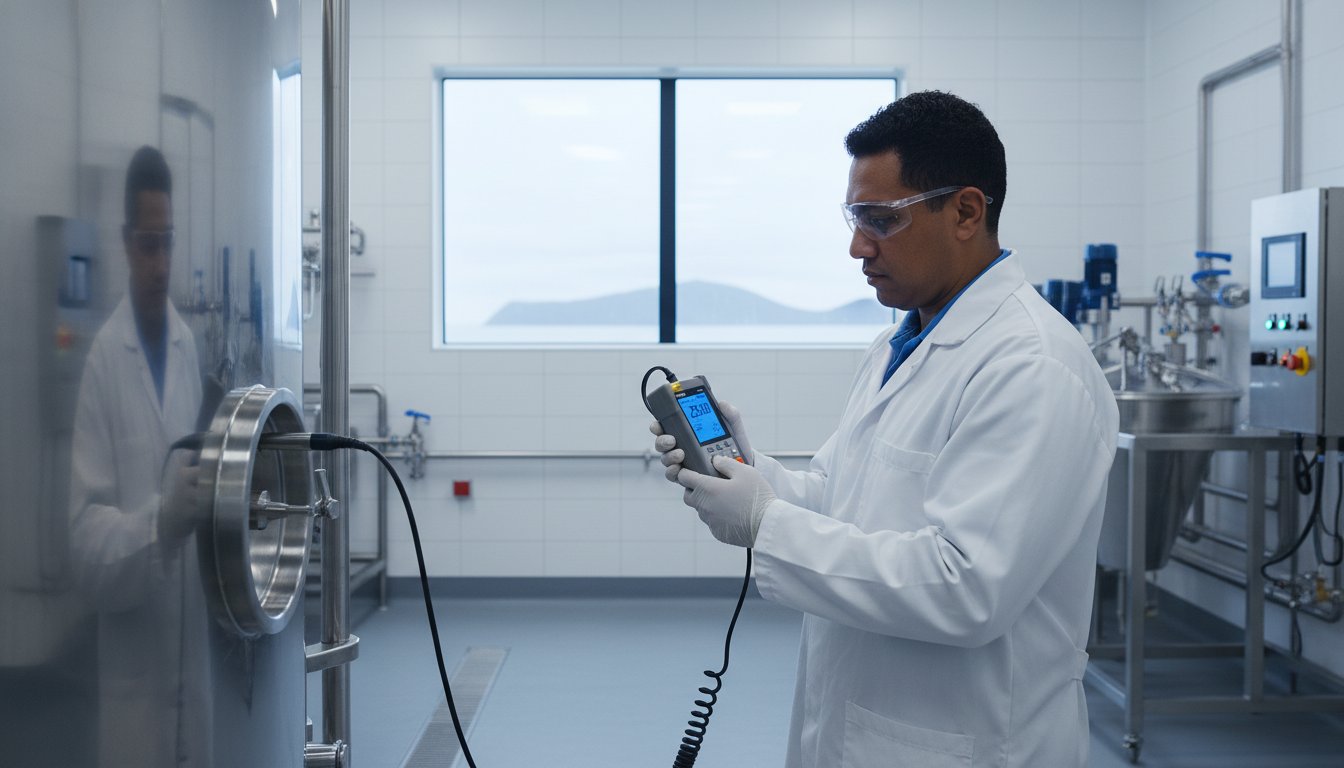
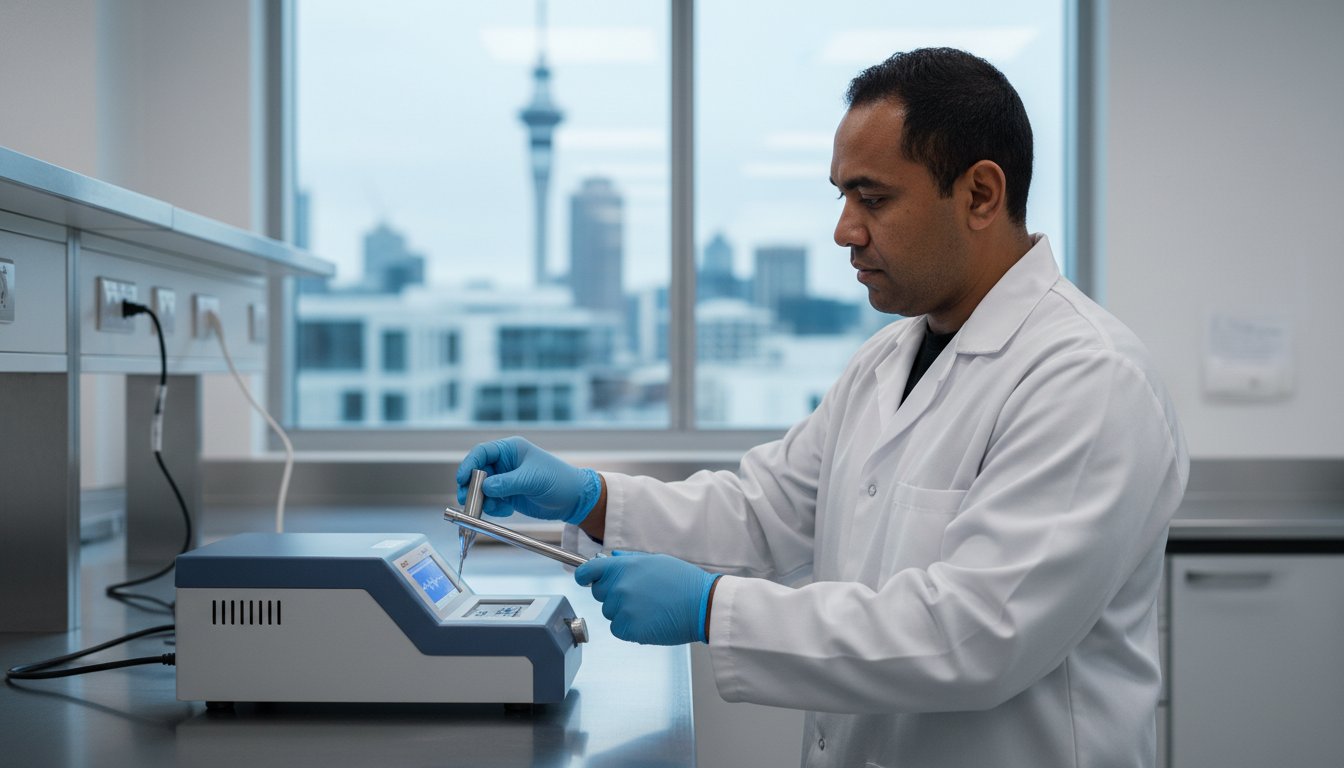
Dry block calibrators are the preferred choice for most food industry temperature calibration NZ requirements. These devices provide a stable, dry environment for verifying the accuracy of food probes and handheld meters. Because they don't use fluids, they eliminate the risk of cross-contamination in sensitive production areas. Dry blocks allow technicians to precisely simulate the high temperatures used in thermal processing or the sub-zero conditions of blast freezing. They're fast, portable, and provide the high-level stability required for IANZ-accredited results.
Liquid bath calibration remains the superior method for oddly shaped sensors or high-volume batches of probes. A stirred liquid bath provides exceptional thermal uniformity, ensuring that every sensor in the batch is exposed to the exact same temperature. This method is often used for Pt100 sensors and thermocouples that don't fit into the standard inserts of a dry block. While baths offer higher precision, they're generally confined to laboratory settings due to the risk of fluid spills in a food-grade environment. If you're managing a large inventory of sensors, you can source professional calibration equipment to maintain these standards in-house.
Traditional field-checking methods like the ice point or boiling point have significant limitations. An ice-point check only verifies a single point on the temperature scale. It doesn't prove that your thermometer is accurate at 75°C for cooking or -18°C for storage. Furthermore, the boiling point of water fluctuates based on local atmospheric pressure and altitude, making it an unreliable reference for high-precision work. Professional calibration utilizes a multi-point approach, typically testing at -20°C, 0°C, and 100°C. This comprehensive testing identifies "drift" or non-linearity in the sensor that a single-point check would miss.
Infrared thermometers present unique challenges because they measure surface emissivity rather than internal heat. Calibration requires a specialized blackbody source, which is a target with a known emissivity and temperature. Surface readings in food retail are prone to errors if the IR gun isn't correctly calibrated for the specific packaging or food type being scanned. In cold storage environments, frost or moisture on the lens can further distort readings. Regular verification against a blackbody source ensures these non-contact tools remain a reliable first line of defense for quick temperature checks.
Effective calibration must treat the entire measurement chain as a single unit. This means calibrating the probe and the handheld meter or data logger together. Verifying Pt100 and thermocouple probes is essential for industrial ovens where temperature consistency is critical for pathogen destruction. For refrigerated transport across New Zealand, data loggers must be verified to ensure they provide an accurate history of the cool chain. Regular verification prevents the "stacking" of errors that occurs when sensors and meters are swapped without a combined calibration certificate.
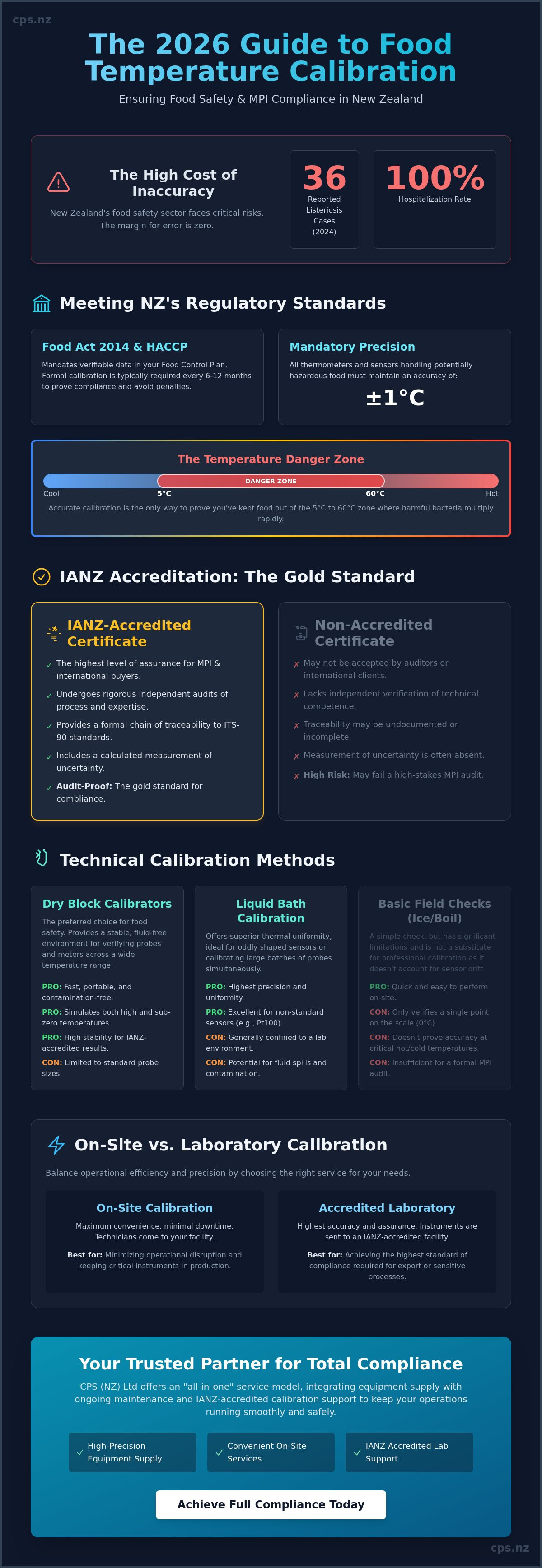
Choosing the optimal location for food industry temperature calibration NZ involves balancing the need for extreme precision against the practicalities of production uptime. Every food business faces a similar dilemma: send instruments to a laboratory and risk logistical delays, or have technicians visit the site to perform verifications in situ. The decision typically hinges on the instrument's role in your Food Control Plan and the specific logistical constraints of your facility.
CPS (NZ) Ltd manages both pathways to provide a seamless service model for Auckland food businesses. Our technicians understand that measurement integrity is the foundation of your food safety framework. We help you determine which instruments require the sterile precision of our laboratory and which are better suited for the rapid, efficient verification of an on-site visit. This dual approach ensures your business meets every MPI requirement while maintaining the highest levels of production efficiency. We focus on providing a comprehensive solution that keeps your facility running and your records audit-ready.
Laboratory calibration remains the preferred choice for high-precision reference thermometers and master gauges. Within a controlled laboratory environment, technicians can eliminate external variables such as air drafts or fluctuating ambient temperatures that might affect sensitive readings. This setting allows for the lowest possible measurement uncertainty. It's also the most efficient option for handheld meters and probes that can be easily shipped without halting production. If you're currently evaluating your hardware needs, our Industrial Thermometer Guide offers detailed insights into selecting instruments that maintain their accuracy during transit.
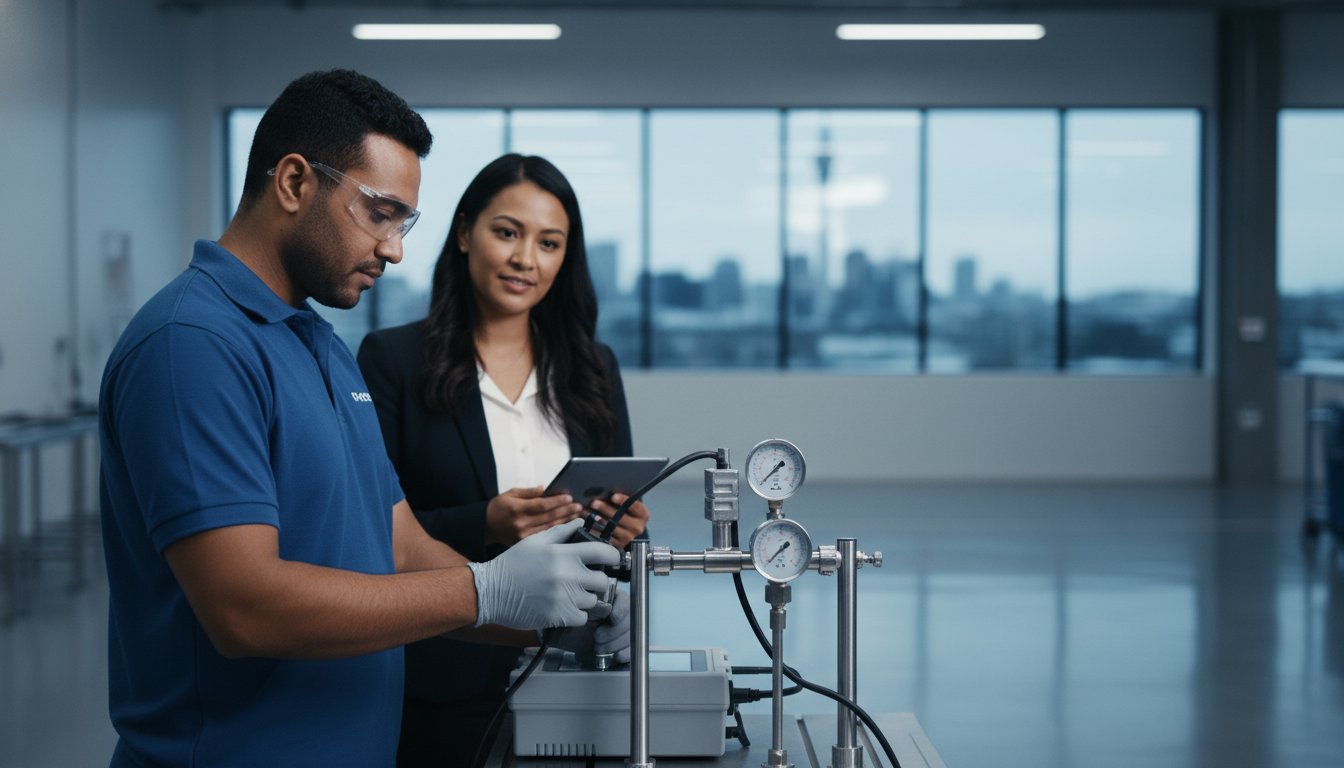
On-site calibration reduces operational friction by bringing accredited verification directly to your production floor. This service is essential for fixed probes in large industrial cookers, pasteurizers, or walk-in chillers that can't be removed without significant infrastructure work. By choosing on-site service, you eliminate shipping costs and the inherent risk of transit damage to delicate sensors. Perhaps the greatest benefit is the immediate feedback. If an instrument is found to be "Out of Tolerance," a technician can often perform adjustments and re-calibration on the spot. This immediate resolution ensures your line remains compliant without the need for a second visit or extended downtime.
Selecting hardware for food industry temperature calibration NZ requires a focus on long-term stability rather than initial purchase price. Low-cost thermometers frequently suffer from "sensor drift," where the accuracy of the device degrades significantly between calibration intervals. If a device drifts outside the mandatory ±1°C tolerance, it can lead to failed MPI audits and compromised food safety. Investing in high-quality instrumentation ensures that your measurements remain reliable throughout the entire 6 to 12-month calibration cycle. This reliability is the technical foundation of a robust Food Control Plan.
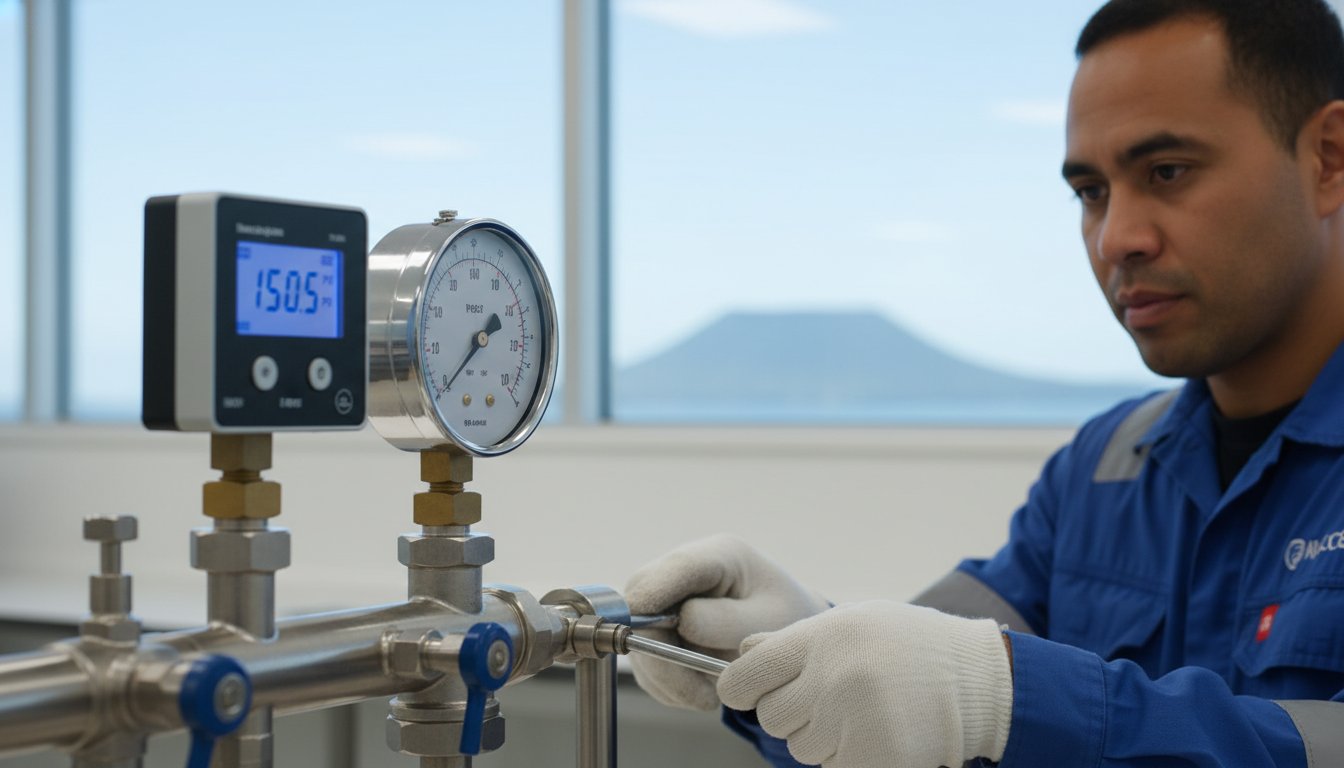
Durability is another critical factor. Equipment used in food production must withstand harsh cleaning protocols. Choosing devices with high Ingress Protection (IP) ratings, such as IP67, is essential for wash-down areas where moisture and chemicals are prevalent. While analog thermometers were once common, digital instrumentation is now the industry standard. Digital meters provide the precision required for modern food safety and allow for the seamless integration of data into automated logging systems. This shift reduces the human error inherent in manual readings and provides a clear, digital audit trail.
Evaluating the long-term cost of ownership is a vital business decision. A cheaper thermometer might appear cost-effective initially. However, if that device requires frequent replacement or fails to hold its calibration, the cumulative cost of ownership far exceeds that of a premium instrument. Professional-grade equipment often features better thermal stability and more robust construction, reducing the risk of unexpected downtime. You can explore our full range of handheld meters and calibration equipment to find the right fit for your specific facility requirements.
Handheld meters are indispensable for spot checks in receiving areas and during dispatch. They allow staff to verify the temperature of incoming goods immediately upon arrival. In contrast, fixed sensors are the backbone of continuous monitoring systems (CMS). These sensors provide 24/7 data for walk-in chillers and processing lines, ensuring that any temperature excursions are caught instantly. For a deeper dive into hardware selection, consult our ultimate guide to calibration equipment.
Modern food industry thermometers must prioritize response time to maintain production efficiency. A slow probe can create bottlenecks on a fast-moving line. Additionally, look for anti-microbial housings and easy-clean probe designs to prevent cross-contamination. Data export capabilities are also essential for automated HACCP reporting, allowing you to generate compliance records without the errors associated with manual data entry. These features ensure that your equipment supports both safety and operational speed.
CPS (NZ) Ltd has established itself as the primary authority for food industry temperature calibration NZ through decades of operational history and continuous investment in high-end technology. We aren't just resellers; we're a complete, end-to-end service provider. Our team understands that for New Zealand’s largest food and beverage producers, a measurement error isn't just a technical glitch. It's a risk to consumer safety and a threat to regulatory standing. We distinguish our value by contrasting our deep-level service model against the shallow, profit-driven approach of generic importers who offer no technical support after the point of sale.
Our state-of-the-art Auckland laboratory serves as a hub for high-precision verification, while our mobile technicians bring that same level of expertise directly to your facility. This "All-in-One" model allows CPS (NZ) Ltd to handle every stage of the technical process, from the initial supply of handheld meters and pressure gauges to their ongoing accredited calibration and maintenance. By providing a single-source solution, we eliminate the logistical friction of dealing with multiple vendors. This comprehensive approach ensures your instrumentation is always accurate, compliant, and ready for the next MPI audit.
Every calibration we perform comes with full traceability and audit-ready documentation. We provide the formal certificates that MPI verifiers and international buyers demand. Our expertise isn't limited to a single niche; we offer accredited services for both temperature and pressure devices, including safety relief valves and industrial gauges. This breadth of service allows CPS (NZ) Ltd to cover every measurement point within a complex food plant. We maintain these rigorous benchmarks by adhering to the highest professional criteria, which you can explore in our guide to Engineering New Zealand standards.
We don't just sell boxes. CPS (NZ) Ltd provides customized measurement solutions that align with your specific HACCP plan. Our expert technicians work with you to establish calibration schedules that minimize production downtime while maximizing food safety. Whether you need on-site installation of fixed sensors or rapid laboratory verification of handheld probes, we provide the long-term support necessary to keep your operations stable. This commitment to personalized attention ensures you're never left without a solution when technical challenges arise. Contact the CPS (NZ) Ltd team in Auckland today for a customized calibration quote tailored to your facility's unique requirements.
Maintaining the technical foundation of your Food Control Plan requires more than just checking boxes. It demands a commitment to high-precision measurement and verification. By understanding the distinction between simple checks and professional calibration, you protect your brand from the risks of listeriosis outbreaks and MPI audit failures. Selecting high-durability equipment with appropriate IP ratings and choosing the right balance between on-site and laboratory services ensures your facility remains both safe and efficient.
Precision in food industry temperature calibration NZ is a continuous process that relies on expert support. Our Auckland-based technical experts utilize an IANZ Accredited Laboratory to provide the traceability and documentation required for global market access. We combine our multi-decade history with the supply and service of world-class brands like Additel and Fluke to deliver an all-in-one solution for your plant. Don't leave your compliance to chance. Request a Professional Calibration Quote from CPS NZ to ensure your instrumentation meets the highest industry standards. We look forward to supporting your long-term food safety goals through technical excellence and reliable service.
Food industry thermometers should be calibrated every 6 to 12 months as part of a robust HACCP plan. This frequency accounts for the physical stress of production environments and ensures the device maintains the mandated ±1°C accuracy. High-use instruments or those subjected to extreme thermal shock may require more frequent verification to prevent measurement drift. Consistent scheduling is essential for maintaining a compliant Food Control Plan under the Food Act 2014.
A calibration is a formal technical process that compares an instrument against a traceable reference standard and results in a detailed certificate. In contrast, a "check" is a simplified verification, such as an ice-point test, used to identify major errors between formal service intervals. While checks are useful for daily monitoring, they don't provide the documented traceability or multi-point accuracy verification required for professional food industry temperature calibration NZ standards.
MPI doesn't strictly mandate IANZ accreditation for every business, but IANZ-endorsed certificates are the preferred evidence for verifiers and international auditors. These certificates prove that the calibration was performed in a laboratory with audited technical competence and equipment traceability. Using an IANZ-accredited provider reduces the risk of your records being questioned during a high-stakes audit. It provides the highest level of assurance that your food safety measurements are legally defensible.
No, infrared thermometers are only suitable for quick surface temperature checks and shouldn't be used to verify internal food temperatures. Because they only measure surface emissivity, they can't confirm if the core of the food has reached required thermal processing limits. You must use a calibrated digital probe thermometer to measure the internal temperature of potentially hazardous foods, especially when verifying the destruction of pathogens like Listeria.
If an instrument fails calibration, it must be removed from service immediately to prevent inaccurate data logging. Our technicians will attempt to adjust the device to bring it back within the specified ±1°C tolerance. If the sensor has suffered permanent drift or physical damage, the unit should be replaced with a high-quality handheld meter. You must also review any food safety records created with that device since its last successful verification.
On-site calibration is highly accurate and meets most food industry requirements when performed by expert technicians using portable dry blocks. While a controlled laboratory environment offers the lowest possible measurement uncertainty by eliminating ambient variables, on-site services provide the precision necessary to satisfy MPI and HACCP standards. The primary advantage of on-site work is the immediate verification of fixed probes without the downtime associated with shipping equipment.
A valid food safety calibration certificate must include the unique serial number of the instrument, the date of service, and the specific reference standards used. It should clearly state the "as found" and "as left" results across multiple test points. Technical details such as measurement uncertainty and environmental conditions during testing are also vital. This documentation provides the evidence required to prove your equipment operates within the mandatory ±1°C tolerance.
A typical temperature calibration takes between one and three hours per instrument, depending on the number of test points required. For laboratory services, the total turnaround time often includes logistical shipping and administrative processing. On-site calibration is significantly faster for large facilities as it eliminates transit time. We focus on efficient workflows to ensure your instruments are returned to service quickly without compromising the technical rigor of the verification process.