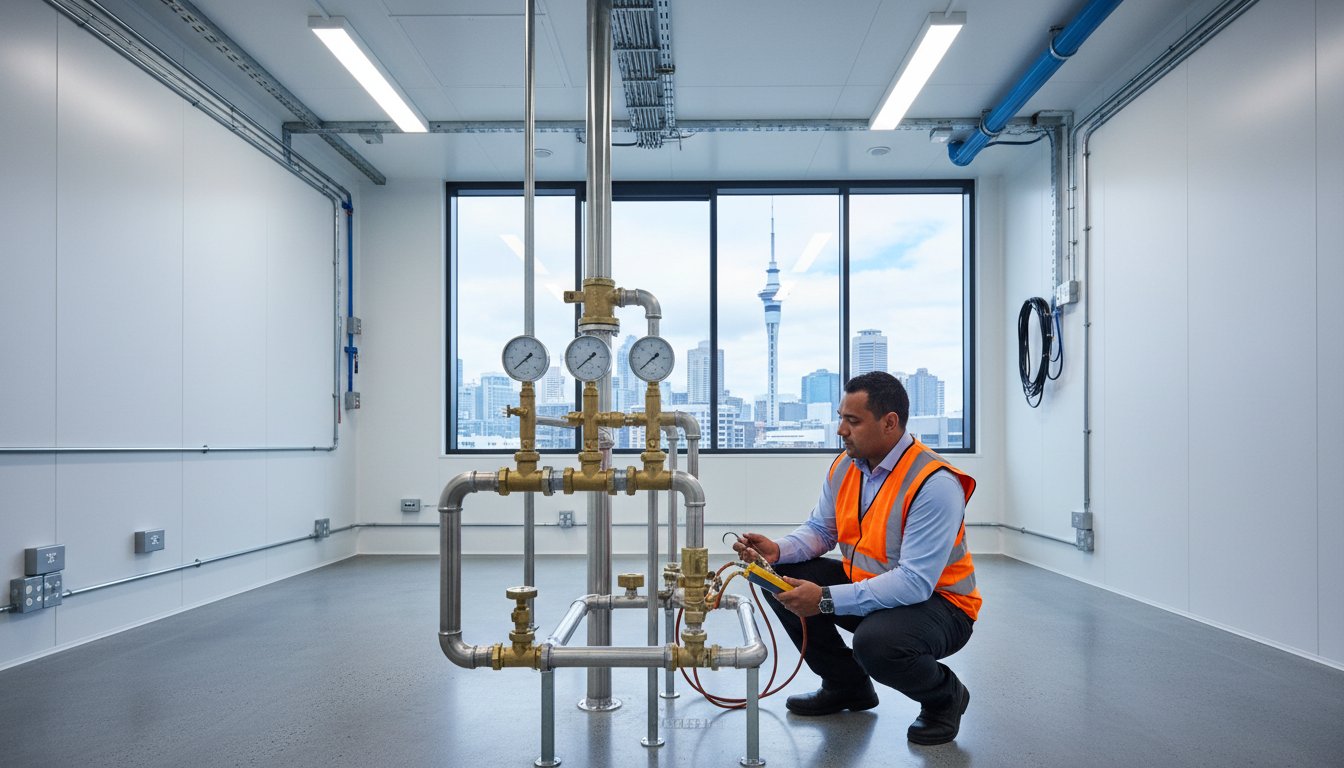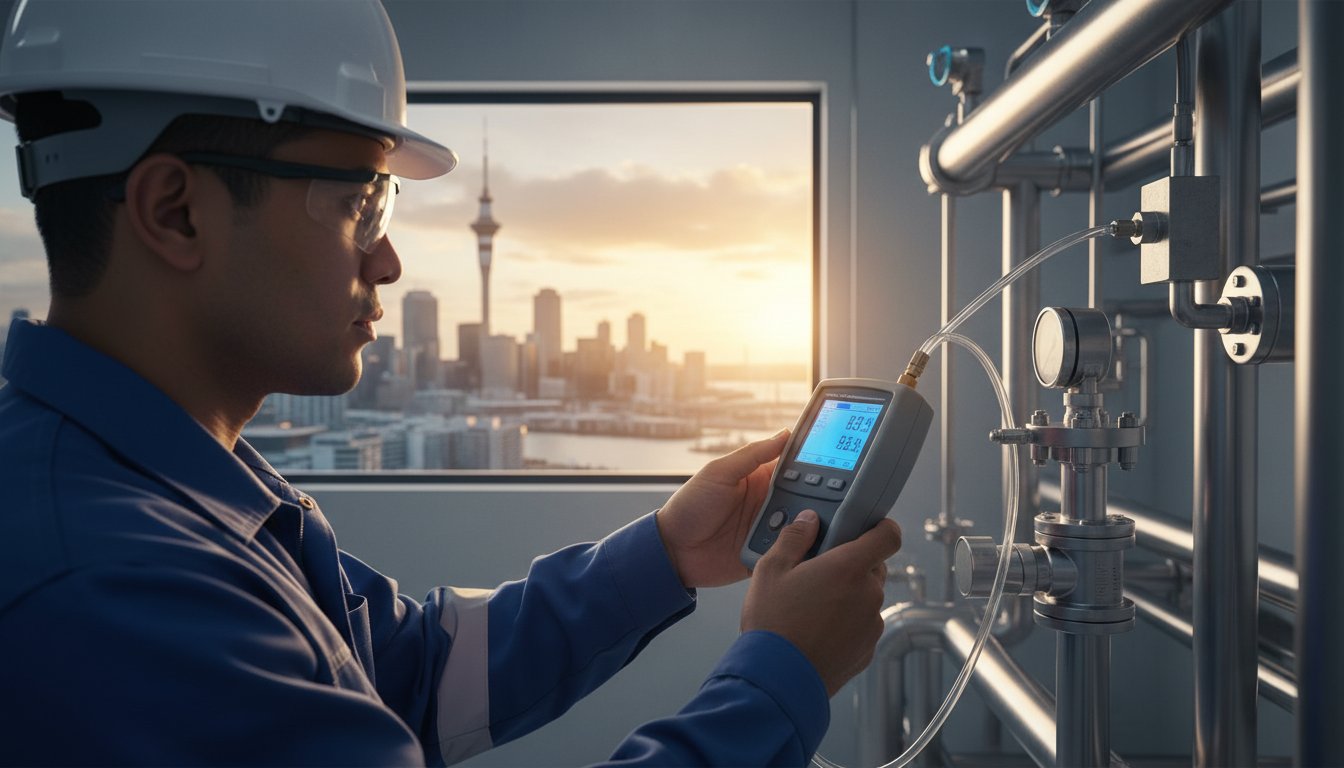



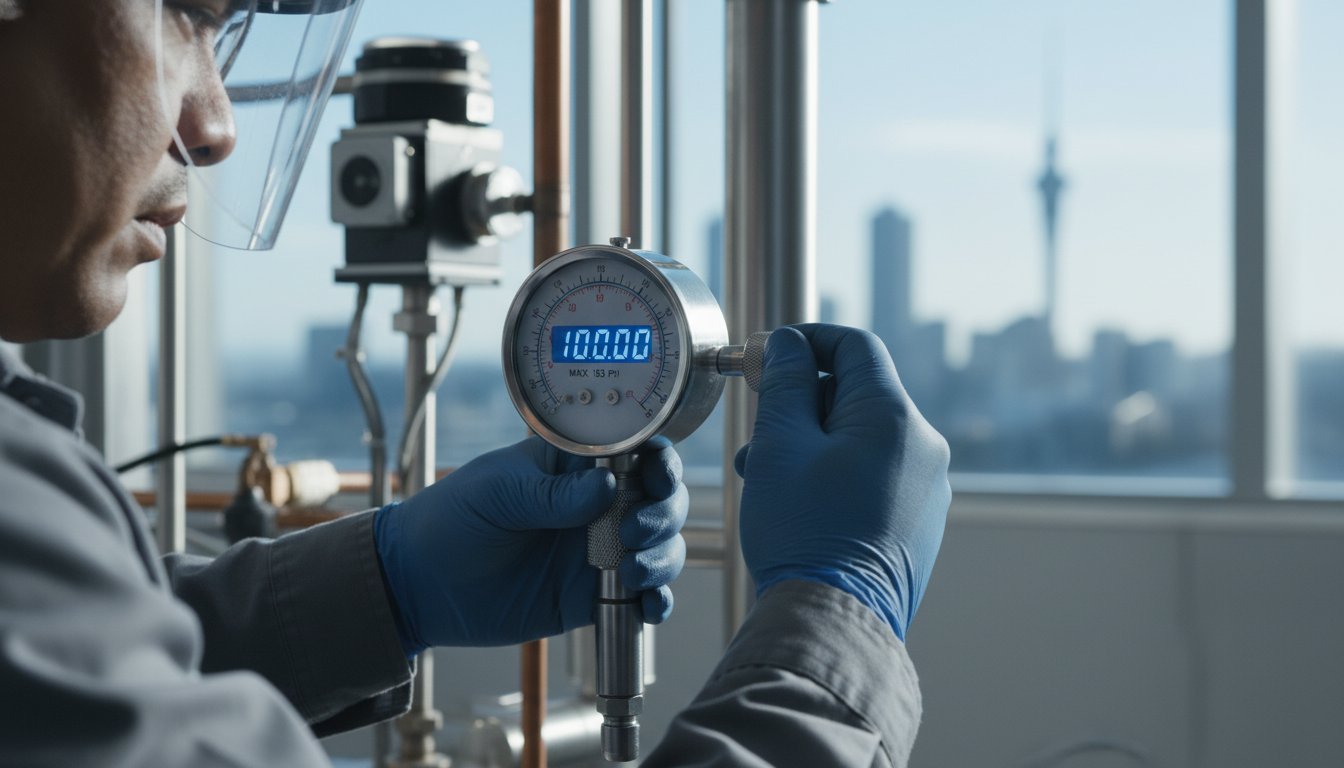
A single inaccurate reading on a high-pressure line can cost a New Zealand facility upwards of NZ$12,000 in a single afternoon of unplanned downtime. You likely already understand that precision isn't just a preference; it's a strict requirement for maintaining site safety and meeting rigorous compliance standards. Finding the right industrial pressure gauge suppliers NZ depends on more than just a catalog. It requires a partner who provides the total solution, including IANZ-accredited documentation and local technical expertise that won't leave you stranded when a fitting fails.
In this 2026 buyer's guide, we'll show you how to source precision instruments that ensure your facility stays operational and compliant. We'll examine why 85% of top-tier NZ firms are moving away from overseas vendors with 8-week lead times in favor of local stock and immediate technical support. You'll learn exactly what to look for in a supplier to ensure your pressure gauges provide the reliability your mission-critical systems demand. We've compiled everything you need to navigate the local market, from understanding traceability to ensuring your fittings are ready for immediate onsite installation.
• Understand why local expertise is vital for New Zealand’s primary industries and how to identify the most reliable industrial pressure gauge suppliers NZ has to offer.
• Learn how to verify IANZ accreditation to ensure your measurement instruments meet the gold standard for accuracy and regulatory compliance.
• Discover when to upgrade to high-precision digital technology for data logging and when traditional analogue gauges remain the most cost-effective choice for harsh environments.
• Avoid the common mistake of overlooked connectivity by learning how "plug and play" kits with custom fittings can significantly reduce onsite labor hours.
• Explore the benefits of a "total solution" partnership that provides end-to-end support, from initial supply and calibration to ongoing technical assistance.
Selecting industrial pressure gauge suppliers NZ involves more than comparing unit prices on a spreadsheet. In 2026, the gap between a generic importer and a technical partner has widened significantly. New Zealand’s primary sectors, including dairy, geothermal energy, and food processing, operate under environmental conditions that punish low-quality components. Local expertise is the only way to ensure instrumentation survives these rigors.
Dairy processing plants require hygienic seals that meet strict 3-A or EHEDG standards to prevent contamination. Geothermal operations in the Taupō Volcanic Zone demand specific materials capable of resisting H2S corrosion and extreme thermal cycling. A deep understanding of pressure measurement principles is essential to ensure these systems remain safe and efficient. A technical partner doesn't just "box drop" equipment. They provide a total solution by managing the fittings, the hoses, and the initial calibration before the gauge reaches your site.
By 2026, standards for traceability have shifted. It's no longer enough to have a paper certificate filed away in a cabinet. Digital traceability and real-time data logging are becoming the baseline for high-output plants. Choosing the right industrial pressure gauge suppliers NZ means partnering with an entity that understands these evolving compliance requirements and provides the infrastructure to support them.
Critical plant shutdowns cost some New Zealand manufacturers upwards of NZ$10,000 per hour in lost productivity. Waiting for a replacement gauge from an overseas warehouse isn't a viable strategy. Local suppliers maintain deep stock levels in Auckland to facilitate immediate dispatch. They also provide expert advice on local thread standards. Mixing NPT and BSP threads is a common cause of high-pressure leaks; local experts catch these compatibility errors during the specification phase. Having access to an Auckland-based lab for urgent repairs or recalibrations ensures your plant stays operational without the three-week lead times associated with international shipping.
Using non-traceable or uncertified equipment exposes a business to severe legal and insurance liabilities under the Health and Safety at Work Act 2015. If a pressure vessel fails and the monitoring gauge lacks a valid calibration history, insurance payouts are frequently denied. Workplace safety incidents involving high-pressure steam or hydraulic fluid can lead to WorkSafe investigations and heavy fines. Traceability is defined as the documented pedigree of an instrument's accuracy, linking it back to national or international standards through an unbroken chain of accredited comparisons.
Selecting from the pool of industrial pressure gauge suppliers NZ requires a filter that goes beyond the lowest unit price. Reliability in heavy industry depends entirely on the technical depth of the partner you choose. A supplier with 35 years of history provides more than just a product; they offer an insurance policy against catastrophic downtime. You need a partner that understands the specific distinction between a standard process gauge and a high-precision laboratory instrument.
The best suppliers don't just "import and sell stuff to make a buck." They invest in their own infrastructure to support the products they put into the New Zealand market. This includes maintaining local stock levels that allow for immediate dispatch, rather than forcing you to wait six weeks for a shipment from Europe or Asia during a critical plant failure.
IANZ accreditation isn't a "nice to have" feature. It's the only way to ensure your audit trail holds up under professional scrutiny. While many suppliers provide factory certificates, these often lack the rigorous, documented traceability required by New Zealand's national metrology institute. An IANZ-endorsed certificate means the equipment has been tested in a laboratory that meets strict ISO/IEC 17025 standards. This level of precision is vital for sectors like dairy or petrochemicals where a 1% margin of error can cost NZ$10,000 in lost product or compromised safety. For those operating across the Pacific, understanding these standards is critical, as detailed in The Fiji Guide to Accredited Instrument Calibration.
Don't settle for a "box mover" who lacks the equipment to support what they sell. Ask if they can handle the "Total Package." This concept includes supply, calibration, and the necessary hoses and fittings to make the gauge functional immediately. If a supplier can't explain how a gauge will perform with 180°C steam or abrasive slurry, they aren't an expert. They're just a reseller. You need technical support that won't leave you stranded when a fitting doesn't match your existing manifold.
Reliable industrial pressure gauge suppliers NZ should offer:
Every unit should be traceable to national standards.
In-house technicians who understand specific media like gas, steam, or chemicals.
Access to everything from NZ$60 general purpose gauges to NZ$5,500 digital master gauges.
A commitment to recalibration and repair that extends the life of your investment.
We don't just sell you a gauge and walk away. We ensure it connects correctly and performs accurately under your specific site conditions. If you need a partner that treats your infrastructure with the respect it deserves, view our full instrumentation range to see the difference 35 years of expertise makes.
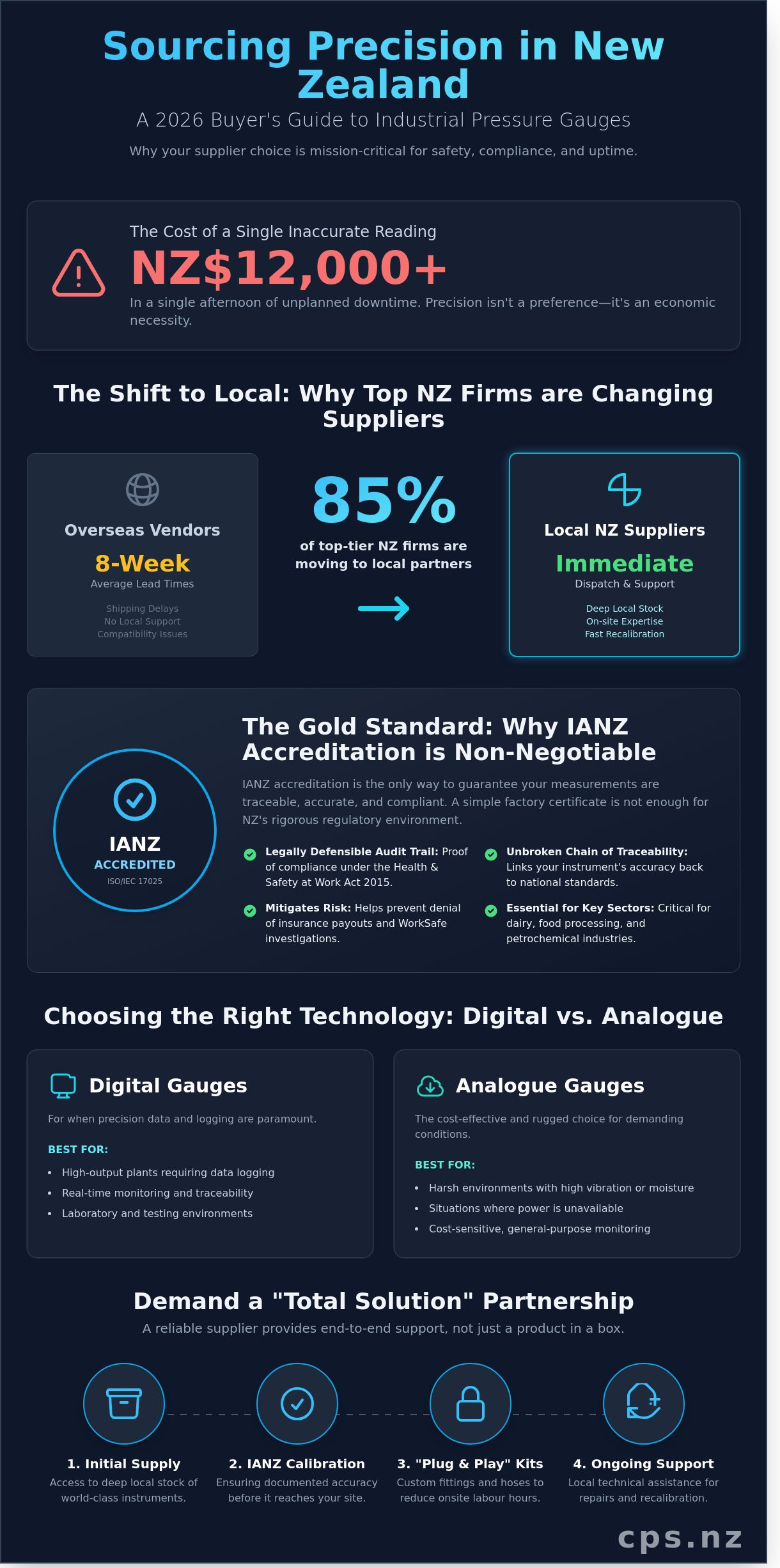
Selecting the right technology isn't just about following trends. It's about matching the instrument to your specific process requirements. Industrial pressure gauge suppliers NZ often see a divide between those upgrading to smart systems and those sticking with proven mechanical hardware. Both technologies have their place in a modern facility, but the decision impacts your long-term maintenance costs and data reliability.
Digital gauges represent the shift toward high-precision data. They eliminate parallax error, which occurs when an operator misreads an analogue dial from an angle. In 2024, approximately 40% of new installations in NZ food processing plants have moved toward digital units for their ability to log data and communicate wirelessly via Bluetooth or WirelessHART. This connectivity allows for real-time monitoring without manual walk-arounds.
Digital gauges excel when precision is the priority. Most high-end digital units offer accuracy levels of 0.1% or even 0.05% of full scale, making them essential for calibration benches and critical safety systems. They also provide versatility. A single digital gauge can switch between bar, psi, kPa, and MPa at the touch of a button. This flexibility reduces the need for large inventories of various spare parts. For facilities using modern SCADA or IoT systems, digital gauges provide the 4-20mA or digital output necessary for automated process control.
Analogue gauges remain a staple because they don't rely on batteries or external power. In remote sites across the Waikato or South Island, a mechanical gauge provides a "set and forget" solution that won't fail due to a dead lithium cell. They offer instant visual feedback; an operator can glance at a needle position from 5 metres away and know if a system is over-pressured. For a deeper look at mechanical selection, see our article on Choosing The Right Pressure Gauge: A Complete Guide.
Analogue gauges are also the preferred choice for high-vibration environments. Glycerine-filled analogue dials dampen needle flutter, extending the life of the movement in ways that can be difficult for digital sensors to replicate without complex electronic filtering. Choosing the right industrial pressure gauge suppliers NZ ensures you get the correct fill for your specific vibration frequency.
NZ's coastal air and geothermal gases require 316 stainless steel housings. Analogue gauges are often easier to seal against moisture (IP65/IP67).
Digital displays can fade or slow down in extreme cold or direct NZ sun. Analogue needles are unaffected by display lag.
An analogue gauge might cost NZ$80 to NZ$150 initially. A high-precision digital unit may exceed NZ$650. However, the digital unit often pays for itself by reducing calibration time and preventing product waste through 25% better accuracy.
We don't just supply a gauge and leave you to figure out the fittings. Whether you choose digital for its data logging or analogue for its rugged simplicity, we provide the total solution, including IANZ accredited calibration to ensure your new instrument is accurate from day one.
A frequent error when sourcing equipment from industrial pressure gauge suppliers NZ is focusing solely on the dial face or pressure range while ignoring the connection. A high-precision gauge is useless if it doesn't mate correctly with your existing manifold or pipework. We've seen projects delayed by 48 hours because a technician lacked a simple NZ$15 adapter. CPS (NZ) Ltd eliminates this risk by providing a total assembly approach. We supply "plug and play" kits that include the gauge, specific fittings, and high-pressure hoses already assembled and tested. This strategy saves your maintenance team up to three hours of onsite labor per installation.
Proper fittings aren't just about convenience; they're essential for long-term accuracy. A loose or poorly matched fitting introduces micro-leaks that fluctuate readings. We don't just sell you a unit and leave you to figure out the plumbing. We focus on the complete assembly to ensure the instrument performs to its stated 2026 specifications from day one. This holistic approach distinguishes a professional instrumentation partner from a basic product reseller.
In New Zealand, we typically encounter a mix of BSP and NPT threads. Using the wrong one causes galling or leaks that compromise your system. Our Fluid Fittings for Instrumentation guide explains these nuances in detail. We also protect your investment with custom carry cases and rubber boots. These additions extend the life of a portable gauge by 25% by absorbing the shocks of daily field use in rugged environments like mines or construction sites.
Efficiency is about receiving equipment that works immediately. We provide pre-calibrated units that meet NZ standards before they leave our IANZ accredited lab. During a 2025 maintenance window at a major North Island dairy plant, our pre-calibrated kits reduced deployment downtime by 50%. You won't have to wait for a third-party lab to certify your new purchase. It arrives onsite with traceability and documentation ready for your quality audit. This ensures your new gauge meets strict NZ safety and performance regulations before it's even taken out of the box.
Don't settle for a box-shifter when you need a technical partner. View our range of total instrumentation solutions at CPS (NZ) Ltd and get your equipment ready for immediate deployment.
CPS (NZ) Ltd stands apart from standard industrial pressure gauge suppliers NZ by offering a comprehensive service model that extends far beyond simple product distribution. We've positioned ourselves as the country's leading experts in pressure and temperature calibration, operating from a state-of-the-art Auckland lab that serves as a hub for engineering excellence. Our philosophy is simple: we don't just sell equipment. We provide a total solution that includes calibration, fitting, and long-term technical support.
When you partner with us, you gain access to world-class brands like Additel and industry-leading reference equipment. Our service includes:
Every instrument is verified in our IANZ accredited laboratory to ensure absolute precision.
We manage the hoses, connectors, and adapters so your gear arrives as a "plug and play" solution.
Our technicians are available to solve complex onsite challenges, ensuring you aren't left stranded during a critical system failure.
We don't believe in the "import and sell" model used by competitors looking to make a quick buck. Instead, we invest in the infrastructure required to support New Zealand’s heavy industry, from dairy processing to power generation. We do the fittings, we do the hoses, and we do the calibrations because we know that reliability is non-negotiable in your facility.
Established over 35 years ago, our company has grown alongside New Zealand’s industrial sector. This longevity isn't just a number; it represents decades of accumulated data and technical insight that we apply to every client project. We've consistently reinvested our profits into state-of-the-art calibration technology, ensuring our Auckland facility remains the most advanced in the country. This commitment to quality is why NZ industrial leaders trust us with their most critical systems. In a 2024 internal review of our long-term clients, 98% cited our technical expertise as the primary factor in their continued partnership. Our experience ensures that the solutions we provide today will still be performing accurately well into the 2030s.
If you're ready to upgrade your facility's accuracy, the process is straightforward. Our technicians are available to consult on complex system designs, ensuring your pressure transmitters and gauges are perfectly matched to your operational requirements. You can request a quote for custom gauge kits, which we deliver in rugged carry cases with full traceability documentation. Don't settle for a supplier that disappears after the invoice is paid. Contact CPS (NZ) Ltd today for expert pressure solutions and experience the difference that genuine technical expertise makes to your bottom line.
Selecting the right instrumentation for 2026 requires looking beyond the initial price tag. High-performing New Zealand operations prioritize long-term accuracy and seamless integration. Your choice between digital and analogue technology must align with specific site conditions, while reliable calibration ensures your data remains beyond reproach. CPS (NZ) Ltd stands apart from other industrial pressure gauge suppliers NZ by offering a total solution that covers every technical detail. We bring 35+ years of NZ industry experience to every project, ensuring your equipment meets the highest standards of traceability.
Our IANZ Accredited Laboratory provides the precision your facility needs to maintain compliance and safety. We don't just ship products; we provide full technical support and custom fittings to ensure your gauges work perfectly from day one. This commitment to quality means you won't be left stranded with incompatible parts or unverified readings. Partnering with a specialist who invests in world-class reference equipment is the smartest way to protect your infrastructure and your bottom line.
Browse Our Professional Range of Industrial Pressure Gauges
We're ready to help you achieve the precision your business deserves.
Industrial gauges feature heavy-duty construction with stainless steel or phenolic cases designed to withstand 24/7 vibration and corrosive environments. Commercial gauges usually have plastic or painted steel housings and are intended for light-duty HVAC or plumbing tasks. While commercial units often have a 2.5% accuracy margin, industrial models provide 1.0% accuracy or better to meet strict New Zealand engineering standards.
Most New Zealand industrial facilities require calibration every 12 months to comply with ISO 9001 and local health and safety regulations. High-precision sectors or plants running 24-hour shifts often move to a 6-month cycle to ensure traceability. Regular testing against world-class reference equipment prevents measurement drift, which can account for a 3% to 5% drop in process efficiency if left unchecked.
Yes, CPS (NZ) Ltd provides IANZ accredited calibration for new instruments through our specialized laboratory established over 35 years ago. We don't just sell hardware; we offer the total solution by verifying every unit before it leaves our facility. As leading industrial pressure gauge suppliers NZ, we ensure your equipment arrives with full documentation, so you aren't left stranded during your next safety audit.
You can use digital pressure gauges in hazardous areas only if they carry a specific Intrinsic Safety (IS) rating like ATEX or IECEx. Standard digital gauges aren't safe for explosive atmospheres because they could trigger an ignition. We supply specialized IS-rated models that meet New Zealand's 2017 Health and Safety at Work regulations for oil, gas, and chemical processing environments.
The most common thread types in the New Zealand market are 1/4" and 1/2" BSP (British Standard Pipe). While NPT (National Pipe Taper) threads appear on roughly 15% of imported American machinery, BSP remains the local industry standard. It's vital to match threads correctly to prevent leaks; we stock a full range of adapters to ensure your gauge connects perfectly to existing pipework.
Glycerine filling, typically at 99.7% purity, protects the gauge's internal movement by dampening high vibrations and rapid pressure pulsations. It stops the pointer from fluttering, which allows operators to take accurate readings in high-stress environments. In New Zealand's colder regions, we sometimes recommend silicone oil instead, as it maintains consistent viscosity even when temperatures drop below -40°C.
Choose a bottom entry gauge for traditional pipe-mounted applications where the dial needs to be visible from above the connection. Back entry gauges are the standard choice for panel mounting or recessed installations where the pipework is hidden behind a dashboard. Standardizing your gauge orientation across a site can reduce your required spare parts inventory by approximately 20%.
Using a range that's too low can cause the Bourdon tube to rupture or permanently deform, leading to immediate equipment failure. If the range is too high, you won't have the resolution needed to see small, critical pressure changes. For the best results and longest service life, select a gauge where your normal operating pressure sits at the 50% mark of the total scale.