


What if a 3% deviation in your pressure reading was actually costing your industrial facility over NZ$12,500 in annual maintenance and lost efficiency? You already know that a reliable manometer is the backbone of any safe operation. However, maintaining that precision is difficult when the varied environmental and operational demands of New Zealand's industrial settings start to interfere with your sensitive instrumentation. It’s frustrating to deal with "drift" or foggy analogue faces when you need data you can trust to keep your plant running.
This guide will show you how to choose the right pressure measurement tools for New Zealand's diverse industrial landscape and why settling for a "near enough" reading isn't an option for professional engineers. At **CPS (NZ) Ltd**, we've spent over 35 years providing total calibration solutions, so we understand the high stakes of system failure. You’ll learn the specific differences between digital and analogue reliability, a four-step framework for tool selection, and why IANZ accredited calibration is the only way to guarantee your system’s long-term integrity. We don't just sell tools; we ensure your equipment performs exactly when you need it most.
• Learn why a precision manometer is the essential tool for accurate low-pressure and differential measurements in complex industrial systems.
• Compare digital and analogue technologies to determine which pressure measurement solution best suits Fiji’s specific environmental and operational demands.
• Understand the vital role of pressure monitoring in maintaining safety and air quality standards within Fiji’s hospitality, healthcare, and gas industries.
• Discover why IANZ accredited calibration is critical for ensuring your instruments provide traceable, reliable data from the moment they are unboxed.
• Find out how a "total solution" kit-complete with hoses, fittings, and professional cases-simplifies onsite instrumentation management for Pacific businesses.
• Understanding the Manometer: More Than Just a Pressure Gauge
• Digital vs. Analogue Manometers: Choosing the Right Technology
• Critical Applications for Manometers in Fiji Industries
• The Importance of IANZ Accredited Calibration for Manometers
• Selecting the Total Pressure Solution with CPS (NZ) Ltd
A manometer is a precision instrument used to measure fluid or gas pressure in a closed system. It's often confused with a standard pressure gauge, yet it offers a level of sensitivity that mechanical dial gauges simply can't match. In the context of industrial maintenance, we view the manometer as the definitive tool for low-pressure and differential pressure measurements. While a standard gauge might tell you if a tank is full, a manometer tells you exactly how air is moving through a complex ventilation system or a gas line.
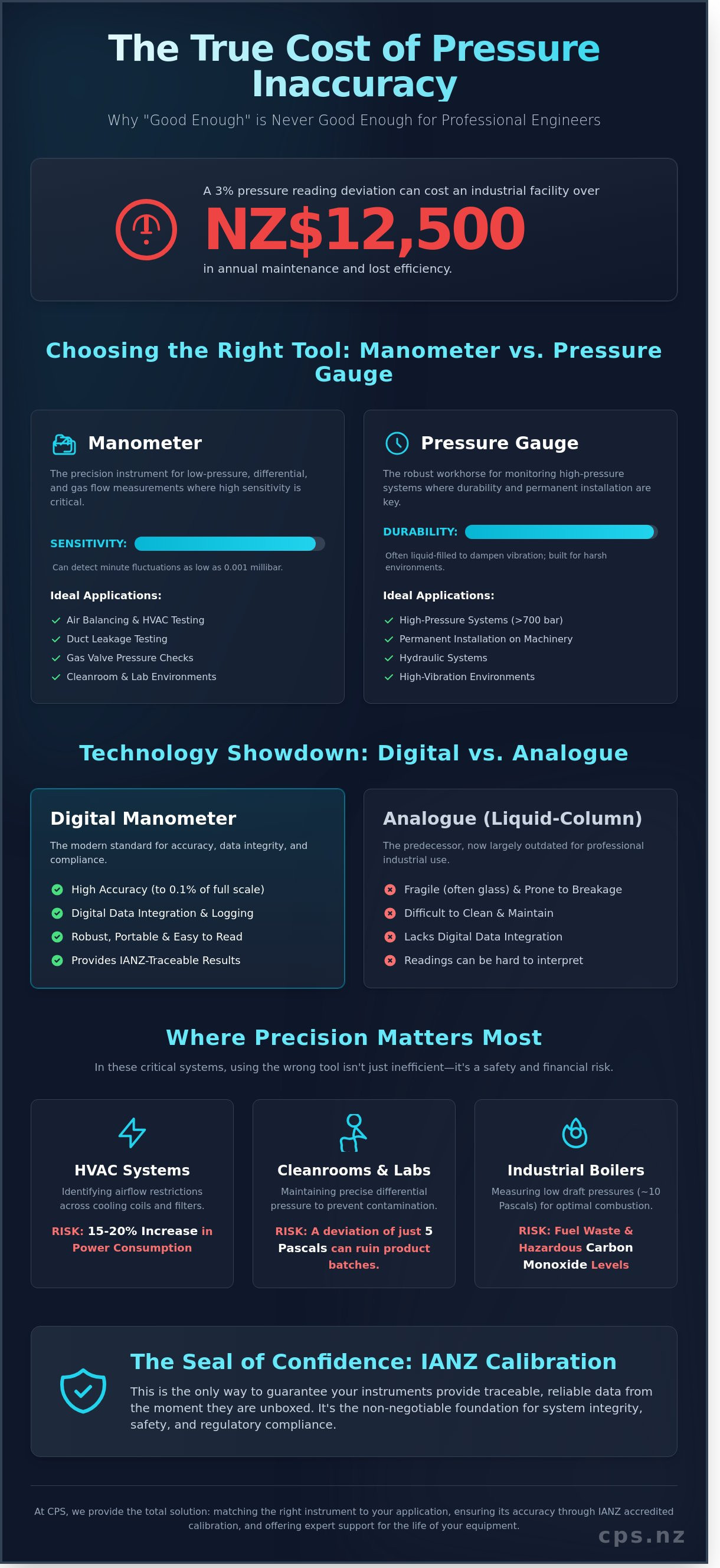
The evolution of this technology reflects the increasing demands for accuracy in modern engineering. Early technicians relied on liquid-column U-tubes, where the physical displacement of water or mercury provided a visual reading. While these were reliable for their time, they lacked the portability and digital data integration required for 2024 safety standards. Modern digital manometers use piezo-resistive sensors to provide readings that are accurate to within 0.1% of the full scale. These devices are now the industry standard for those who require IANZ-traceable results. We've seen that accurate pressure measurement is the vital sign of your industrial system; a deviation of just 5 pascals in a cleanroom or laboratory environment can lead to contamination and thousands of dollars in lost product.
Understanding pressure measurement principles allows technicians to diagnose issues that are invisible to the naked eye. In Fiji's industrial sector, from the sugar mills in Lautoka to the expansive HVAC systems in Nadi's resorts, the manometer is indispensable for maintaining peak efficiency and regulatory compliance.
Precision measurement relies on three core components: high-grade sensors, digital displays, and dual pressure ports. These dual ports are what make the manometer unique, as they allow for the calculation of differential pressure (dP). Differential pressure is the difference between two pressure points in a system. In a typical Fiji resort HVAC setup, measuring the pressure drop across a cooling coil helps identify scale buildup or airflow restrictions. This data allows for predictive maintenance, preventing the 15% to 20% increase in power consumption often seen in poorly maintained cooling loops.
The choice between a manometer and a pressure gauge usually comes down to the required resolution and the operating environment. Pressure gauges are the workhorses of the industry. They're robust, often liquid-filled to dampen vibration, and designed for high-pressure systems exceeding 700 bar. However, they lack the precision required for low-flow gas applications.
Manometers win for gas flow and filter monitoring because they can detect minute fluctuations as low as 0.001 millibar.
Standard gauges are better for permanent installation on high-vibration heavy machinery.
Use a manometer for air balancing, duct leakage testing, and gas valve pressure checks.
For example, a technician checking the boiler draft in a Fiji sugar mill needs to measure pressures as low as 10 pascals to ensure optimal combustion. A standard mechanical gauge isn't sensitive enough for this task. Using the wrong tool can lead to fuel waste or hazardous carbon monoxide levels. We provide the total solution by matching the instrument to your specific application, ensuring you have the precision of a manometer when it counts and the durability of a gauge when the environment demands it. Our 35 years of experience has taught us that the right tool doesn't just measure pressure; it protects your bottom line.
In the industrial hubs of Suva and Lautoka, the shift toward digital technology is accelerating. Traditional liquid-filled tubes are becoming a rarity as businesses prioritize speed and data integrity. While the basic physics of pressure measurement remains the same, the method of capture has evolved to meet modern compliance standards. Most Fiji businesses are moving away from glass tubes because they're fragile and difficult to clean. Instead, they're opting for robust electronic sensors that can withstand the rigors of a busy workshop or a humid processing plant.
A digital manometer offers a level of accuracy that liquid-filled tubes simply cannot match. High-end digital units frequently provide a precision of 0.05% of full scale. This is vital for industrial manometer applications where even a small deviation can lead to system failure or safety risks. Beyond simple numbers, these tools offer data logging capabilities. This allows technicians to record pressure fluctuations over a 24-hour period, providing a clear picture of system performance that a manual reading could never capture. Digital tools also allow users to toggle between multiple units like kPa, PSI, and Bar at the touch of a button, eliminating the need for manual conversion charts.
Many plant rooms in Fiji's industrial zones are poorly lit and cramped. A digital instrument with a backlit display ensures that technicians get an accurate reading every time, even in the darkest corners. It also eliminates parallax error. This occurs when a technician reads a manual scale from an angle, leading to inconsistent data. Features like auto-zeroing and min/max recording further reduce human error. These functions are essential for capturing peak pressure spikes that occur too quickly for the human eye to track on an analogue dial. It's about having total confidence in the data you're collecting.
Analogue gauges aren't obsolete yet. They remain a cost-effective choice for non-critical monitoring where a simple visual check is all that's required. In a busy factory, a needle pointing to a green zone is often faster to interpret than a digital readout flickering between decimals. These units don't require batteries, so they're always ready for use. However, the quality of the brand matters. Low-grade analogue gauges often suffer from leaks or lose calibration within six months of heavy use. Choosing a reputable brand ensures the internal bellows remain resilient against the humid Fiji climate. A high-quality analogue gauge might cost around NZ$180, while a professional digital calibrator can exceed NZ$1,500 depending on the features required.
At CPS (NZ) Ltd, we view these tools as part of a total solution. We don't just ship a gauge; we provide the fittings, hoses, and IANZ accredited calibration needed to ensure your equipment is ready for the field. Our 35 years of experience in the industry means we understand the specific challenges of maintaining precision in the South Pacific. Modern digital tools now integrate directly with calibration software, allowing for seamless certificate generation and asset management. This connectivity is the cornerstone of a modern maintenance strategy. If you're looking to upgrade your facility, we offer comprehensive calibration equipment kits tailored to your specific pressure ranges and onsite requirements.
Fiji's industrial landscape requires precision to maintain safety and operational efficiency. From the heavy machinery in Lautoka to the luxury resorts in Denarau, pressure measurement is a daily necessity. A manometer serves as a primary tool for technicians who need to verify that systems are running within their designed parameters. At CPS (NZ) Ltd, we provide the total solution for these environments, ensuring that every piece of equipment is calibrated for the specific demands of the Pacific region.
Sugar milling remains a cornerstone of the Western Division's economy. In the Lautoka and Rarawai mills, monitoring boiler draft is essential for combustion efficiency. If the pressure isn't balanced correctly, the mill wastes fuel and risks equipment damage. Similarly, the marine and shipping sector in Suva depends on these instruments. Ships require frequent pressure checks in engine rooms and ballast systems to ensure stability and mechanical reliability during long Pacific crossings. We don't just supply a gauge; we offer the technical expertise to ensure your readings are accurate every time.
Fiji's high humidity, which often averages between 70% and 90%, significantly impacts air density and HVAC system performance. This moisture-heavy air puts additional strain on air handling units in Suva’s commercial office blocks and Nadi’s resorts. Technicians use a manometer to measure the pressure drop across air filters. When a filter becomes saturated with dust and tropical moisture, the pressure differential increases. Monitoring this allows maintenance teams to replace filters at the optimal time, preventing mold growth and maintaining "Healthy Building" standards.
Optimizing fan speeds is another area where precision matters. By using differential pressure data, engineers can adjust variable speed drives to match the actual demand of the building. This reduces energy consumption by up to 15% in large-scale cooling systems. It's a practical way to manage the high electricity costs associated with tropical climate control while ensuring guest comfort in the hospitality sector.
Safety is the highest priority in Fiji’s commercial kitchens and industrial gas installations. Following AS/NZS 5601 standards, which are widely recognized in the region, gas lines must undergo rigorous leak testing. Technicians use digital manometers to perform let-by and tightness testing. This process involves monitoring for any drop in pressure over a specific period, typically three to five minutes, to ensure there are no microscopic leaks in the pipework. Even a small drop of 0.25 mbar can indicate a serious safety risk.
Burner pressure optimization is equally vital for fuel efficiency. We've seen industrial clients reduce their gas consumption by 8% simply by ensuring their burners are tuned to the manufacturer's specified pressure. This level of accuracy requires professional-grade instrumentation that can withstand the heat and vibration of a busy production floor. Our kits come as plug-and-play solutions, including all the necessary hoses and fittings, so your team isn't left stranded during a critical safety audit. We believe in providing world-class equipment that stands up to the rigors of Fiji’s industrial sectors, backed by our decades of calibration experience.
IANZ accreditation represents the highest tier of technical competence in New Zealand and the Pacific. It isn't just a badge; it's a formal recognition that a laboratory operates under the strict ISO/IEC 17025 international standard. For a Fiji-based operation, using an IANZ accredited lab like CPS means your measurement data is globally defensible. This level of oversight ensures that the technicians, the environment, and the reference equipment all meet rigorous quality benchmarks. Without this accreditation, a calibration certificate is merely a piece of paper with no guarantee of technical validity or legal standing during a safety audit.
Many site managers mistakenly believe that a brand-new manometer is ready for service immediately upon arrival. This "out of the box" confidence is often misplaced. Shipping a sensitive instrument from a factory in Europe or Asia to the Pacific involves vibration, significant temperature swings, and rough handling. At CPS, we've identified that approximately 12% of new instruments arrive with deviations that exceed the manufacturer’s stated accuracy. Verification before the first use is the only way to establish a reliable baseline for your processes. Traceability is the backbone of this system. It creates an unbroken chain of comparisons back to national standards, ensuring that a kilopascal measured in Suva is identical to a kilopascal measured anywhere else in the world.
CPS technicians follow a disciplined protocol to verify instrument integrity. We utilize reference equipment that is at least four times more accurate than the device being tested. The process involves applying pressure at a minimum of five points across the scale, both in ascending and descending order, to check for hysteresis and linearity errors. We don't just look for a pass or fail; we analyze the "uncertainty" of the reading. This figure accounts for all possible variables in the measurement process, giving you a clear window into the actual performance of your tool. IANZ accredited calibration ensures that every manometer reading is traceable to national standards, providing legal and technical certainty.
The environmental conditions in Fiji present unique challenges for instrumentation. High humidity levels, often exceeding 80% in regions like Suva, combined with salt-laden air, can lead to internal corrosion and sensor drift much faster than in temperate climates. Heat also affects the elasticity of the sensing elements inside the device. While a 12-month calibration cycle is the industry standard, we recommend a 6-month interval for manometers used in coastal or high-heat industrial zones to prevent unexpected failures.
Regular calibration is a strategic investment in risk management. A single inaccurate reading in a pressure-critical system can lead to a catastrophic seal failure or an emergency plant shutdown. In a high-output Fiji bottling plant, for example, an hour of downtime can result in lost production valued at over NZ$15,000. CPS removes the administrative burden of tracking these dates by managing your equipment history and sending automated re-calibration reminders 30 days before they're due. This proactive approach prevents safety incidents and keeps your facility compliant with international insurance requirements.
To ensure your instruments meet the highest standards of accuracy and reliability, contact our IANZ accredited team today for professional calibration services tailored to the Pacific.
CPS (NZ) Ltd operates as more than a simple equipment importer. We've spent over 35 years establishing ourselves as the leading experts in pressure and temperature instrumentation across New Zealand and the Pacific. For businesses in Fiji, this means access to the same IANZ-accredited standards and world-class equipment used by top-tier engineering firms. We don't just sell a box. We provide a total solution that integrates supply, calibration, and long-term technical support. Our team understands that instrumentation is an investment in your operational safety and efficiency.
Our "Plug and Play" kit approach is specifically designed for the logistical realities of working in Suva, Lautoka, or remote resort locations. We know that a technician stranded without a specific 1/4" NPT fitting or a high-pressure hose is a technician who isn't making money. Every kit we ship to Fiji includes the manometer, matched hoses, specific fittings, and a ruggedised transit case. This ensures your equipment arrives calibrated and ready for immediate deployment on site. You won't have to scramble for parts or worry about compatibility issues when you're in the middle of a critical system check.
We partner with world-leading brands like Additel to bring the latest digital technology to the Pacific market. These aren't fragile laboratory instruments; they're handheld digital meters built for the rigours of industrial environments. Digital units offer significant advantages over traditional analog gauges, including better shock resistance and easier data logging. We offer customized kits designed for specific Fiji industry requirements, such as:
High-durability meters for steam and hydraulic monitoring.
Precision low-pressure units for commercial cooling systems.
Sanitary fittings and traceable calibration for compliance with international safety standards.
Robust field kits for municipal pressure testing in Suva and Lautoka.
We ensure every manometer meets the precise pressure ranges your project demands, whether you're measuring millibars in a gas line or high-pressure hydraulics. Our technical team selects equipment that handles the tropical humidity and salt-air environments common in Fiji, ensuring your investment lasts for years rather than months.
Reaching our Auckland-based team is simple and efficient. We manage rapid shipping from our warehouse directly to Fiji, often reaching major hubs faster than local sourcing for specialised parts. Our commitment to personalised service means you'll speak to a technician who understands the nuances of IANZ calibration and traceability. We don't just ship the gear; we provide the technical training and after-sales service that ensures you aren't left stranded mid-project. If a tool fails or needs re-certification, our accredited laboratory is ready to provide the necessary support to get you back online.
We believe in building long-term partnerships with our clients in the Pacific. By choosing CPS (NZ) Ltd, you're choosing a partner that invests in the best technology and the best people. We take pride in our history and our ability to solve complex instrumentation challenges for our customers.
CTA: Contact CPS today for a comprehensive quote on manometers and IANZ calibration
Selecting the right manometer for your operations in Fiji requires a balance of technical precision and local environmental suitability. Whether you opt for the high-resolution data of a digital unit or the rugged simplicity of an analogue gauge, the accuracy of your readings depends on rigorous testing. CPS (NZ) Ltd brings over 35 years of instrumentation expertise to every partnership, ensuring your equipment performs exactly as required. We don't just supply a product and leave you to figure out the connections. Our team provides the total solution, which includes supply, custom fittings, and ongoing support from our IANZ Accredited Laboratory. This commitment to quality ensures that every tool we deliver meets the highest international standards for traceability and performance. By choosing a partner that invests in world-class reference equipment, you protect your infrastructure and your personnel. It's time to move beyond basic hardware and invest in a complete measurement strategy that supports your long-term industrial goals.
Request a Quote for Calibrated Manometers
We're ready to help you secure the precision your business demands.
A manometer measures the pressure difference between two points, while a barometer specifically measures absolute atmospheric pressure. Most technicians in New Zealand use a manometer to monitor HVAC systems or gas lines where relative pressure is the priority. Barometers are primarily used for weather monitoring or altimeter settings in aviation and marine sectors.
You should calibrate your digital manometer every 12 months to maintain IANZ traceability and ensure accurate readings. In high-humidity environments like Fiji, sensors can drift by 0.5% to 2% more rapidly than in temperate climates. CPS provides full calibration services in our Auckland lab, ensuring your equipment meets international standards before it's shipped back to your site.
Yes, a manometer can measure both gas and liquid pressure, provided the internal sensor is compatible with the media. Many digital models feature 316L stainless steel diaphragms that handle water or hydraulic fluids without corroding. You must verify the media compatibility rating in the technical manual, as standard gas-only units will fail if liquid enters the internal pneumatic block.
While this article focuses on industrial applications, the principle of precise pressure measurement is also critical in the medical field. For those interested in the broader world of health-related instrumentation, you can click here to explore a range of medical devices.
You definitely need a differential manometer for HVAC testing to measure the pressure drop across filters and cooling coils. A standard single-port gauge won't calculate the specific 25 Pa or 50 Pa difference required to determine if a filter is blocked. We provide total solution kits that include the necessary hoses and pitot tubes for comprehensive airflow balancing and ductwork inspections.
Your manometer should support Pascals (Pa), kilopascals (kPa), and millibars (mbar) to align with New Zealand and international engineering standards. While some older systems still use inches of water (inH2O) or psi, modern digital units allow you to toggle between 11 different scales. This versatility ensures you don't have to perform manual conversions in the field, reducing the risk of calculation errors.
A digital manometer often shows a non-zero reading when disconnected due to changes in local barometric pressure or sensor drift. Most high-quality instruments include a zero button to tare the display to the current atmospheric conditions before you start a test. If the reading fluctuates by more than 0.05% of the full scale, it's a sign that your device requires professional recalibration in an accredited lab.
Choose a digital manometer if you require 0.1% accuracy, data logging, or backlit displays for dark workspaces. U-tube models are useful for basic, low-cost visual checks where power isn't available, but they're harder to read and lack the precision of electronic sensors. For professional B2B applications in New Zealand, the digital option is the standard because it provides faster, more reliable results for compliance reporting.
Manometers are only safe for corrosive gases if they are specifically built with chemically resistant materials like Hastelloy or 316 stainless steel. Standard aluminium or plastic ports will degrade within 3 to 6 months if exposed to ammonia or hydrogen sulfide. Always consult your instrumentation partner to ensure the wetted parts of the gauge match the specific chemical profile of your gas line.