


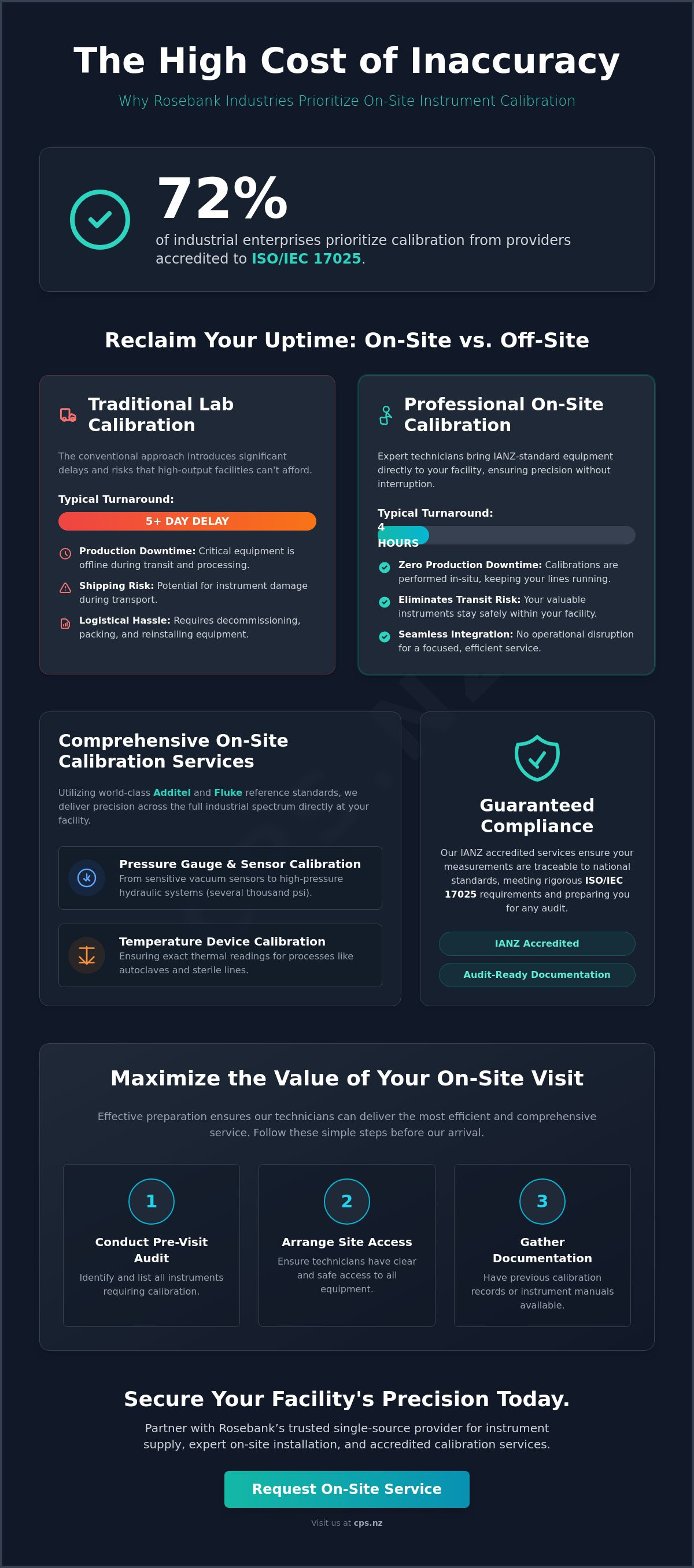
Did you know that over 72% of industrial enterprises prioritize calibration services from providers accredited to ISO/IEC 17025? In Rosebank’s high-output manufacturing environment, precision isn't just a technical requirement; it's a strategic tool for operational uptime. We understand the significant pressure local manufacturers face, from production downtime during equipment transit to the risk of damage during shipping. Inconsistent readings from uncalibrated gauges don't just threaten your quality control; they compromise your entire compliance status.
Our professional on-site instrument calibration Rosebank services eliminate these logistical headaches by bringing expert technicians directly to your facility. We ensure full compliance with IANZ standards while maintaining a zero-interruption schedule. This article explores how expert on-site calibration minimizes downtime and provides the traceable certification necessary for Rosebank’s industrial sector. You’ll find technical advice on maintaining pressure and temperature precision without the need for off-site shipping. Discover how a single-source provider can secure your facility’s precision through expert on-site installation and maintenance.
• Professional on-site instrument calibration Rosebank reduces production downtime by eliminating the logistical risks and delays associated with equipment transit.
• Specialized calibration for pressure and temperature devices ensures your facility maintains full compliance with IANZ standards and safety regulations.
• Learn how to evaluate whether your specific environmental conditions require laboratory precision or if on-site services provide the optimal balance of accuracy and efficiency.
• Effective pre-visit audits and site access preparation maximize the technical value of your scheduled calibration day.
• Partnering with a single-source provider allows you to integrate high-quality instrument supply with expert on-site installation and maintenance.
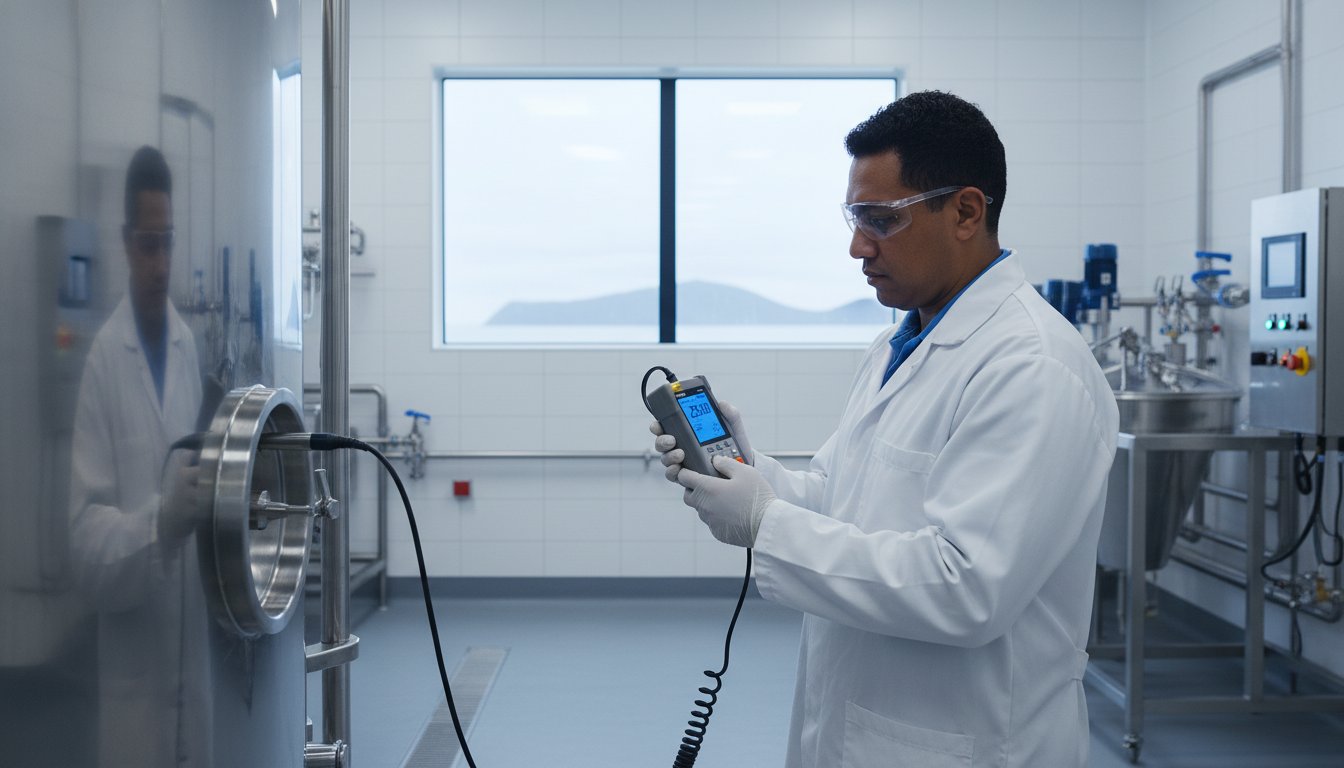
Rosebank serves as a critical engine for West Auckland’s economy. For the high-output manufacturing plants lining Rosebank Road, precision isn't just a preference; it's a structural requirement. On-site instrument calibration Rosebank involves bringing IANZ-standard reference equipment directly to your facility. This approach ensures your measurement systems remain integrated into your workflow while receiving expert verification. To understand the technical necessity of these procedures, one must first grasp what is calibration in a formal industrial context: it's the comparison of a device's performance against a known standard to ensure accuracy and traceability.
Local sectors such as food and beverage processing and pharmaceutical manufacturing rely on exact thermal and pressure readings. A single degree of variance in an autoclave or a minor pressure drop in a sterile line can lead to entire batches being discarded. Achieving full compliance with IANZ standards provides these businesses with a significant competitive advantage. It demonstrates a commitment to global quality benchmarks that satisfy both local auditors and international partners. By prioritizing regular verification, Rosebank firms protect their reputation and their bottom line.
Traditional laboratory calibration often requires a "shipping window." This period includes the time needed to decommission, pack, ship, and wait for a lab to process the instrument. In many cases, this results in a 5-day turnaround where critical equipment remains offline. Our on-site service model replaces this extended delay with a focused 4-hour visit. By performing calibrations in situ, we eliminate the transit phase entirely. This ensures your production lines maintain continuity without the risk of instrument damage during transport. It's a pragmatic solution for high-pressure manufacturing environments where every hour of uptime counts.
IANZ (International Accreditation New Zealand) accreditation represents the gold standard for technical competence. For Rosebank firms, utilizing an accredited provider for on-site instrument calibration Rosebank ensures that every measurement is traceable to national standards. This alignment is vital for meeting ISO/IEC 17025 requirements. Our technicians provide the detailed documentation necessary for audit readiness, ensuring your quality management system stands up to the most rigorous inspections. We don't just provide a sticker; we provide the technical assurance that your facility operates within defined tolerances. This level of detail is essential for businesses that cannot afford inconsistent readings or compliance failures.
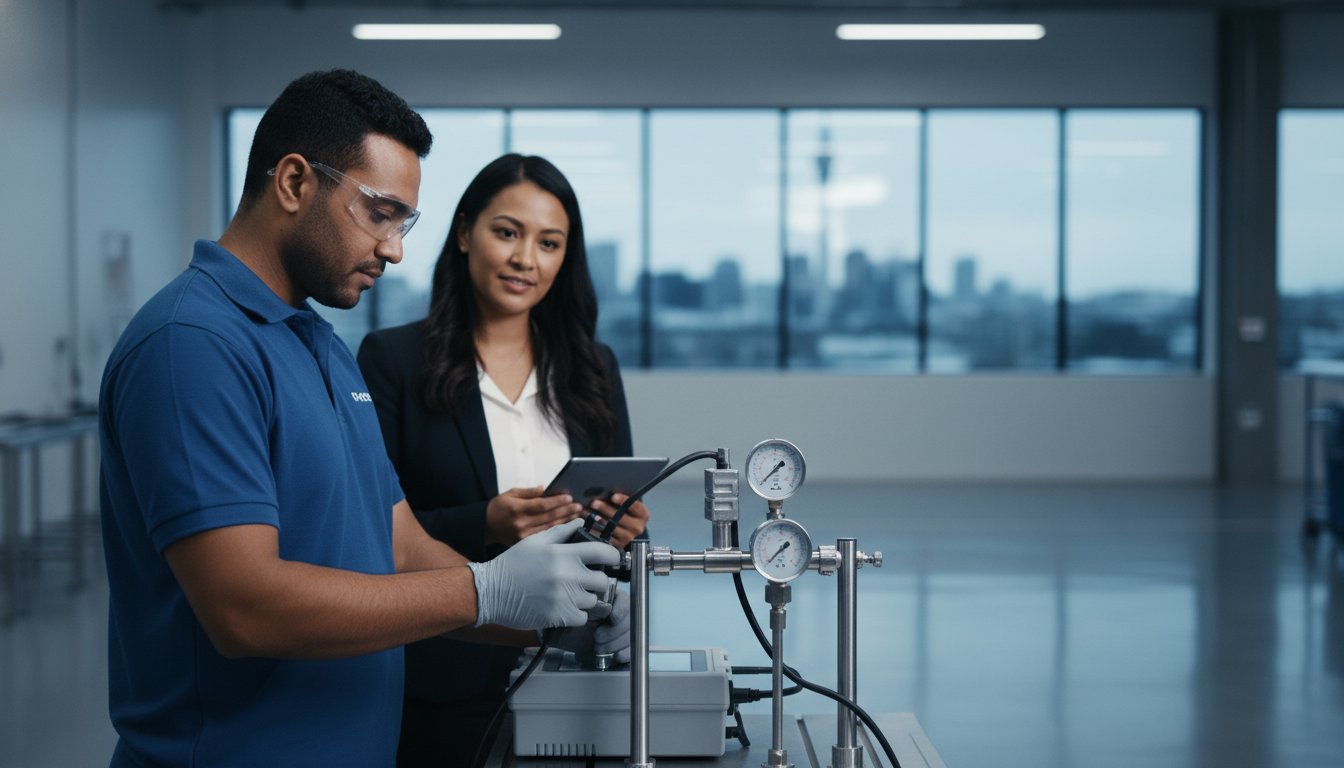
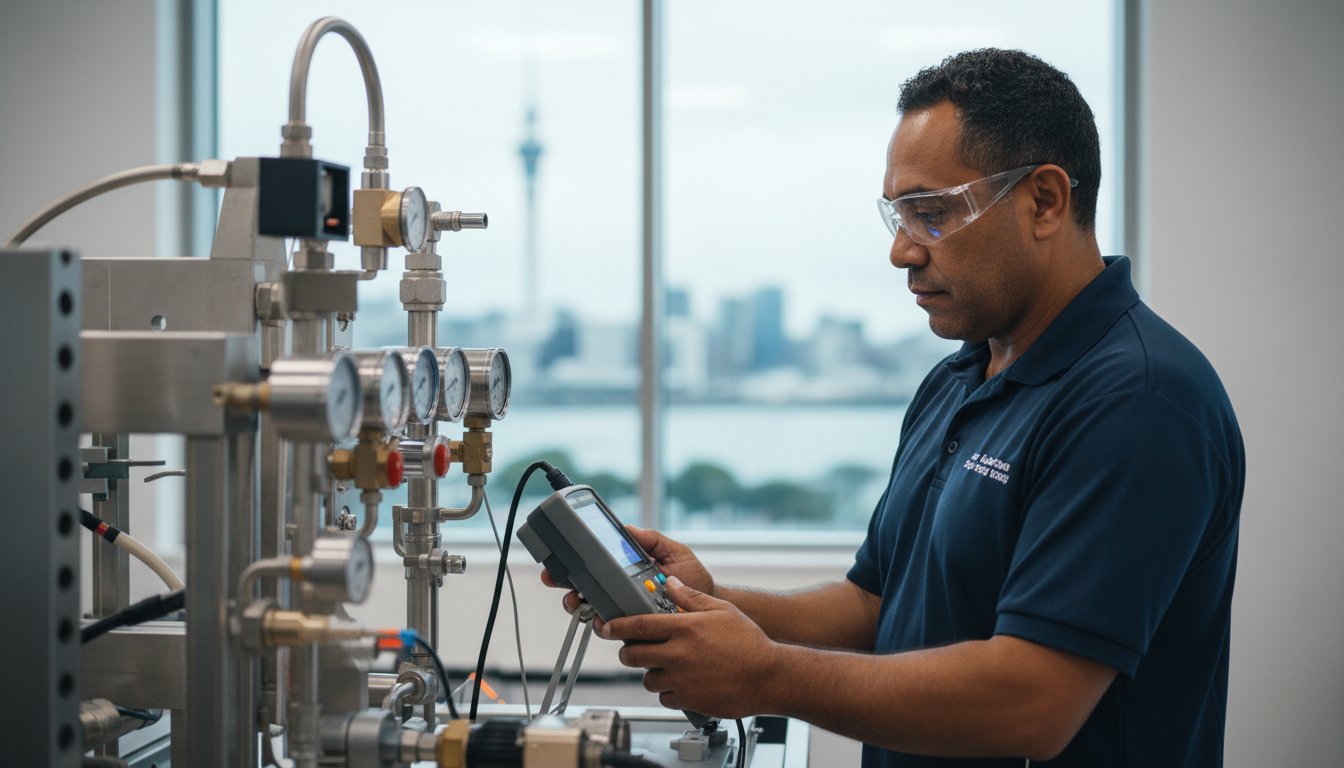
Precision measurement systems in Rosebank require a specialized approach that spans multiple technical parameters. Our technical teams utilize world-class Additel and Fluke reference standards to deliver on-site instrument calibration Rosebank across the full industrial spectrum. This capability extends from sensitive vacuum sensors to high-pressure hydraulic systems reaching several thousand psi. By bringing these high-end standards directly to your production line, we ensure your instruments perform within their specified tolerances under actual operating conditions.
Many complex manufacturing lines in Rosebank don't rely on a single variable. They require integrated accuracy where pressure and temperature interact to define product quality. Multi-parameter calibration is essential for these environments to maintain strict regulatory requirements for calibration and ensure overall process stability. Our technicians possess the expertise to verify these interconnected systems simultaneously, providing a comprehensive view of your facility's technical health. If you are currently evaluating your hardware requirements, our team can provide expert onsite installation of equipment to ensure your new systems are calibrated and compliant from the moment they are commissioned.
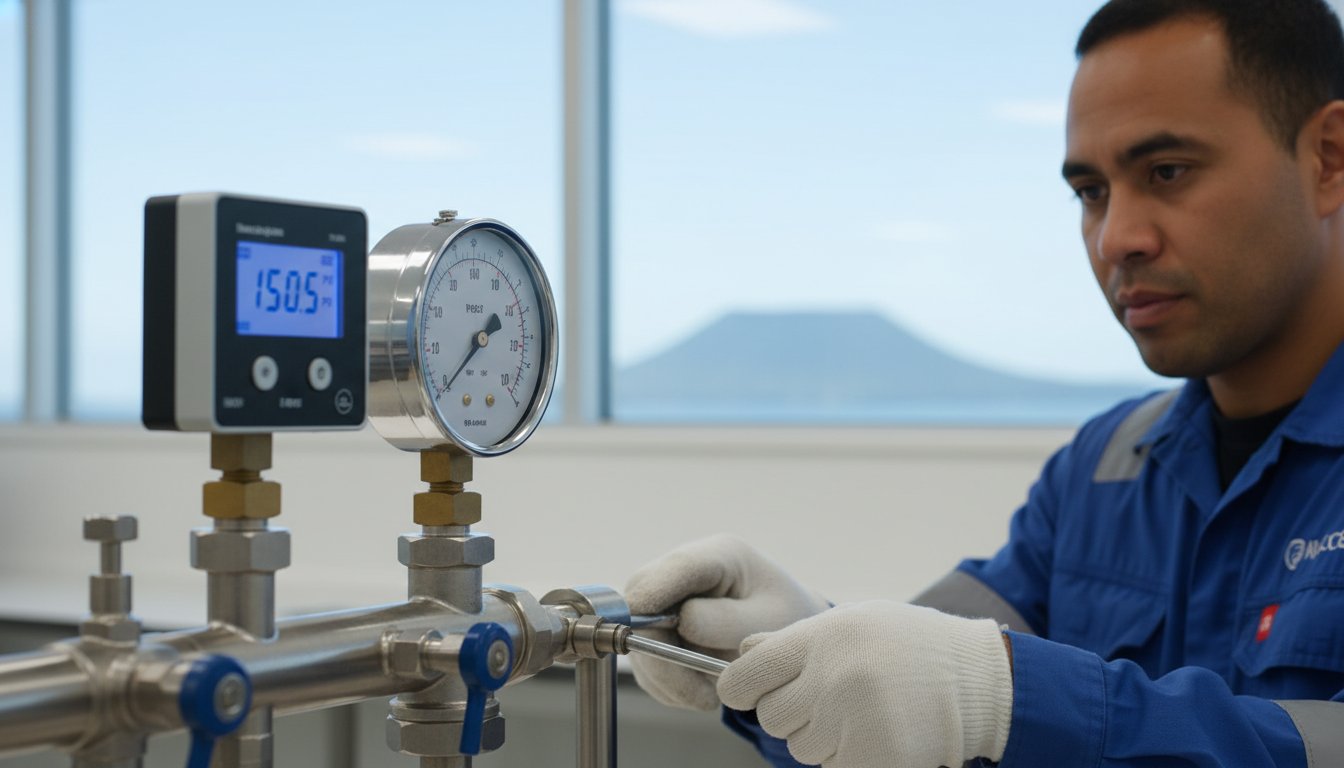
Industrial accuracy depends on distinguishing between the needs of traditional analog gauges and modern digital pressure modules. While analog gauges are prone to mechanical wear, digital sensors often experience electronic drift that requires precise adjustment. We pay particular attention to safety relief valves, where even minor drift can lead to significant facility hazards or unexpected shutdowns. Maintaining these components is a core safety requirement for any Rosebank plant. For those looking to optimize their measurement hardware, we recommend reviewing our comprehensive guide on choosing the right pressure gauge to match your specific application needs.
Thermal accuracy is the backbone of the food processing and pharmaceutical sectors located in West Auckland. We provide in situ verification for a wide range of devices, including RTDs, thermocouples, and digital thermometers. For facilities operating autoclaves, ovens, or cold storage units, thermal mapping is a critical service that identifies cold spots or temperature fluctuations that could compromise product safety. You can find more detailed information on selecting high-precision sensors in our industrial thermometer guide. Ensuring these devices are calibrated on-site means your thermal processes remain uninterrupted and fully traceable to international standards.
Deciding between on-site services and laboratory calibration requires a careful assessment of your technical requirements and operational risks. Laboratory environments offer ultra-low uncertainty because they provide strictly controlled temperature, humidity, and vibration levels. These conditions are necessary for calibrating high-precision master gauges or primary standards. However, on-site instrument calibration Rosebank is often the superior choice for active production hardware. Bringing the laboratory to the plant floor ensures that instruments are verified under the exact environmental conditions where they operate daily.
Logistics play a significant role in this decision. While our Onehunga facility is geographically close to Rosebank, the process of decommissioning, packing, and transporting sensitive instruments introduces the risk of mechanical shock or transit damage. Even minor impacts can shift the alignment of a pressure gauge or damage the probe of a digital thermometer. For many Rosebank firms, the cost-benefit analysis favors on-site visits. While technician travel is a factor, it's typically offset by the elimination of shipping fees and the prevention of extended production downtime. Industry data suggests that outsourcing these needs to specialized providers can reduce internal maintenance costs by 20-35%.
A hybrid approach often serves as the most robust strategy for large facilities. In this model, critical path items that cannot leave the line are handled on-site, while secondary or spare instruments are sent to the lab for deeper analysis. Regardless of the location, The Importance of Instrument Calibration cannot be overstated for maintaining process safety and product quality. Correctly choosing the calibration path ensures your facility remains compliant without sacrificing efficiency.
On-site services are essential for large or fixed equipment that is physically integrated into the production line. Moving these items is often cost-prohibitive or technically impossible. This method also benefits facilities with high-output schedules where sensitive production batches require frequent verification to prevent waste. One of the most immediate advantages is the generation of traceable certificates. Having documentation ready the moment the technician finishes is a vital asset during urgent compliance audits or unexpected quality inspections.
Our Onehunga facility serves as the technical backbone for our field operations. This laboratory handles the most demanding high-precision primary standards that require a perfectly stable environment. It's also the designated location for complex repairs or significant adjustments that require specialized lab-only tools. For Rosebank businesses, our proximity means we can offer rapid-response lab services when an instrument requires more than a standard field calibration. This ensures your equipment returns to service with the highest possible level of technical assurance.
Maximizing the efficiency of a technical visit requires proactive planning. A well-prepared site ensures that our technicians can focus entirely on the precision of your instruments from the moment they arrive. Start by conducting a comprehensive pre-visit audit to identify every pressure gauge, safety relief valve, and handheld meter due for verification. This prevents the need for follow-up visits and ensures that your on-site instrument calibration Rosebank schedule remains tight and cost-effective. When every instrument is accounted for, the calibration process moves forward without administrative delays.
Safety and site access are paramount in West Auckland’s industrial corridor. Ensure that our technical team has completed all necessary site-specific inductions before their arrival. This includes providing clear directions to the specific production lines or plant rooms where the work will occur. Clear workspaces are also essential for technical accuracy. Our technicians require enough room to set up reference standards and a stable power source to operate sensitive electronic equipment. Environmental stability within the workspace helps maintain the integrity of the readings and ensures that the reference gear performs to its specified uncertainty levels.
Traceability depends on accurate record-keeping and historical data. Have your previous calibration certificates and original equipment manuals ready for the technician to review. This data allows our team to identify any long-term drift or recurring issues with specific instruments. It also speeds up the data entry process for new certifications, ensuring you receive your documentation promptly. Accurate records are the backbone of any IANZ-compliant quality management system.
• Isolate equipment from active processes. This is a critical safety step to prevent accidental discharge or process contamination during testing.
• Clean all instruments thoroughly. In Rosebank's food-grade and chemical environments, hygiene is essential for both the technician's safety and the accuracy of the readings.
• Verify that all calibration equipment and fixed sensors are accessible and clearly tagged for easy identification.
Effective coordination minimizes disruption to your daily output. We recommend scheduling visits during planned maintenance windows or shift changes to avoid stopping active production. Communicate any specific uncertainty requirements or local site standards well in advance. This allows our team to bring the most appropriate reference gear for your specific needs. Finally, ensure a dedicated technical point of contact is available for the duration of the visit. This person should have the authority to grant access to restricted areas and sign off on completed work. Ready to secure your production line? Contact our technical team to book your on-site calibration today.
CPS (NZ) Ltd has established itself as the primary industry authority for measurement and verification within Auckland's industrial heartland. Operating from our Onehunga base for several decades, we've developed a deep understanding of the specific technical pressures facing Rosebank manufacturing. Our approach centers on the "all-in-one" concept. We distinguish ourselves from purely transactional competitors by providing a complete lifecycle for your instrumentation. This includes initial supply, expert on-site installation, and ongoing on-site instrument calibration Rosebank services. We don't just sell hardware; we provide the technical framework that keeps your facility compliant.
We maintain a clear focus on high-end technology to ensure our clients receive the most accurate data possible. Our technical teams possess extensive expertise in Fluke precision instruments and Additel technology, which are global benchmarks for reliability. By investing in these standards, we provide the technical assurance that your measurements are world-class. Our commitment to professional integrity is further reinforced by our alignment with Engineering New Zealand standards. This ensures that every technician on your site adheres to the highest level of professional conduct and technical accuracy during every visit.
Our service model goes beyond the standard verification visit. We function as a strategic partner, where our sales department works closely with your team to develop long-term instrumentation strategies. If a pressure gauge or safety relief valve fails during a routine test, we don't just leave you with a non-conformance report. We carry extensive stock, allowing for the immediate on-site replacement of failed components to keep your lines moving. This capability is a distinct marker of our deep-level service model compared to generic importers who lack technical support. We also offer guidance to your staff on correct instrument handling, which helps reduce the risk of mechanical drift between scheduled visits.
Proximity is a vital trust signal for Rosebank’s industrial sector. Being located just minutes away in Onehunga allows us to provide a rapid response that distant competitors cannot match. While our roots are local, our standards remain global. We've made significant technological investments, equipping our technicians with the latest automated calibrators to eliminate human error during data collection. This investment translates into customized reporting designed to satisfy the most stringent IANZ and ISO auditors. Our on-site instrument calibration Rosebank services deliver the detailed, traceable certification your business needs to remain a leader in its field.
Precision isn't just a technical requirement; it's the foundation of your facility's operational integrity and safety. By prioritizing on-site instrument calibration Rosebank, you eliminate the risks of transit damage and significantly reduce production downtime. Our technical teams bring global standards directly to your facility, ensuring every pressure gauge and temperature sensor performs within its specified tolerances. This proactive approach maintains your compliance status and protects your reputation in a competitive market.
CPS (NZ) Ltd provides the technical expertise necessary to keep your systems running at peak performance. With an IANZ Accredited Laboratory and over 30 years of NZ industrial experience, we understand the unique demands of West Auckland's manufacturing sector. As official partners for Additel and Fluke, we combine high-end technology with local, personalized service. Don't leave your quality standards to chance. Book your Rosebank on-site calibration visit with the experts at CPS (NZ) Ltd today and ensure your equipment remains accurate, traceable, and fully compliant. We look forward to supporting your long-term instrumentation strategy.
Our technicians perform on-site instrument calibration Rosebank for a wide range of pressure and temperature devices directly at your facility. This includes analog and digital pressure gauges, safety relief valves, and handheld meters. We also verify temperature sensors such as RTDs and thermocouples in their operating environment. This comprehensive approach ensures that your primary process instruments remain within their required tolerances without leaving the site.
Calibration frequency is typically determined by your facility’s quality management system and the specific risk profile of your production line. Most industrial operations in Rosebank schedule services every 6 to 12 months to maintain compliance. Factors such as instrument drift, environmental conditions, and regulatory requirements influence this schedule. Our team provides technical advice to help you establish a schedule that balances precision with operational efficiency.
Yes, our on-site instrument calibration Rosebank services are performed under our IANZ accreditation scope for pressure and temperature. This accreditation confirms that our technical procedures, reference standards, and documentation meet the rigorous requirements of ISO/IEC 17025. You receive detailed, traceable certification that is recognized both nationally and internationally by auditors and regulatory bodies.
The duration of a visit depends entirely on the volume and complexity of the instruments requiring verification. A focused session for a few critical gauges might take approximately 4 hours, while a full plant audit could span several days. We work closely with your technical point of contact to schedule these visits during maintenance windows to ensure zero interruption to your primary production cycles.
If an instrument fails to meet its specified tolerance, our technician will immediately document the deviation and notify your team. As a single-source provider, we carry an extensive stock of pressure gauges and safety relief valves to facilitate immediate on-site replacement. This prevents extended downtime and ensures your process returns to a compliant state before the technician leaves your facility.
You don't need to provide any specialized testing hardware. Our technicians arrive with all necessary Additel and Fluke reference standards required for the session. We only ask that your facility provides a safe, clear workspace with access to stable power. Ensuring that instruments are isolated and cleaned before the technician arrives will further maximize the efficiency of the visit.
We provide on-site calibration for safety relief valves to ensure they lift at the correct set pressure. This is a vital safety service for Rosebank’s high-pressure manufacturing environments. Verifying these valves in situ eliminates the logistical challenge of removing them from the line. It also provides immediate assurance that your pressure systems are protected against over-pressurization hazards.
On-site services involve technician travel and site-specific setup, which differs from the workflow of our Onehunga laboratory. While laboratory calibration is ideal for high-precision primary standards in a controlled environment, on-site visits provide superior value by eliminating shipping costs and production downtime. You should assess the total operational impact, including the risk of transit damage, when choosing the most efficient path for your facility.