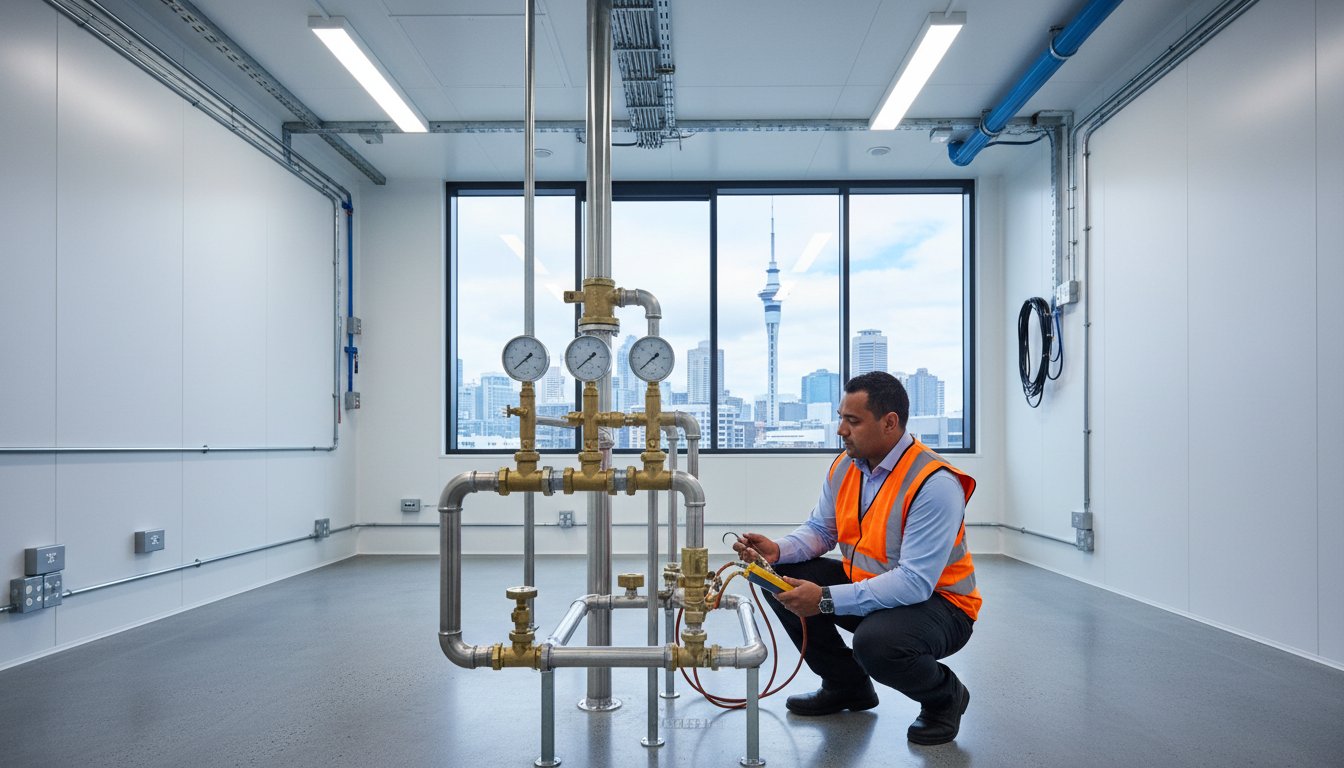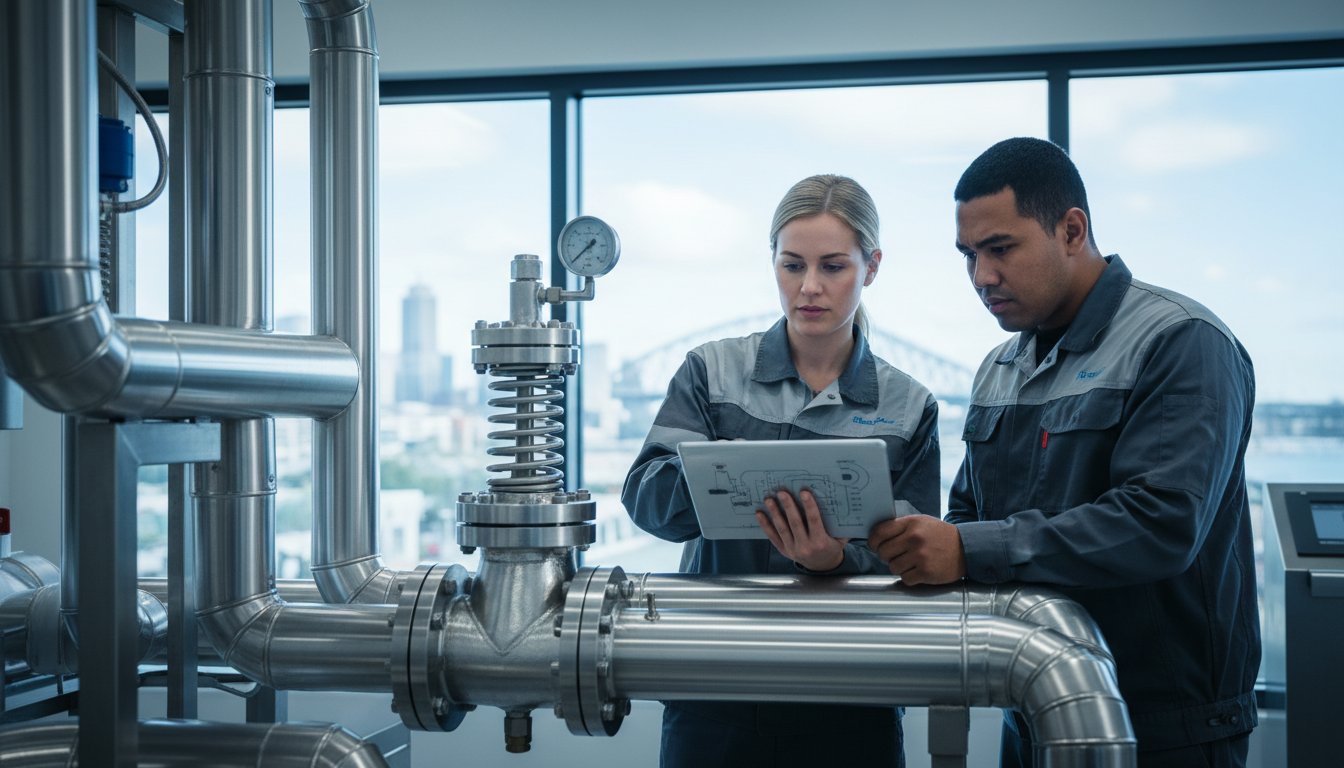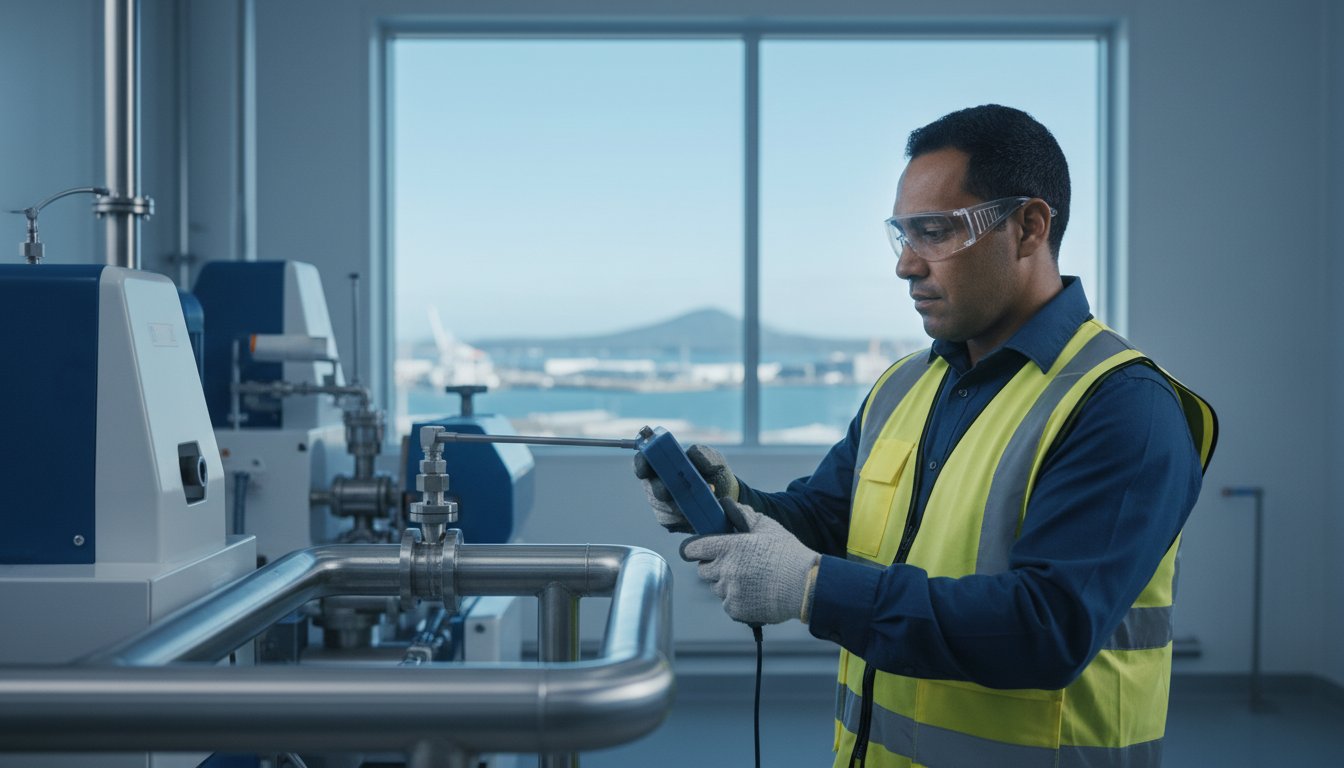




Could a single millimetre of incorrect valve sizing lead to a NZ$50,000 fine under the Health and Safety at Work Act? You already know that pressure system safety is non-negotiable, yet the complexity of the Pressure Equipment, Cranes, and Passenger Ropeways (PEPR) regulations often creates confusion and costly downtime. Securing a professional pressure relief valve installation Auckland wide requires more than just a standard fitting; it demands absolute traceability and IANZ accredited precision to prevent catastrophic failure. At CPS (NZ) Ltd, we've spent over 35 years ensuring New Zealand businesses don't get left stranded by incorrect equipment selection or poor calibration.
This 2026 compliance guide helps you master the technical and regulatory requirements for professional installation to ensure absolute site safety. You'll learn how to align your systems with the latest NZ standards to achieve a zero-incident record and full HSWA compliance. We'll preview the essential steps for correct valve sizing, provide a roadmap for navigating PEPR requirements, and explain how to optimize system uptime through a total solution approach to instrumentation and maintenance.
• Understand why professional pressure relief valve installation Auckland is a critical safety barrier for industrial sites across Onehunga, Wiri, and the greater region.
• Discover why precise technical alignment—including vertical mounting and verifying "Set Pressure" against system MAWP—is non-negotiable for NZ compliance.
• Learn to distinguish between general contractors and instrumentation specialists to ensure your high-pressure systems receive a "total solution" rather than just a basic fix.
• Follow a comprehensive commissioning checklist that covers everything from initial transport damage inspections to final nameplate data verification.
• Leverage local expertise and IANZ-accredited laboratory support to maintain world-leading standards with brands like Taylor Valve and Mack Valves.
Professional pressure relief valve installation Auckland wide ensures that industrial systems remain within safe operating limits. These valves serve as the ultimate safety barrier against catastrophic overpressure events. For businesses operating in high-density industrial hubs like Onehunga and Wiri, the stakes are high. A single failure can lead to significant asset damage or personnel injury. The technical nature of these components means they aren't simple "set and forget" items. They require precise calibration and strategic placement to function when they're needed most.
The legal weight of the Health and Safety at Work Act (2015) places strict liability on NZ business owners. Directors and managers must demonstrate "due diligence" in managing risks associated with pressure equipment. Improper installation isn't just a safety hazard; it's a legal liability that can result in six-figure fines or total site shutdowns. We've seen that the cost of professional installation is a fraction of the price of a single day of unplanned downtime caused by a system rupture or a WorkSafe NZ prohibition notice.
This requirement for due diligence is a standard for industrial safety across the region. For businesses also operating in Australia, check out ShieldComply for expert emergency management and fire safety compliance services to ensure your New South Wales facilities meet all necessary regulatory standards.
The Health and Safety in Employment (Pressure Equipment, Cranes, and Passenger Ropeways) Regulations 1999, commonly known as PEPR, dictate the lifecycle of pressure systems. These regulations require Auckland businesses to maintain a detailed register of all safety-critical valves. Every valve must have a traceable history of its design, installation, and maintenance. WorkSafe NZ inspectors prioritize these registers during audits to ensure every component meets the Technical Requirements for Pressure Relief Valve Installation. Our team provides the total solution by handling both the technical installation and the necessary documentation for your compliance register.
Auckland’s coastal environment introduces specific challenges for industrial hardware. High humidity levels, particularly in Penrose and Highbrook business parks, accelerate atmospheric corrosion. This makes material selection vital during pressure relief valve installation Auckland projects. Choosing 316 stainless steel over standard carbon steel alloys can extend valve life by 40 percent in salt-heavy air environments.
Our proximity to an IANZ accredited lab right here in Auckland reduces your turnaround time significantly. You don't have to wait for parts to be shipped across the country for verification. Local testing ensures your systems return to service faster while meeting the specific standards required for the Auckland region's unique climate and industrial density. We don't just sell you a valve; we ensure it's the right fit for your specific Auckland site conditions.
A successful pressure relief valve installation Auckland project begins with verifying the valve's "Set Pressure" against the system’s Maximum Allowable Working Pressure (MAWP). If the set pressure exceeds the MAWP, the valve fails to protect the equipment, which can lead to catastrophic failure. According to the official New Zealand regulations, all pressure equipment must be fitted with protective devices that are correctly rated and maintained for their specific application. Technicians must ensure the valve is mounted vertically with the spindle in the upright position. Horizontal mounting causes friction and misalignment of internal components, preventing the valve from reseating correctly after a discharge event.
Inlet piping requires careful engineering to minimize pressure drop. A drop exceeding 3% of the set pressure often causes the valve to open and close rapidly, a phenomenon known as "chatter." This instability damages the seating surfaces and significantly reduces the relief capacity. Discharge piping must be at least the same diameter as the valve outlet and should vent to a safe, external location. Backpressure in the discharge line can shift the set point higher than intended, so ensuring an unobstructed path is vital for site safety in industrial Auckland environments.
Selecting a valve that is too large for the required flow rate is a common error. Oversized valves lead to rapid cycling, which causes mechanical damage and potential seat leakage. It's critical to match the valve materials to the media being handled. Steam applications require different trim materials than corrosive gases or high-viscosity liquids. For a deeper look at these technical variables, consult The Definitive Guide to Pressure Relief Valves. Our team ensures that every valve selected meets the specific thermodynamic requirements of your system.
Proper torque specifications must be followed for all flanged and threaded connections to prevent body distortion. Technicians should never use the valve body as a support for the piping system. The weight of the discharge pipe must be supported independently to avoid stress on the valve internals. Before commissioning, follow these steps to ensure a "clean" installation:
• Flush the system thoroughly to remove metal shavings or welding slag.
• Inspect the valve inlet for any packaging materials or temporary plugs.
• Verify that the discharge pipe is sloped to prevent condensate build-up against the valve seat.
Even a small piece of debris can ruin a precision-ground valve seat during the first test. If you require technical assistance with your site's specific requirements, the experts at CPS (NZ) Ltd provide comprehensive support for complex instrumentation and pressure systems.
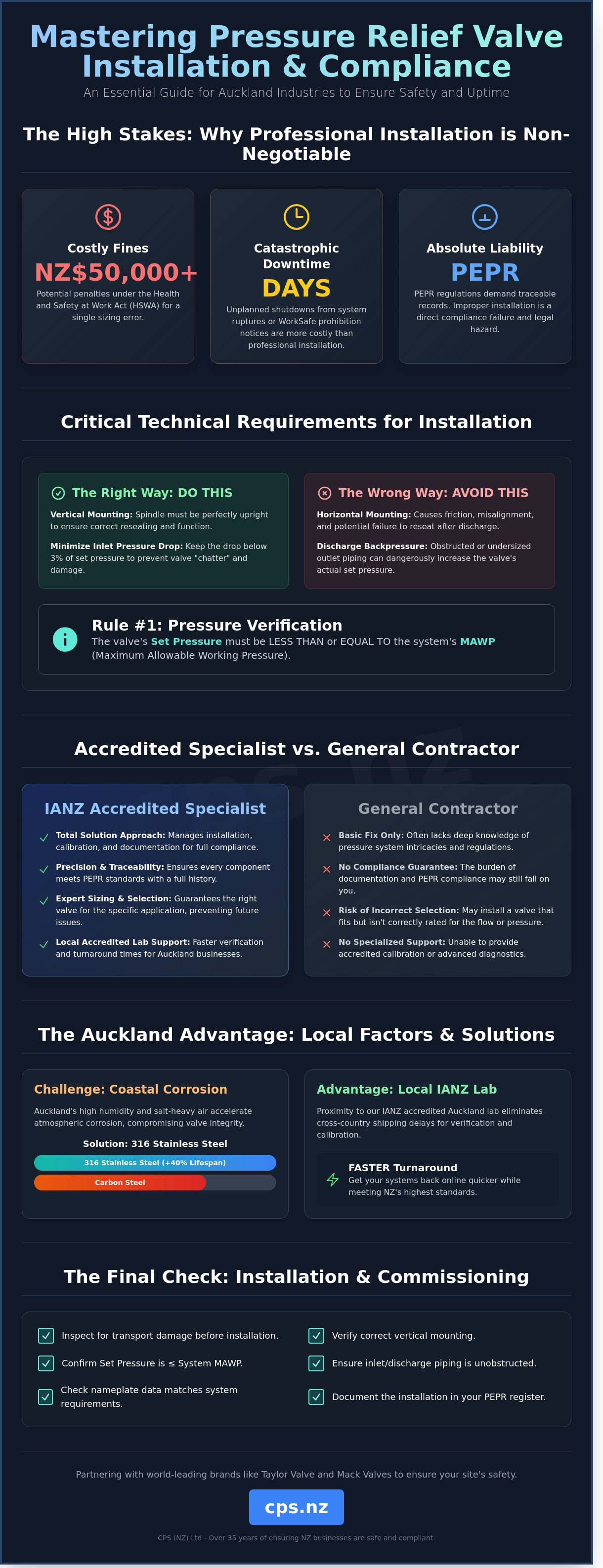
Selecting the right partner for pressure relief valve installation Auckland determines whether your facility operates with precision or remains a safety liability. While general plumbers are skilled in fluid transport, they often lack the instrumentation depth required for high-pressure safety systems. We offer the total solution. This means we handle the technical nuances of calibration, fitting, and verification that generalists simply aren't equipped to manage. A specialist approach focuses on the interaction between the valve and the wider process control system. General contractors often treat a pressure relief valve as a simple pipe fitting. It's not. It's a precision safety instrument. We ensure the installation accounts for backpressure, temperature compensation, and medium density. These factors are critical for the valve to function during a genuine overpressure event.
Using non-specialised labor introduces significant risks. An incorrectly set valve might not lift when required, or it could simmer and leak, causing "chatter" that destroys the valve seat within weeks. In Auckland’s industrial sectors, traceability is a legal requirement. Every installation must be backed by data that proves the equipment performs to its specified set-point under actual operating conditions. We provide the documentation necessary to satisfy auditors and health and safety inspectors, ensuring your site remains compliant and your team stays safe.
International Accreditation New Zealand (IANZ) provides the framework that separates professional instrumentation firms from simple resellers. An IANZ accredited lab ensures your valves are calibrated using world-class reference equipment before they arrive on-site. This provides "out-of-the-box" accuracy, eliminating the guesswork that often plagues standard installations. For a deeper look at these requirements, consult our guide on Engineering New Zealand Standards. We've maintained these high standards for over 35 years, ensuring our clients meet every regulatory hurdle without delay. Our accreditation is your guarantee that the measurements are accurate and the results are repeatable.
Low-cost providers often follow a "just import and sell" model. They provide the hardware but offer no technical support when a valve fails to reseat or starts leaking. This leads to "stranded" customers who face unplanned downtime and expensive emergency repairs. We don't operate that way. We do the fittings. We do the hoses. We do the full calibration. Investing in a specialist prevents the long-term costs of frequent valve replacements and energy loss from steam or gas leaks. Our approach ensures your pressure relief valve installation Auckland is a one-time success, not a recurring problem. We provide the expert support you need to keep your plant running at peak efficiency without the risk of sudden failure.
Execution of a pressure relief valve installation Auckland requires more than just a pipe wrench and a steady hand. It demands a systematic approach to ensure the safety of your plant and compliance with the PEPR Regulations 1999. Following a structured checklist prevents catastrophic failures and ensures your equipment operates within its design limits from the first hour of service.
Examine the valve for transport damage immediately upon arrival. Check for broken seals, debris in the inlet, or signs of impact on the spindle. Even a minor scratch on the nozzle seat can cause permanent leakage under high pressure.
Verify that the set pressure, temperature rating, and flow capacity on the nameplate match your system design. Cross-reference these details against your IANZ calibration certificate to confirm the valve is fit for purpose.
Ensure the inlet and outlet piping are correctly aligned. The discharge pipe must be supported independently so it does not exert mechanical stress on the valve body, which can cause the valve to stick or leak.
Conduct a final leak test at 90% of the set pressure. Where safe and applicable, perform a "simulated" lift using a test gag or lift lever to confirm the internal components move freely.
Finalise the installation by logging the serial number, installation date, and technician details. This data is essential for your annual pressure equipment inspection.
Many Auckland industrial sites struggle with premature valve failure due to the "Three Percent Rule." This rule dictates that the pressure drop between the vessel and the valve inlet must not exceed 3% of the set pressure. If the inlet piping is too long or narrow, the valve will "chatter," leading to rapid seat destruction. You should also choose gasket materials carefully. Using standard rubber gaskets in Auckland’s high-temperature steam systems instead of reinforced graphite or spiral-wound gaskets is a frequent cause of site-wide shutdowns. For outdoor installations in coastal Auckland areas like Onehunga or Penrose, ensure the valve has adequate weather hoods to prevent salt-air corrosion of the spring.
A new valve is not ready for "live" operation until it has a valid calibration certificate. We provide the total solution by ensuring every valve is tested in an accredited lab before it reaches your site. Standardised tagging is the backbone of Auckland plant maintenance. Each tag should clearly display the set pressure, the last test date, and the next scheduled inspection. Most Auckland facilities operate on a 12-month or 24-month recurring inspection schedule depending on the medium and risk level. Maintaining this schedule ensures you aren't left stranded during a WorkSafe audit.
Don't risk your site safety with unverified equipment; contact us for a professional pressure relief valve installation and calibration service today.
CPS (NZ) Ltd isn't just another equipment importer. We've spent over 35 years building a reputation as New Zealand's leading experts in instrumentation and pressure management. When you require professional pressure relief valve installation Auckland wide, you need a partner that understands the technical nuances of your specific facility. We supply world-leading brands like Taylor Valve and Mack Valves, ensuring your system is built on a foundation of global quality. These aren't just off-the-shelf items; they are precision instruments.
Our Auckland-based IANZ accredited laboratory provides immediate, traceable calibration. This ensures every unit meets the 2026 compliance standards before it even reaches your site. We operate on a simple, firm promise: we don't just sell it; we fit, hose, and calibrate it. This end-to-end approach eliminates the risk of using unverified components or incorrect fittings that often lead to system failures or compliance breaches. We provide the total solution, from the initial supply to the final onsite verification.
Our custom plug-and-play kits are designed for local site teams who need precision without the guesswork. We provide tailored valve and fitting assemblies that are pre-calibrated in our lab and packed in custom carry cases. This reduces onsite variables and installation time significantly. We also provide hands-on training for your maintenance personnel. This support ensures your team has the skills to monitor the system effectively long after the initial pressure relief valve installation Auckland project is complete.
Getting your system up to code shouldn't be a headache. You can leverage our 35+ years of NZ-specific experience to secure your facility and protect your staff. We provide comprehensive system pressure audits to identify potential vulnerabilities before they become costly liabilities. Our technicians are ready to visit your site, assess your current infrastructure, and provide a roadmap for full 2026 compliance. Don't leave your site safety to chance or settle for a supplier that leaves you stranded after the sale.
Ready to secure your facility?
Contact CPS Auckland for Professional PRV Installation today to speak with a technical expert about your audit or installation requirements.
Maintaining industrial safety in New Zealand requires more than just meeting minimum standards. It demands a commitment to precision and technical excellence. By following a rigorous commissioning checklist and prioritizing accredited expertise, you protect your plant from catastrophic failure and ensure full compliance with 2026 regulations. General contractors often lack the specialized tools needed for high-precision tasks. This makes choosing a partner with an IANZ Accredited Laboratory essential for your ongoing peace of mind.
CPS provides the total solution for pressure relief valve installation Auckland industries rely on for long-term reliability. We don't just sell equipment. We deliver 35+ years of NZ industry expertise to ensure every valve performs exactly when it's needed most. As NZ’s leading instrumentation specialists, we handle everything from initial supply to complex onsite calibration. Don't leave your site's safety to chance or unverified providers who just import and sell products without technical backing.
Get the Total Solution: Enquire About PRV Installation & Calibration
We look forward to helping you achieve a safer, fully compliant workspace.
Yes, you must use a certifying plumber for domestic installations or a qualified technician for industrial systems to comply with the Health and Safety at Work Regulations 2016. Auckland Council requires these professionals to ensure the work meets NZBC G12 standards. We provide technical support to ensure your pressure relief valve installation in Auckland meets every regulatory requirement and passes local inspections.
Most industrial valves require a manual lift test every 6 months and a full bench calibration every 12 to 24 months. The exact frequency is determined by your specific Pressure Equipment, Cranes, and Passenger Ropeways (PEPR) management plan. Systems operating in high-corrosion environments often require inspections every 12 months to maintain IANZ accreditation standards and ensure operational safety.
A safety valve opens fully and rapidly to vent gas or steam, while a relief valve opens gradually in proportion to the pressure increase in liquid systems. You'll find safety valves on steam boilers and relief valves on thermal expansion lines. Choosing the wrong type for your Auckland facility can lead to system instability or catastrophic failure during an overpressure event.
No, you should install pressure relief valves vertically with the spindle pointing upward to ensure the internal disc reseats correctly. Horizontal mounting can cause the valve to leak or fail to open at the set pressure due to friction and gravity. If space is limited, our technicians can help redesign your piping layout to maintain compliance with AS/NZS 1200 standards.
You must maintain a comprehensive equipment record that includes the manufacturer’s certificate of conformity and the most recent IANZ calibration report. Under the Health and Safety at Work Act 2015, you also need a documented maintenance log showing all test dates and results. These records prove your system is safe and compliant during WorkSafe NZ audits or insurance reviews.
You should contact a qualified technician immediately if a valve leaks, as this often indicates a damaged seat or debris trapped in the seal. don't attempt to tighten the adjustment screw to stop the leak; this alters the set pressure and creates a major safety hazard. We offer rapid diagnostic services across Auckland to repair or replace faulty components before they cause system downtime.
You must set the valve at or below the Maximum Allowable Working Pressure (MAWP) of your vessel, which is typically 10% above the normal operating pressure. This margin prevents "simmering" where the valve leaks because the operating pressure is too close to the set point. Our team uses precision reference equipment to calculate the exact margins required for your specific industrial application.
Yes, we provide full onsite calibration and testing services for valves already integrated into your Auckland plant. Our mobile service kits are tailored to your requirements and include all necessary fittings and IANZ traceable reference equipment. This onsite approach minimizes your downtime because it's not necessary to ship heavy components to a lab for routine verification.