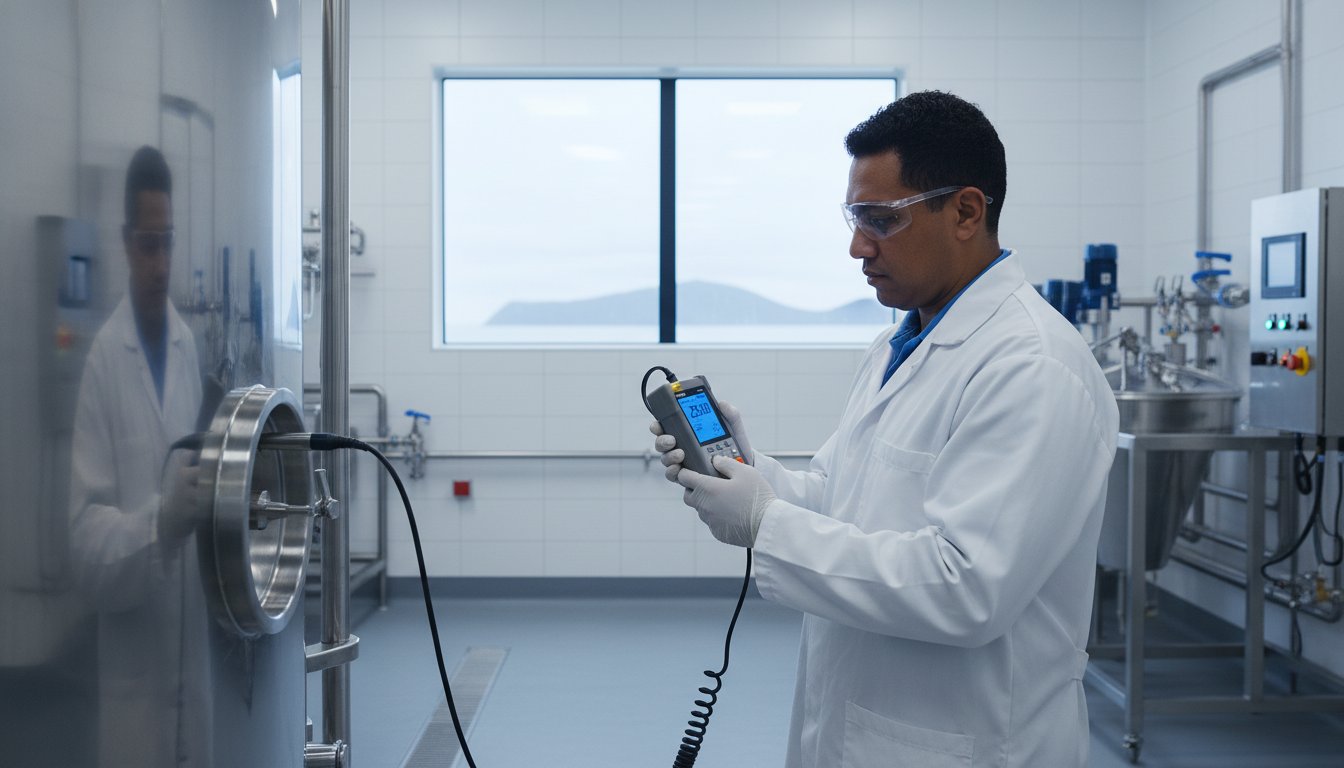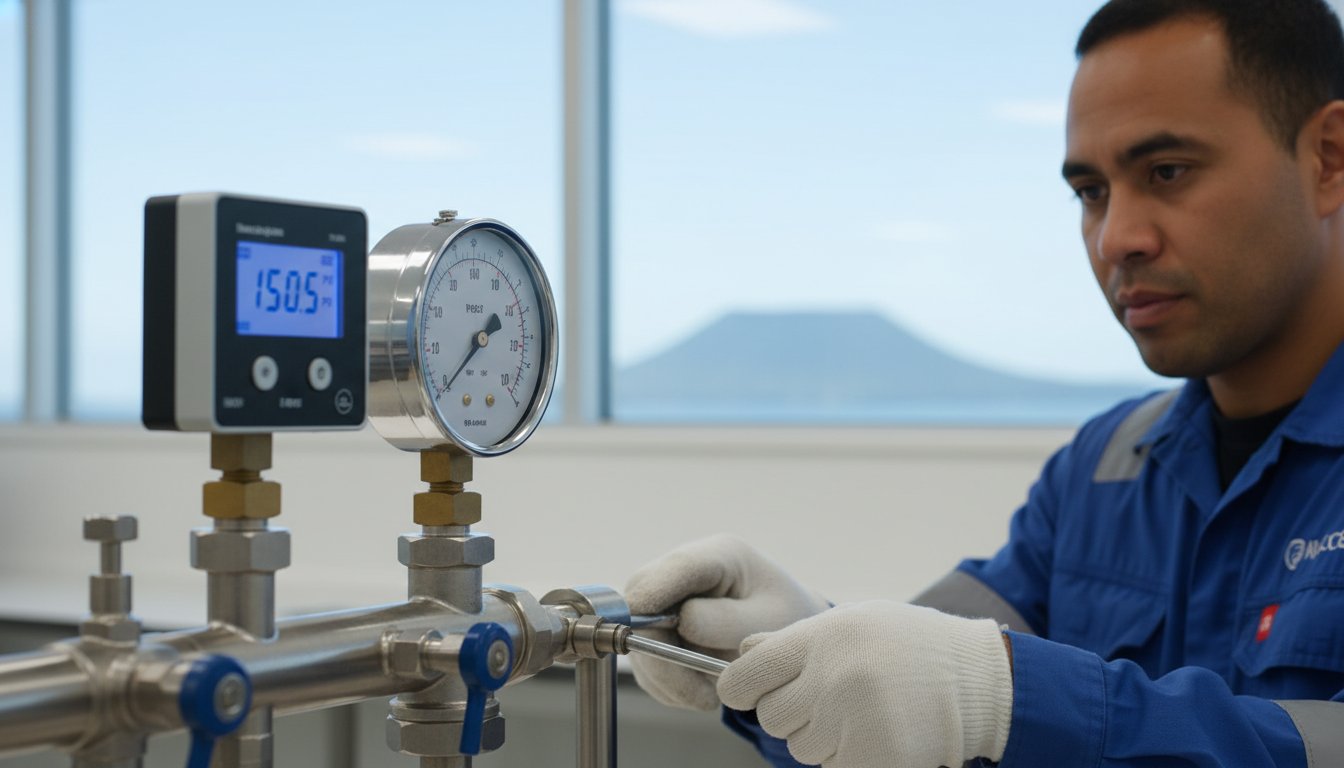




In New Zealand's industrial landscape, a temperature monitoring system without IANZ-traceable calibration isn't a safety tool; it's a legal and financial liability waiting to happen. You likely know the stress of an impending MPI or Medsafe audit, where a single 0.5°C deviation in a pharmacy dispensary fridge can mean the difference between compliance and a failed validation. Many operators fear catastrophic stock loss due to sensor failure or the complexity of meeting the latest 2025/2026 IANZ fee schedule requirements. We understand that you need more than just a cheap sensor from a company that imports and sells stuff to make a buck. This 2026 guide will show you how to select high-precision temperature monitoring systems NZ industries rely on to ensure regulatory compliance and total operational safety. We will break down the latest wireless IoT trends, explain how to automate your reporting for 24/7 visibility, and detail why choosing a partner with local technical support is the only way to secure the total solution your facility deserves.
• Learn the fundamental differences between consumer-grade "smart" sensors and professional industrial systems designed for high-risk NZ environments.
• Discover how to navigate signal penetration challenges in steel and concrete facilities by selecting the right wireless or IoT architecture for your site.
• Gain a clear understanding of the 2026 MPI and Medsafe regulatory requirements to ensure your monitoring records are always audit-ready.
• Master the selection criteria for high-precision temperature monitoring systems NZ industries use, focusing on specific accuracy and resolution needs for sensitive stock.
• Understand why a "total solution" that includes IANZ-accredited calibration and local technical support is vital for long-term system reliability and operational safety.
A professional system relies on three core pillars to maintain compliance and safety. First are the sensors and probes. Resistance Temperature Detectors (RTDs) provide exceptional stability for high-precision environments, while thermocouples offer the durability and range required for extreme heat applications. Second is the Temperature data logger, which serves as the brain of the operation. Modern loggers provide local storage to prevent data loss during network outages and transmit real-time readings to the cloud for immediate analysis. Finally, integrated alerting mechanisms ensure that critical staff receive SMS, email, or audible alarms the moment a temperature threshold is breached. This creates a safety net that manual spot-checks simply can't match.
Relying on staff to manually record temperatures every four hours is a recipe for disaster. Human error and missed logs are the leading causes of audit failures in New Zealand food and medical sectors. Automated systems eliminate this risk by providing a digital paper trail that's both tamper-proof and accurate to within 0.1°C. This level of detail is vital for protecting high-value assets in cold storage, where a single equipment failure could result in the loss of thousands of dollars in stock. Continuous monitoring is now the gold standard for NZ food safety, as it provides the complete visibility required to satisfy MPI Food Control Plans without the burden of manual record-keeping. At CPS, we draw on 35 years of experience to ensure these systems don't just collect data; they provide a total solution for operational confidence.
Choosing the right architecture for temperature monitoring systems NZ is a decision that dictates the long-term reliability of your data. While many vendors push wireless as a universal fix, the reality of New Zealand's industrial builds requires a more nuanced approach. Our facilities are often constructed with heavy concrete and steel, which act as significant barriers to radio signals. Accuracy drift is another real concern that many "plug and play" providers ignore. A professional system must account for these environmental factors to ensure the data you see on your screen matches the physical reality of your cold store or laboratory.
Wireless sensors using Wi-Fi or Bluetooth are popular for their ease of installation. However, in large-scale dairy or meat processing plants, LoRaWAN (Long Range Wide Area Network) is the superior choice. It offers signal penetration through several floors of concrete and can reach distances of up to 15 kilometres in open space. Battery-powered sensors are convenient but require proactive management. In walk-in freezers, extreme cold can reduce standard battery life by up to 40%, making high-capacity industrial cells a necessity. It's also vital to ensure your network uses AES-128 encryption to protect your compliance records from unauthorized access.
For critical infrastructure where signal drop-outs aren't an option, hardwired systems using Ethernet or Modbus remain the industry benchmark. These systems aren't affected by the high electromagnetic interference found in facilities with large motors or heavy machinery. They also integrate seamlessly with existing Building Management Systems (BMS), providing a centralized view of all facility operations. If you're managing a complex site and need a setup that won't fail during a network peak, our team can provide onsite installation of equipment to ensure your sensors are positioned for maximum reliability and longevity.
Modern IoT integration takes these systems beyond simple data logging. By analyzing temperature trends alongside energy consumption data, cloud-based dashboards can now identify when a cooling plant is losing efficiency before it actually fails. This predictive maintenance approach is particularly valuable for multi-site operations in Auckland, Wellington, and Christchurch. It allows managers to oversee entire networks from a single screen, ensuring that every facility meets the same rigorous standards. Unlike basic sensors that just record history, these integrated systems help you prevent future stock losses by alerting you to mechanical decline before the temperature even begins to rise.
This proactive approach to identifying mechanical decline is a cornerstone of professional climate management globally. For example, Around the Clock Heating and Air Conditioning demonstrates how expert maintenance of the primary heating and cooling infrastructure is essential to preventing the temperature fluctuations that these monitoring systems are designed to detect.
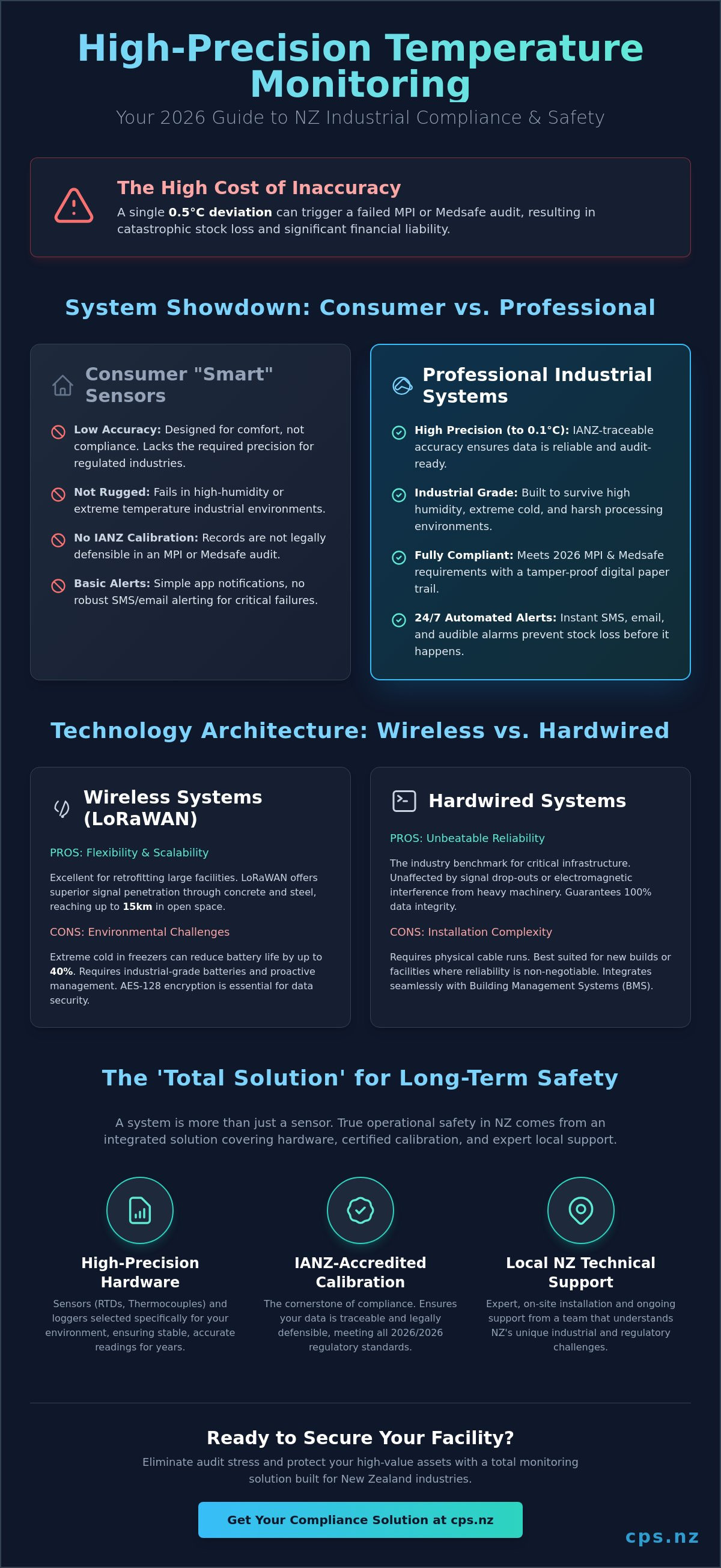
Operational success in New Zealand’s industrial sectors is inseparable from regulatory compliance. For businesses in food production or pharmaceuticals, a temperature monitoring system isn't just a technical asset; it's a legal requirement. Without IANZ-traceable records, your data lacks the authority needed to survive a high-stakes audit. Traceability ensures that every reading can be linked back to a national standard through an unbroken chain of comparisons. This provides the "trust mark" that separates professional operations from those using uncalibrated, consumer-grade hardware.
The Ministry for Primary Industries (MPI) mandates strict temperature thresholds to prevent the growth of pathogens. Potentially hazardous foods must be stored at or below 5°C, or at or above 60°C, to remain compliant. For those in poultry processing, internal temperatures must reach at least 75°C during cooking. Managing these critical limits requires more than just a sensor; it requires a robust HACCP-based food control programme. Automated temperature monitoring systems NZ providers offer simplify this by digitising the "Corrective Action" process. If a walk-in chiller rises to 6°C, the system logs the deviation and the subsequent response, creating an audit-ready paper trail. Selecting the right hardware for these tasks is essential, and our Industrial Thermometer Guide provides deep insights into probe selection for various food safety applications.
Medsafe requirements for pharmaceutical storage are even more stringent, particularly for cold chain integrity. Vaccine fridges typically require monitoring within a tight 2°C to 8°C window. For pharmacy dispensary fridges, a temperature deviation of only 0.5°C between monitoring devices is the accepted standard for validation. This level of precision is impossible to maintain without regular, accredited calibration. Laboratory incubators and cryogenic freezers also demand IANZ-certified oversight to ensure life-saving medicines and biological samples aren't compromised. Adhering to Engineering New Zealand standards ensures that your instrumentation meets the professional benchmarks required for high-precision environments. At CPS, we provide the total solution by offering IANZ-accredited calibration services that give Medsafe inspectors full confidence in your facility’s stability and accuracy.
When an auditor asks for your records, they are looking for proof of consistency. Manual logs are often viewed with skepticism because they are prone to "rounding" and missed entries. An automated system provides time-stamped, tamper-proof data that demonstrates continuous control. This transparency protects your brand reputation and ensures you meet the latest 2025/2026 IANZ standards for metrology and calibration. By investing in professional-grade monitoring, you move from a reactive stance to a proactive one, where compliance is a natural byproduct of your operational excellence.
Evaluating temperature monitoring systems NZ involves more than just comparing brand names. You must scrutinize the technical specifications to ensure the hardware can withstand your specific site conditions. While consumer-grade gadgets focus on aesthetics, industrial systems prioritize measurement stability and data integrity. For pharmaceutical storage, a standard ±0.5°C accuracy is often the bare minimum. High-precision labs frequently require resolution down to 0.01°C to identify micro-trends before they breach safety limits. This level of detail is necessary to protect sensitive stock and maintain the integrity of your cold chain.
All sensors experience accuracy drift over time due to thermal shock or environmental exposure. This is why periodic re-calibration is non-negotiable. A "factory calibrated" label only means the device was accurate when it left the assembly line; it doesn't provide the ongoing traceability required for an IANZ audit. You need a system supported by a laboratory that understands the nuances of precision. For a deeper dive into maintaining these standards, consult our Ultimate Guide to Selecting Calibration Equipment. We believe in providing the total package, ensuring your sensors stay accurate long after the initial installation.
Sensors in food processing areas face daily high-pressure wash-downs. An IP67 or IP69K rating is essential to prevent moisture ingress. For food-grade environments, stainless steel housings are preferred over plastic to prevent contamination and resist corrosive cleaning agents. If you are monitoring sealed systems or pressurized vessels, selecting the correct pressure gauge is a vital part of your total instrumentation package. Your monitoring system should be as rugged as the facility it protects.
Measurement range and power redundancy are equally critical. Your hardware must handle your specific operational extremes, whether that's cryogenic storage at -196°C or industrial ovens exceeding 400°C. Given New Zealand's susceptibility to storm-related power outages, your data loggers must have internal battery backups and local memory. This ensures that monitoring continues even if the main power or Wi-Fi fails. Finally, the software user experience should allow you to generate automated compliance reports with a single click. This saves hours of manual work during an audit and ensures your records are always organized. If you need to verify your current hardware, we provide accredited calibration services to ensure your monitoring equipment remains precise and compliant year after year.
CPS (NZ) Ltd isn't a company that just imports and sells stuff to make a buck. We understand that for temperature monitoring systems NZ industries use, the hardware is only half of the equation. Our "Total Solution" philosophy means we take responsibility for the entire system's performance, from the initial site assessment to the final IANZ-traceable report. We don't just supply you a sensor and leave you to worry about how it integrates with your network. We do the fittings, we do the calibrations, and we provide the onsite installation to ensure your facility is protected from day one. This end-to-end approach distinguishes us from general resellers who lack the technical "know-how" to support complex industrial environments.
Our Auckland-based IANZ accredited calibration lab is the heart of our operation. With over 35 years of experience in the NZ instrumentation market, we've built a reputation for reliability that general industrial suppliers can't match. We offer customised "plug and play" kits tailored to your exact facility layout. These kits arrive calibrated and packed in custom carry cases, ensuring every sensor is ready for immediate use. Our ongoing calibration programmes keep your system compliant year after year, providing the traceability needed to satisfy even the most rigorous MPI or Medsafe audits. This proactive approach prevents accuracy drift and ensures your data remains beyond reproach, even in the most demanding cold storage or laboratory settings.
The difference between a "box mover" and a technical partner lies in the level of investment and support provided. We've invested heavily in world-class reference equipment to ensure the highest precision for our clients. This investment allows us to provide a level of after-sales support that won't leave you stranded when you have a technical question or a sensor failure. We provide onsite installation and training services to ensure your team knows exactly how to manage the temperature monitoring systems NZ businesses rely on for safety. When you choose CPS, you're choosing a partner that values your operational safety as much as you do. We don't just sell equipment; we deliver the total package of expertise, technology, and service. Don't risk your compliance on unproven hardware from a supplier without a local lab.
Contact CPS (NZ) Ltd for a professional system assessment.
Selecting the right temperature monitoring systems NZ requires a shift from viewing sensors as simple gadgets to seeing them as critical compliance assets. We've explored how automated logging eliminates the risks of manual error while meeting the rigorous 2026 standards set by MPI and Medsafe. A system is only as reliable as its calibration; relying on uncertified hardware is a gamble your facility shouldn't take. By integrating high-precision IoT technology with IANZ-traceable oversight, you ensure your cold chain remains unbroken and your audits remain stress-free.
CPS (NZ) Ltd brings 35+ years of industry expertise to your site, serving as the exclusive NZ partner for leading global brands. Our Auckland-based IANZ Accredited Calibration Laboratory ensures that every device we install provides the "trust mark" of absolute accuracy. We don't just supply equipment; we provide a total solution that includes installation, training, and ongoing technical support. Get a Quote for a Custom Temperature Monitoring System today to protect your assets with the confidence of local expert backing. It's time to move forward with a partner who understands that in your industry, precision is the only standard that matters.
MPI mandates that potentially hazardous foods stay at or below 5°C or at or above 60°C to remain safe. When cooling hot food, it's required to reach 21°C within 2 hours and below 5°C within a further 4 hours. Using professional temperature monitoring systems NZ businesses can automate these logs to satisfy MPI Food Control Plan audits without the risk of manual record errors.
Most industrial systems require calibration every 12 months to maintain measurement stability and regulatory compliance. High-risk sectors like pharmaceutical storage often move to a 6-month cycle to minimize the risk of accuracy drift in sensitive environments. Regular calibration ensures your traceability chain remains unbroken and your data is legally defensible during a Medsafe or IANZ inspection.
Wired Ethernet connections remain the most reliable choice for critical infrastructure where signal drop-outs aren't an option. While LoRaWAN wireless systems offer excellent flexibility, steel-clad cold rooms often block standard radio signals, creating data gaps. If your facility has significant concrete or steel interference, a hardwired setup provides the most consistent 24/7 visibility for your operations.
A data logger is a single device that records and stores temperature readings locally for later retrieval. A temperature monitoring system is a networked solution that integrates multiple sensors with real-time software and automated alerting mechanisms. While a logger tells you what happened in the past, a complete system provides live oversight and immediate SMS notifications when thresholds are breached.
You can use a Wi-Fi sensor for vaccine storage if it meets Medsafe's strict 2°C to 8°C monitoring requirements and holds an IANZ-accredited calibration certificate. For pharmacy dispensary fridges, the accepted standard is a maximum 0.5°C deviation between monitoring devices. It's vital to choose industrial-grade hardware with local memory to prevent data loss if your Wi-Fi network fails during a storm.
Costs for professional systems depend on the number of monitoring points and the specific technical requirements of your facility. Factors like the choice between RTD or thermocouple probes and the ongoing alignment with the 2025/2026 IANZ fee schedule for calibration will influence the total investment. We recommend a custom assessment to determine the total solution that fits your specific regulatory and operational needs.
Professional data loggers include internal battery backups and local non-volatile memory to protect your records during New Zealand power outages. Even if your facility loses main power or internet connectivity, the sensors continue to record data internally. Once services are restored, the system automatically uploads the buffered data to the cloud to ensure your temperature monitoring systems NZ records remain continuous and unbroken.
IANZ accreditation is the benchmark for ensuring that your equipment calibration is performed competently and that results are traceable to national standards. For industries regulated by MPI or Medsafe, IANZ-accredited calibration to the ISO/IEC 17025 standard is the standard auditors use to verify measurement accuracy. It transforms your data from a simple record into a verified, audit-ready asset that protects your business reputation.