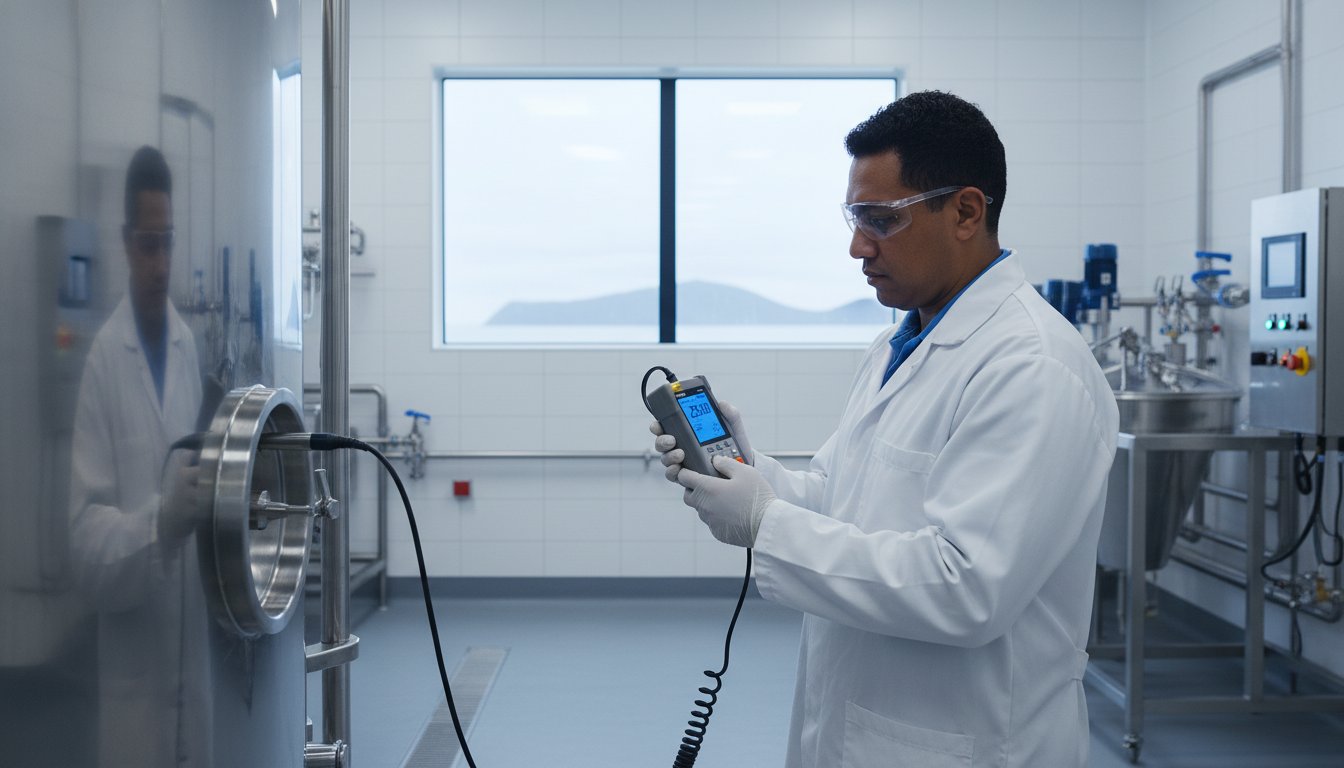




Your thermometer might be accurate to the decimal point, but that doesn't mean your entire facility is compliant. Many operators confuse simple instrument calibration with the comprehensive data required for temperature validation services NZ, a mistake that often leads to failed IANZ or MPI audits. With 80 percent of New Zealand's food production destined for export markets, the stakes for maintaining environmental consistency have never been higher.
We understand the stress of keeping up with shifting regulations, such as the draft MPI Further Processing guidance released on January 15, 2026. You want documented proof of compliance without the headache of production shutdowns or technical confusion. This guide provides the expertise you need to master these complexities, ensuring your facility meets every 2026 standard with confidence. We'll explore the distinction between hardware accuracy and process validation, review current AS/NZS requirements, and outline a strategy for maintaining a total solution that protects your product integrity.
• Understand the critical distinction between calibrating a single instrument and validating the performance of a complex thermal environment like a vaccine fridge or autoclave.
• Learn how to navigate the latest MPI and Medsafe compliance requirements to ensure your facility remains audit-ready throughout the 2026 regulatory cycle.
• Master the "total solution" approach to temperature validation services NZ by integrating expert equipment supply, professional installation, and IANZ-accredited calibration.
• Identify "worst-case" thermal zones in your facility, such as door seals and skylights, to proactively prevent temperature excursions and product loss.
• Discover how to maintain rigorous regulatory standards with documented proof while minimizing operational downtime during essential equipment testing.
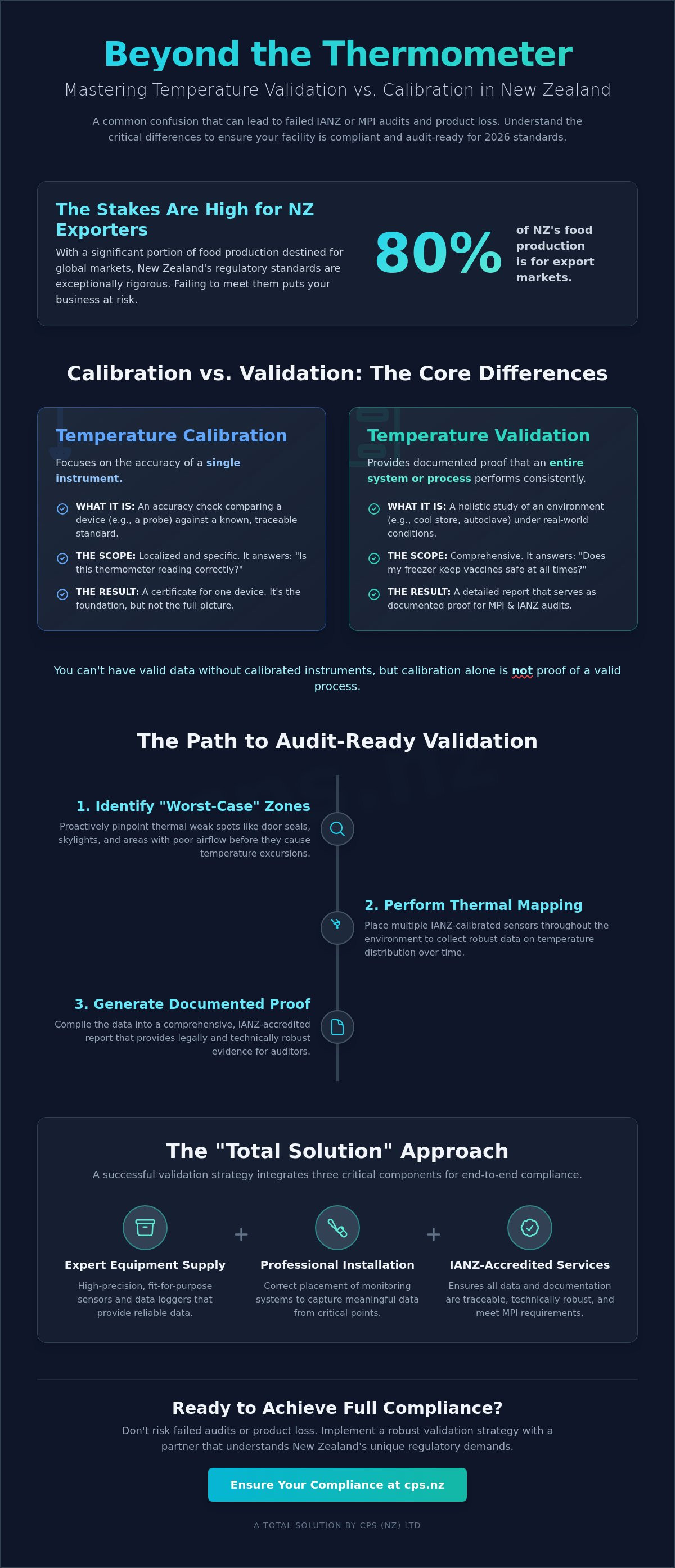
Temperature validation is the documented proof that a system or environment consistently maintains specific thermal parameters under all operating conditions. For New Zealand facilities, this isn't just a best practice; it's a legal necessity. Whether you're managing a pharmaceutical warehouse or a food processing plant, you must prove that your environment protects the integrity of your product. Temperature validation is a holistic process check of an entire thermal environment rather than a localized check of a single instrument's accuracy.
In the New Zealand market, 80 percent of our food production is exported. This makes our regulatory framework exceptionally rigorous. If you're operating autoclaves, freezers, or large-scale warehouses, you need more than just a working thermometer. You need data that stands up to an IANZ or MPI audit. Utilizing professional temperature validation services NZ ensures that your facility complies with the latest standards, such as the MPI draft "Guidance document: Further processing (2026)" issued on January 15, 2026. This level of technical oversight prevents the costly product loss and legal liability that follow temperature excursions.
While the fundamental process of Temperature Calibration focuses on comparing a measurement device to a traceable standard, validation looks at the bigger picture. It involves testing the equipment, the environment, and the operational procedures together. We rely on IANZ accreditation to ensure this data is legally and technically robust. This accreditation provides the mark of compliance and traceability to national standards, giving you the confidence that your records will satisfy any regulatory inspector.
It's easy to confuse these terms, but the distinction is critical for high-risk sectors. Verification is usually a point-in-time check to see if a device is working at that moment. Validation is a performance proof that demonstrates a process, such as a vaccine fridge cycle, works correctly every single time. For businesses managing a Risk Management Programme (RMP), validation provides the scientific evidence that your controls are effective. It's the difference between hoping your system works and knowing it does because you have the documented performance history to prove it.
Modern validation covers every aspect of your thermal infrastructure. This includes thermal mapping, where sensors are placed throughout a cool store to find "hot spots" or areas of poor airflow. We also validate sterilization equipment like autoclaves and ovens to ensure they meet the specific time and temperature thresholds required for safety. Finally, we assess the performance of your monitoring systems and data loggers over time. This total solution approach ensures that every link in your cold chain is secure and every piece of equipment is operating within its specified tolerances.
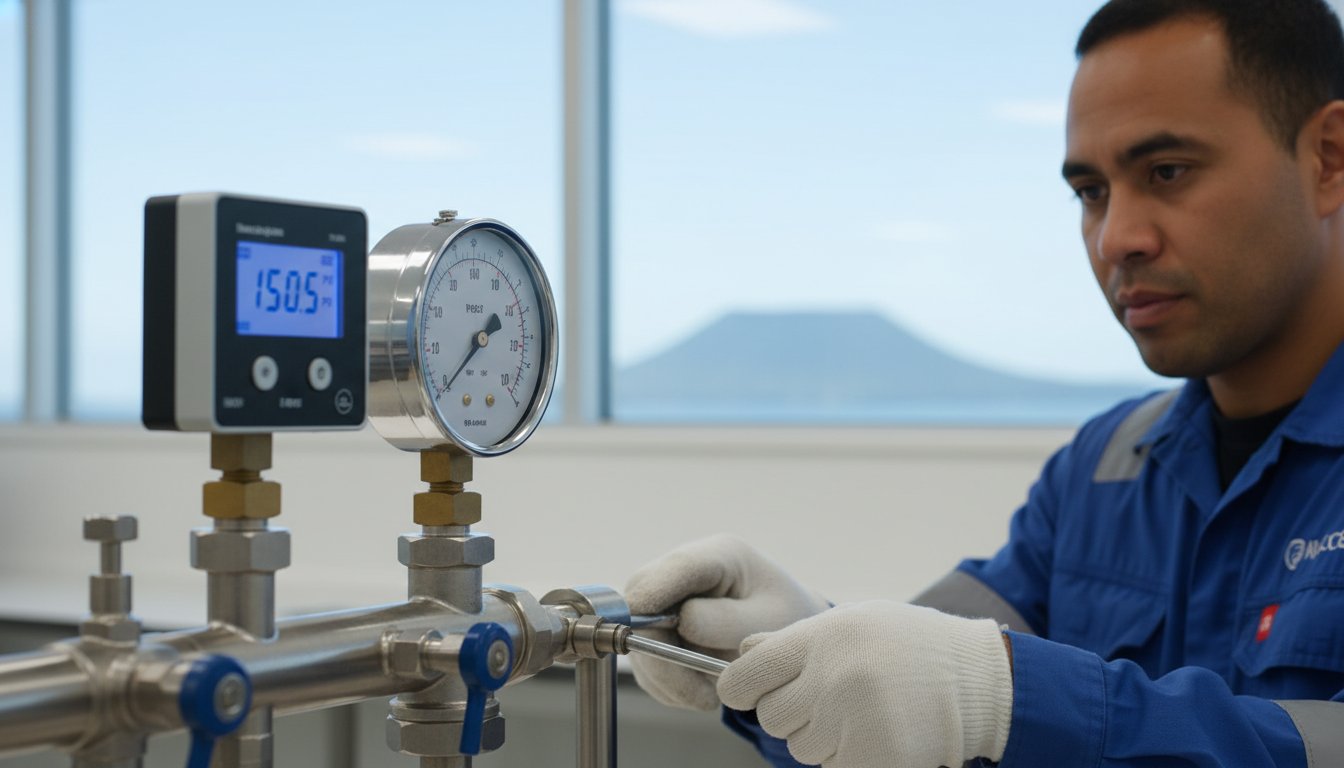
While they are often treated as interchangeable, calibration and validation serve two distinct purposes in your facility's compliance strategy. Calibration is the technical process of ensuring a single instrument, such as a digital probe or pressure transmitter, provides an accurate reading against a known reference standard. Validation is the comprehensive study of how a process or space, like a cold storage warehouse or a vaccine fridge, performs over a set period. You can't achieve successful temperature validation services NZ without first ensuring every sensor used in the study is accurately calibrated. If your reference equipment isn't traceable, your validation data is effectively worthless.
At CPS (NZ) Ltd, we provide the total solution by integrating high-precision equipment with expert environmental mapping. We don't just hand you a report; we ensure the instrumentation used to generate that report is IANZ accredited and fit for purpose. This end-to-end oversight is what distinguishes a seasoned partner from a company that simply sells hardware to make a buck. With over 35 years of experience in New Zealand's instrumentation industry, we understand that precision at the device level is the foundation of every successful validation project.
Routine calibration is your first line of defense against data drift. Most facilities require annual checks for handheld meters and probes to maintain traceability. You should also order an accuracy check following any major repairs to your instrumentation. For a deeper dive into selecting the right tools for these checks, our Industrial Thermometer Guide provides a detailed breakdown of precision solutions. To ensure your team follows best practices, the Measurement Standards Laboratory of New Zealand offers several temperature calibration technical guides that define the national standards for measurement accuracy.
Validation becomes a non-negotiable requirement during specific operational milestones. When you commission a new warehouse or install a high-capacity freezer, you must prove the space maintains its thermal parameters before any product is introduced. Regulatory bodies also mandate annual re-validation for critical cycles in food processing and medical storage. If you make significant changes to your HVAC system or building insulation, a new temperature validation services NZ study is necessary to confirm that these modifications haven't created dangerous hot spots or dead zones. If you're unsure about your current compliance status, our team can provide expert advice on equipment maintenance and validation scheduling.
Navigating the regulatory landscape in New Zealand requires a deep understanding of the specific mandates set by the Ministry for Primary Industries (MPI) and Medsafe. These organizations enforce strict standards that protect public health and maintain our international trade reputation. Using professional temperature validation services NZ is the most reliable way to ensure your facility remains compliant with these requirements. Because 80 percent of New Zealand's food production is exported, our domestic standards must mirror global expectations for safety and traceability.
The technical foundation for this compliance is ISO/IEC 17025. This is the international standard for testing and calibration laboratories, ensuring that the data generated during a validation study is both accurate and repeatable. When your facility undergoes an audit, an IANZ endorsed report acts as your primary defense. These reports provide the documented proof that your processes meet national standards, protecting your business from the legal and financial risks of non-compliance. We've spent over 35 years investing in the reference equipment and accredited labs necessary to provide this level of certainty.
MPI requires rigorous validation for all thermal processing, particularly cooking and cooling cycles. For example, poultry and minced meat must reach a minimum internal temperature of 75°C to be considered safe. Proving that your equipment consistently reaches these thresholds requires accurate instruments and a robust validation protocol. Integrity in the cold chain is equally vital. You must demonstrate that chilled products stay at 5°C or below throughout the entire journey from production to the retail shelf. Failure to provide this proof can result in immediate corrective actions or the suspension of your Risk Management Programme (RMP).
In the healthcare sector, Medsafe oversees the storage and distribution of pharmaceuticals and medical devices. This involves precise temperature mapping for controlled environments, such as 2-8°C refrigerated storage and 15-25°C ambient areas. Validation of ultra-low temperature (ULT) freezers is also a critical requirement for specialized biologics and vaccines. These processes must align with Good Manufacturing Practice (GMP) standards to ensure patient safety. Regular validation ensures that your HVAC systems and insulation continue to perform as expected, even as equipment ages or environmental conditions change. We provide the total solution for these high-stakes environments, ensuring your critical storage remains within tolerance 24/7.
Successful validation doesn't happen by accident. It requires a structured approach that identifies potential failures before they impact your product integrity. One of the most critical steps in planning is identifying 'worst-case' locations within your facility. These are areas most susceptible to temperature fluctuations, such as spaces near loading dock doors, beneath skylights, or at the highest points of pallet racking where heat accumulates. By focusing your sensors on these high-risk zones, you provide the most rigorous test of your system's capabilities.
Before the process begins, you must ensure all reference equipment is currently within its calibration cycle. Using sensors with expired certificates will immediately invalidate your results during an IANZ or MPI audit. You must also define your acceptance criteria upfront. This means setting clear upper and lower temperature limits that the environment must maintain to be considered compliant. If you encounter deviations or equipment failures during the testing period, they must be documented in detail; attempting to hide or ignore data spikes is a breach of Good Manufacturing Practice (GMP) and will lead to audit failure. If you need help choosing the right tools for this process, see our guide on selecting calibration equipment.
Your Validation Master Plan (VMP) serves as the roadmap for the entire project. It outlines exactly what is being tested, the methodology used, and the sensor placement strategy for thermal mapping. For most New Zealand warehouses and cool stores, sensor placement should follow a three-dimensional grid to capture vertical and horizontal variances. The duration of the test is equally important. While a 24-hour map might suffice for small equipment, large-scale facilities typically require a 7-day study to account for weekend temperature shifts and varied operational loads.
During the execution phase, we use high-accuracy data loggers with traceable calibration to ensure every data point is defensible. It's vital to minimize operational interference so the data reflects your true working environment. We also monitor for external factors, such as power outages or extreme weather events, that could skew the results. Our goal is to provide a total solution that captures a realistic performance profile of your facility without disrupting your production schedule.
Once data collection is complete, we analyze the results for minimum, maximum, and mean kinetic temperature (MKT). MKT is particularly important for pharmaceutical storage as it expresses the cumulative thermal stress on a product. The final output is a comprehensive IANZ endorsed report that provides clear pass/fail results for your facility. This document is your primary proof of compliance during regulatory inspections. To ensure your facility is ready for its next audit, contact our technical team for a validation consultation today.
Choosing a partner for your facility's compliance needs requires more than just finding a service provider with a set of data loggers. With over 35 years of experience in New Zealand's instrumentation industry, CPS (NZ) Ltd has built a reputation for deep technical expertise and reliability. We provide the "Total Solution," a concept that distinguishes us from simple product resellers. We don't just test your environment; we supply the world's best hardware, manage the onsite installation, and provide accredited calibration from our own facilities. This end-to-end oversight is vital for temperature validation services NZ because it removes the risk of technical gaps between equipment procurement and operational performance.
Our commitment to precision is backed by significant investment in technology and infrastructure. We operate state-of-the-art IANZ accredited laboratories in Auckland, ensuring that every measurement we take is traceable to national standards. We've equipped our labs with world-class reference equipment from industry leaders like Additel and Fluke. This high-level instrumentation allows us to deliver the technical certainty you need to pass an MPI or Medsafe audit without hesitation. When you work with us, you're partnering with a team that values quality solutions over quick sales.
We provide our clients with direct access to the world's best calibration equipment through tailored, plug-and-play kits. These kits are designed for your specific onsite requirements, packed in custom carry cases, and fully calibrated before they arrive. We don't just supply a gauge and let you worry about the connections. We do the fittings, we do the hoses, and we do the calibrations. Our expert onsite installation ensures your systems are set up for success from the start. Most importantly, we provide ongoing technical support; we won't leave you stranded after the audit is finished.
Our technicians aren't just "selling stuff" to make a profit. They are seasoned instrumentation experts who understand the complexities of thermal mapping and process validation. This technical pedigree is essential when navigating the strict requirements of New Zealand's food and healthcare sectors. Our constant reinvestment in the latest technology sets us apart from competitors who simply import and resell basic tools. We take pride in our history and our role as a complete service provider for temperature validation services NZ. We're here to ensure your facility remains compliant, efficient, and audit-ready 365 days a year. Contact the CPS team today for an expert validation quote.
Maintaining audit readiness in 2026 requires more than just high-quality sensors. It demands a comprehensive understanding of how your entire environment performs under pressure. By distinguishing between simple instrument checks and robust temperature validation services NZ, you protect your product integrity and your business reputation. As New Zealand's leading experts, CPS (NZ) Ltd offers the total solution to ensure your facility meets every IANZ and MPI standard with confidence.
With over 35 years of NZ industry experience, we've invested in the technology and expertise necessary to keep your operations compliant. Our IANZ accredited laboratory and official partnerships with world leaders like Additel and Fluke provide the technical foundation for every report we issue. We don't just supply equipment; we provide the installation, calibration, and ongoing support that prevents operational downtime. Don't leave your compliance to chance with simple resellers who just import and sell hardware to make a buck.
Request a Professional Temperature Validation Quote from NZ's Experts and secure your facility today. We're ready to help you master the complexities of modern regulatory standards.
Temperature calibration verifies the accuracy of an individual instrument by comparing it against a known standard, whereas validation proves that an entire system consistently meets specified thermal requirements. Calibration is a device-level check that serves as the foundation for validation. Validation is a process-level study that examines the performance of a whole environment, such as a cool store or autoclave, over a set period to ensure it remains within safe operating limits.
Most New Zealand facilities must undergo validation at least every 12 months to comply with standards like AS/NZS 4187:2014. However, high-risk environments or facilities using older equipment may require 6-month cycles to ensure continued reliability. Regular testing prevents data drift and ensures your facility remains compliant with the latest Ministry for Primary Industries requirements. If you make significant changes to your HVAC or insulation, you must perform a new validation study immediately.
IANZ accreditation is the primary mark of technical competence and ensures your validation data is legally robust during a Medsafe or MPI audit. Reports backed by an IANZ accredited laboratory provide proof of traceability to national standards, which is essential for risk management. Without this accreditation, your data may be challenged by auditors, potentially leading to compliance failures. Our Auckland-based lab provides the documented certainty needed to satisfy the most rigorous regulatory inspections.
Yes, we provide comprehensive onsite temperature validation services NZ to ensure your systems are tested in their true operating environment. Our technicians travel to your facility with all necessary reference equipment and calibrated data loggers to minimize your operational downtime. This onsite approach allows us to identify real-world "worst-case" locations, such as zones near loading doors, which might be missed during laboratory-only testing of individual components.
Any industry managing high-risk products, including food manufacturing, pharmaceuticals, and healthcare providers, is legally mandated to perform regular validation. The food manufacturing sector alone contributed 11,135 million dollars to New Zealand's GDP in 2019, and maintaining international market access depends on these safety standards. Medical providers must also validate their sterilization and cold chain equipment to meet Medsafe requirements and ensure patient safety throughout the country.
If equipment fails, you must document the deviation and implement immediate corrective actions, such as repairing HVAC systems or adjusting shelving to improve airflow. Once repairs are completed, a follow-up validation test is required to prove the environment now meets the required acceptance criteria. We don't just leave you with a fail report; our team provides expert advice on equipment maintenance and technical support to help you return to full compliance quickly.
A typical mapping project ranges from 24 hours for a small piece of equipment to a full 7-day study for large-scale warehouses. The 7-day duration is often necessary for large facilities to capture temperature fluctuations during weekend cycles and varied operational loads. For sterilization equipment like autoclaves, the testing phase is usually shorter but involves multiple cycles to prove consistency. We plan each project to ensure maximum data collection with minimal production interference.
CPS provides all the high-accuracy data loggers required for the study as part of our total solution package. Every logger we use is currently within its IANZ calibration cycle, ensuring the data we collect is accurate and defensible. This saves your facility the significant cost of purchasing and maintaining a fleet of specialized sensors. We handle the setup, data retrieval, and analysis, providing you with a complete IANZ endorsed report at the conclusion of the project.