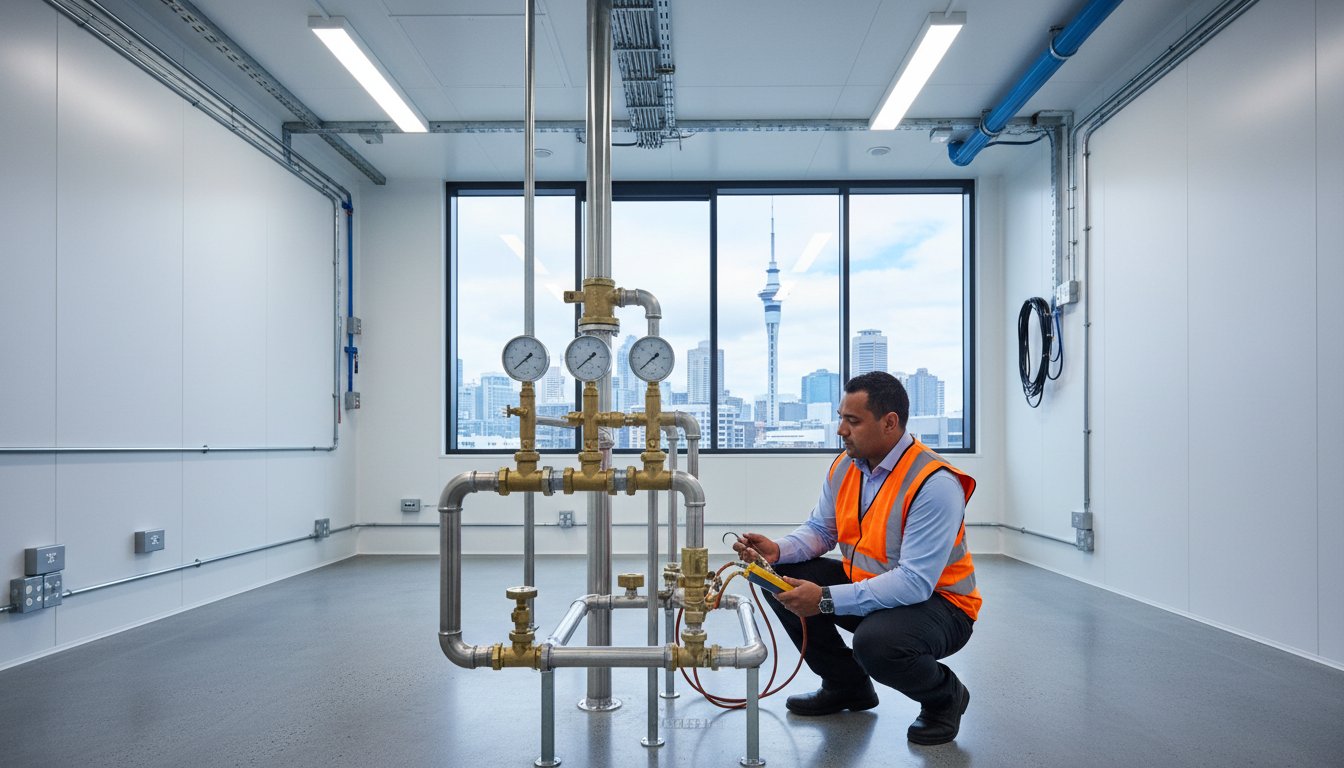




A single measurement error in a high-pressure system doesn't just fail an audit; it can trigger a $50,000 product recall or a catastrophic equipment failure on a Fiji industrial site. You've likely felt that spike of anxiety when an auditor scrutinizes your equipment labels, wondering if your documentation will actually hold up under pressure. It's a common frustration for New Zealand's technical teams who need more than just a "traceable" sticker to ensure international trade compliance.
We understand that you need certainty, not just a service. This article clarifies exactly what is calibration traceability and why this unbroken chain of comparisons is the only thing standing between your operations and a major safety or legal risk. As NZ's leading experts with over 35 years of experience, we've seen how the right certification protects your reputation and your bottom line.
You'll learn to navigate the metrological hierarchy, from your local workshop to the Measurement Standards Laboratory (MSL) and beyond. We'll also provide a practical checklist to verify your IANZ certificates, giving you total confidence that your measurements meet the highest global standards for accuracy and safety.
• Understand how an unbroken chain of documented comparisons links your local measurements to international standards for guaranteed accuracy.
• Gain a clear understanding of what is calibration traceability and the six essential elements required to maintain a valid, defensible measurement result.
• Learn how to navigate legal requirements in New Zealand and Fiji to protect your operations from the risks of untraceable measurement failures.
• Discover how to verify accreditation logos like IANZ and interpret traceability statements on your certificates to ensure compliance and quality.
• Explore why a total solution approach—combining world-class reference equipment with expert lineage—is the key to achieving the lowest possible measurement uncertainty.
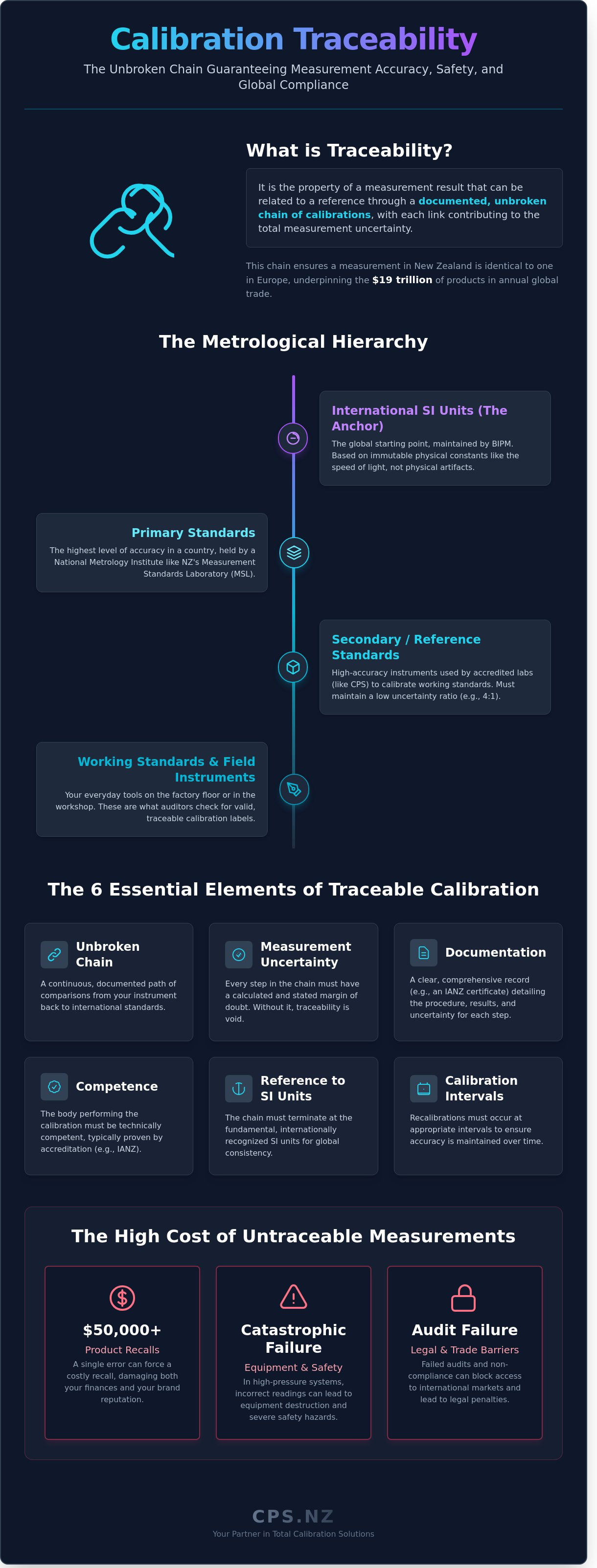
Understanding what is calibration traceability starts with recognizing that a measurement is only as reliable as its history. In the technical world of metrology, traceability is defined as the property of a measurement result whereby the result can be related to a reference through a documented unbroken chain of calibrations. Each link in this chain must contribute to the measurement uncertainty. Think of it as a verified pedigree for your instrumentation. Without this documented history, a reading on a pressure gauge or a digital thermometer is just an isolated number without verified context.
The "unbroken chain" metaphor is a literal requirement in quality management. If a single link is missing or undocumented, the entire measurement process loses its technical standing and legal validity. This chain connects your onsite workshop tools to secondary standards, then to national standards, and eventually to international benchmarks. This rigorous system ensures that a kilopascal measured in a New Zealand dairy factory is identical to a kilopascal measured in a European laboratory. This consistency forms the bedrock of global trade. Approximately $19 trillion of products cross international borders annually, and every one of those transactions relies on shared, traceable technical specifications.
Many operators mistake a simple comparison for a calibration. If you compare two gauges and they show the same reading, you haven't performed a traceable calibration. You've simply confirmed they agree with each other at that specific moment. True Measurement traceability requires a comparison against a reference standard of higher accuracy that is itself part of the traceable chain.
The hierarchy of standards is structured to manage precision. It typically follows this path:
These are the everyday tools used for calibrations in the field or on the factory floor.
These are high-accuracy instruments used to calibrate working standards. Accredited labs, like those at CPS with over 35 years of experience, maintain these to strict tolerances.
These represent the highest level of accuracy within a national metrology institute.
Each step down the hierarchy adds a layer of measurement uncertainty. Metrologists often target a 4:1 test uncertainty ratio to ensure the higher standard is sufficiently precise to verify the tool below it.
The International Bureau of Weights and Measures (BIPM) has maintained the global infrastructure for measurement since the Metre Convention was signed on May 20, 1875. For over a century, traceability relied on physical artefacts, such as the international prototype of the kilogram. However, physical objects can change over time due to environmental factors. On May 20, 2019, the system shifted to rely entirely on fundamental physical constants. These include the speed of light and the Planck constant, which are immutable laws of nature.
The International System of Units (SI) serves as the globally agreed-upon starting point for all traceable measurements, ensuring every measurement is anchored to universal physical constants rather than a physical object in a vault. This shift ensures that what is calibration traceability today remains a constant and reliable standard for centuries to come.
Establishing what is calibration traceability involves more than just a paper trail; it requires a rigorous, six-part framework that ensures every measurement is defensible. Without these elements, a calibration certificate is merely a piece of paper without technical weight. To maintain a "total solution" for your facility, you must ensure each of the following components is present:
This starts at your facility's device and leads directly back to national or international standards, such as those held by MSL in New Zealand or NIST in the USA.
Every link in the chain must have a calculated and stated uncertainty. You cannot claim traceability if you don't know the margin of doubt for each comparison.
Each step must be recorded in a detailed calibration certificate that identifies the specific standards used, the environmental conditions, and the raw data.
The laboratories performing the work must demonstrate technical proficiency, typically through formal accreditation like ISO/IEC 17025.
The chain must eventually terminate at the International System of Units (SI), ensuring a universal language of measurement.
Traceability is not permanent. Standards must be recalibrated at defined intervals to account for drift and wear.
No measurement is 100% perfect. Whether you're measuring 100 PSI or 500°C, there's always a small margin of doubt. Uncertainty quantifies this doubt. In a traceable chain, uncertainty "stacks" as you move further from the primary standard. A primary standard might have an uncertainty of 0.001%, while the working gauge on your factory floor might have 1.0%. It's a common mistake to confuse accuracy with uncertainty; accuracy is a qualitative target, while uncertainty is the statistical reality of the measurement's reliability. If your certificate doesn't state the uncertainty, it isn't truly traceable.
Technical ability is the most critical link in the chain. Many businesses mistakenly believe an ISO 9001 certification is enough for a calibration lab. It isn't. ISO 9001 is a management standard, while ISO/IEC 17025 is the global "gold standard" for technical competence. Accreditation bodies like IANZ (International Accreditation New Zealand) perform deep-dive audits to ensure a lab's equipment, staff, and methods are capable of delivering precise results. We've seen many "box movers" claim expertise, but without IANZ accreditation, they can't prove their technical link in the traceability chain. You can view our accredited services to see how we maintain these rigorous standards for every client.
Understanding what is calibration traceability isn't just a technical exercise; it's a legal and operational safeguard for every industrial site. In New Zealand, businesses must adhere to specific NZ Standards to remain compliant. Fiji operates under the National Weights and Measures Act, which mandates that any equipment used for trade or safety must be accurate. When an accident occurs or a product fails, the first thing an investigator examines is the calibration log. If you're caught in the "untraceable measurement" trap during an audit, your insurance may be voided, and your site could face immediate closure.
The stakes are highest in safety-critical applications. For example, traceable pressure relief valves act as the final line of defense against catastrophic boiler or tank explosions. Without a certificate that traces back to a national standard, there's no proof that the valve will lift at the set pressure. This is why we don't just "check" equipment. We provide a total solution that links every device to a recognized reference point.
The same principles of traceability are equally vital in other high-stakes fields, such as the medical industry, where the accuracy of patient monitoring accessories is critical for patient safety. To explore how these standards apply in a healthcare context, you can check out Cables and Sensors.
International trade depends on this chain. The ILAC Mutual Recognition Arrangement (MRA) allows Fiji exporters to use NZ-calibrated tools to meet global requirements. This means a fish processing plant in Suva can use a thermometer calibrated in our Auckland lab to satisfy a buyer in the European Union. It removes technical barriers and ensures that a kilogram in Nadi is exactly the same as a kilogram in London.
International Accreditation New Zealand (IANZ) is the hallmark of technical competence in our region. CPS (NZ) Ltd has invested in IANZ-accredited labs for over 35 years to ensure our customers receive world-class service. We support Fiji businesses by offering a bridge to these high-level standards, ensuring local industries aren't left behind. For specific details on regional compliance, refer to The Fiji Guide to Accredited Instrument Calibration.
Precise pressure gauge calibration is essential in high-stakes environments like geothermal power plants or refineries. A measurement error of only 3% can lead to significant energy waste or equipment fatigue. In Fiji's food processing sector, temperature traceability is the difference between a successful export and a total loss. If a cold chain log shows a 1-degree discrepancy that lacks a traceable history, an entire shipment of perishable goods might be rejected at the border. Broken traceability in steam systems or logistics doesn't just cost money; it ruins reputations and compromises public safety.
This focus on preventing waste is also central to modern energy management. Platforms that support standards like ISO 50001 rely on accurate, traceable data to function effectively; to see a leading example, you can visit Intelli-EMS.
When you receive a certificate, you're looking for proof of an unbroken chain. Understanding what is calibration traceability involves more than a quick glance at the header. You're verifying that the measurement can be linked back to the International System of Units (SI) through a documented path. This document is your primary defense during a quality audit, so it must be technically sound.
Look for the IANZ (International Accreditation New Zealand) logo or the ILAC MRA mark. These symbols prove the lab's competence has been independently verified to ISO/IEC 17025 standards.
A valid certificate must explicitly state the reference standards used. It should list the specific instrument, its serial number, and its own calibration expiry date to prove the chain was active during your test.
Traceability is incomplete without a statement of measurement uncertainty. If your process requires a tolerance of ±0.2% but the lab reports an uncertainty of ±0.5%, your traceability chain doesn't support your specific quality requirements.
Don't assume a lab is accredited for everything. Check the IANZ directory to ensure they're accredited for the specific range and instrument type you've submitted. A lab accredited for 200 bar pressure cannot provide a traceable certificate for a 700 bar gauge.
Watch out for certificates that use vague language. Phrases like "Traceable to National Standards" without naming the specific laboratory or standard are common signs of a broken chain. In the last 12 months, we've seen several instances where "pass/fail" results were issued without any supporting uncertainty data. This makes the certificate technically invalid for high-stakes audits. Always ensure the reference equipment listed wasn't expired at the time of your calibration.
Traceability doesn't end when the tool returns to your workshop. You must maintain an internal asset log that tracks calibration dates and certificate numbers for every device. It's also vital to distinguish between a "Calibration Check", which is an intermediate verification, and a "Full Calibration" performed by an accredited lab. Ensuring engineering standards are met through rigorous documentation is the only way to guarantee what is calibration traceability in a practical, industrial sense.
If you're unsure if your current documentation holds up to IANZ scrutiny, we can help. Contact our accredited laboratory team to review your requirements and ensure your instruments are backed by a world-class chain of accuracy.
Understanding what is calibration traceability is only the beginning. For 36 years, CPS (NZ) Ltd has acted as the definitive link in the measurement chain for industries across New Zealand and the Pacific. We don't operate as a simple importer that sells hardware to make a quick profit. Instead, we provide a total solution that includes the lineage, the technical support, and the accredited documentation required for high-stakes compliance.
Our Auckland-based facility utilizes world-class reference equipment to deliver the lowest possible measurement uncertainty. This precision is vital for our clients in Fiji and New Zealand who require absolute certainty in their data. When you invest in our calibration equipment sales, you receive a "plug and play" solution. Every device arrives with the necessary traceable certificates, pre-calibrated and ready for immediate deployment in the field. This eliminates the downtime usually associated with sourcing new tools and then sending them off for initial certification.
Since 1988, we've supported the Pacific’s most demanding sectors, including oil, gas, and power generation. We believe in personalized service that goes beyond a pass or fail result; our technicians explain the "why" behind your calibration data. We also address the practical side of what is calibration traceability by focusing on the entire kit. We provide the specific fittings, high-pressure hoses, and rugged carry cases that protect your instrumentation. This ensures your equipment maintains its accuracy during transport to remote sites, as 90% of measurement drift occurs due to poor handling or environmental stress.
Our IANZ-accredited laboratory in Auckland serves as the backbone of our operations, providing a bridge between international standards and local applications. We consistently reinvest 15% of our annual revenue into new technology to stay at the top of the traceability hierarchy. This commitment ensures that we remain NZ's leading experts in pressure, temperature, and electrical instrumentation. We offer a level of technical competence that simple resellers cannot match, ensuring your audit trail is always bulletproof.
Secure your measurement accuracy today. Don't risk your compliance on unverified measurements. Contact the CPS team today to secure the traceability of your critical instrumentation and experience the total package in calibration excellence.
Maintaining an unbroken chain of measurement isn't just a compliance box to tick; it's the foundation of every result your facility produces. By understanding what is calibration traceability, you ensure your equipment meets the 6 essential elements required for global standards. This technical rigour protects industries across New Zealand and Fiji from costly measurement errors and safety failures. You shouldn't settle for a simple certificate when your reputation relies on documented, verified precision.
CPS (NZ) Ltd has operated as a total solution provider for over 35 years. Our IANZ Accredited Laboratory delivers the deep expertise needed to keep your operations running. We don't just supply a gauge; we provide the fittings, the hoses, and the world-class reference equipment to ensure your instruments perform correctly in the field. Trusting your measurements to seasoned experts means you'll never be left stranded with unverified data or technical gaps.
Ensure your equipment is traceable with our IANZ Accredited Calibration Services
We're here to help you build a more accurate future for your business.
NIST traceable means a measurement is linked to National Institute of Standards and Technology benchmarks through an unbroken chain. Understanding what is calibration traceability is vital here, as it's the link to the physical standard. ISO 17025:2017 accreditation is a formal recognition of a laboratory's technical competence. While traceability is a requirement of ISO 17025, an unaccredited lab can claim it without the independent verification that accreditation provides.
You can have traceability without an accredited calibration, but you must manually document the entire chain of certificates and uncertainty budgets. Most quality standards, such as ISO 9001, require verifiable evidence of this chain. Without an IANZ or similar accredited seal, you'll need to provide the calibration reports for every reference standard used in the process to satisfy a Tier 1 auditor.
A calibration certificate is typically valid for 12 months, though the specific interval depends on your internal quality manual and the instrument's stability. Some high-precision pressure sensors require 6-month cycles to maintain a 0.01% accuracy rating. You shouldn't rely on a "standard" date; instead, use historical drift data to set a schedule that ensures your equipment stays within its defined tolerance.
Traceability isn't mandatory for every gauge in a plant, but it's essential for any instrument that impacts product quality, safety, or regulatory compliance. In a typical dairy processing facility, 100% of the sensors on the pasteurisation line require traceability. Conversely, a general pressure gauge on a non-critical wash-down hose doesn't need a formal certificate to function effectively for its basic purpose.
Any repair to an instrument's internal components immediately voids its current calibration status and breaks the traceability chain. You must perform a full "as-left" calibration before returning the device to service. If a technician replaces a 4-20mA transmitter circuit, the previous certificate no longer represents the hardware's performance. A new calibration restores the link to national standards and confirms the repair's success.
A "Factory Calibration" only counts as traceable if the manufacturer provides a certificate listing the specific reference standards used and their own traceability to a national body. Some lower-cost imports only include a "statement of conformity," which lacks the 5 or 6 levels of documentation needed for a true audit trail. Understanding what is calibration traceability helps you distinguish between a simple functional check and a valid metrological record.
The ILAC MRA allows calibration certificates from IANZ-accredited labs in New Zealand to be legally accepted in Fiji and 100+ other signatory countries. Because the Fiji Republic is a member of the Pacific Accreditation Cooperation, they recognise the technical equivalence of our laboratory standards. This means a pressure gauge calibrated in our Auckland facility meets the same international requirements as one tested by a local Fijian authority.
A broken traceability chain occurs when an instrument is calibrated using a reference tool that doesn't have its own valid, documented calibration. You fix this by sending the equipment to an IANZ-accredited laboratory for a fresh calibration against certified standards. This process reinstates the link to the International System of Units (SI). We've seen 15% of new clients come to us specifically to repair these documentation gaps.