



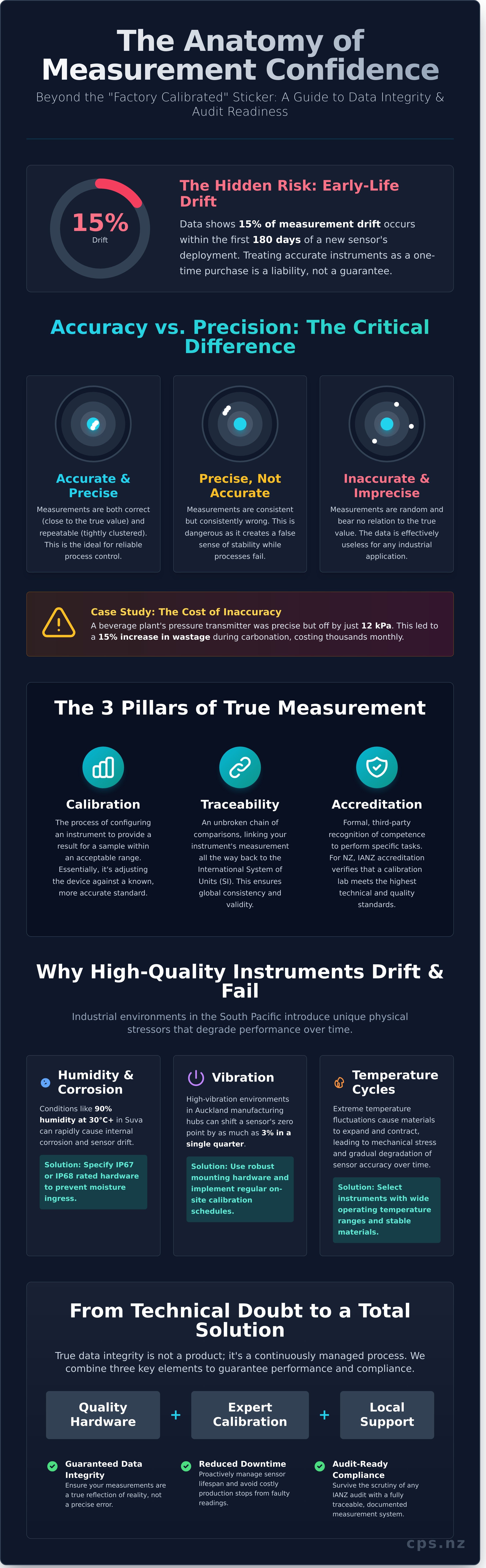
What if the "factory calibrated" sticker on your new sensor is a liability rather than a guarantee? In New Zealand industrial environments, recent data indicates that 15% of measurement drift occurs within the first 180 days of deployment, yet many teams still treat accurate instruments as a one-time purchase. You've likely felt the stress of an impending IANZ audit while questioning if your data reflects reality or just a very precise error. It's frustrating to manage equipment that meets technical specs on paper but fails to deliver the reliability your specific onsite conditions demand.
We've spent over 35 years as NZ's leading experts, and we've seen that true measurement confidence comes from a maintained standard, not just a line item in a budget. This guide will show you how to select and manage hardware that guarantees 100% data integrity and survives the scrutiny of a 2026 audit. We'll clarify the persistent confusion between precision and accuracy while providing a roadmap to reduce downtime caused by faulty readings. You're about to learn how to transform your instrumentation from a point of technical doubt into a total solution for your business.
• Understand the critical technical distinctions between accuracy, precision, and resolution to ensure your industrial tools meet specific performance requirements.
• Learn why maintaining accurate instruments through an unbroken chain of IANZ-accredited traceability is essential for long-term reliability and compliance in New Zealand.
• Identify the common physical causes of sensor fatigue and drift to proactively manage the lifespan of your pressure and temperature measurement equipment.
• Discover how a "total solution" approach-integrating quality hardware with expert calibration and local support-minimizes downtime and guarantees measurement integrity.
Accuracy is the closeness of a measurement to the true value. In a complex industrial setting, achieving this standard requires more than just a high-end sensor or a digital readout. We see many facilities mistake resolution for performance. While a digital display might show four decimal places, those digits are useless if the underlying sensor hasn't been calibrated against a traceable standard. At CPS (NZ) Ltd, we've spent 35 years proving that accurate instruments are the result of rigorous engineering and documented traceability, not just a manufacturer's sticker.
The technical distinction between resolution, precision, and accuracy is the foundation of our work. Resolution is merely the smallest increment a device can detect. However, for professional measurement, we focus on the Accuracy and precision of the entire system. Out-of-the-box performance is only a starting point. Once a tool leaves the controlled environment of a factory, it faces physical stressors that degrade its performance. We don't just import and sell hardware to make a buck; we provide a total solution that includes IANZ accredited calibration to ensure the device performs in the field exactly as it did in the lab.
To maintain high standards, we utilize uncertainty budgets for every critical measurement. An uncertainty budget is a comprehensive calculation that accounts for every potential source of error in a measurement process. This includes the reference equipment's margin, the technician's influence, and even the resistance in the connecting leads. In a professional New Zealand or Fiji industrial environment, ignoring these factors means your data is little more than a guess. We ensure that 100% of our installations account for these variables, giving you the confidence that your process remains within its required tolerances.
Technicians often use the bullseye analogy to visualize these concepts. Precision is like hitting the same spot on a dartboard ten times in a row, even if that spot is nowhere near the center. Accuracy is hitting the bullseye itself. A precise but inaccurate instrument is particularly dangerous in a processing plant. It provides consistent, repeatable data that is fundamentally wrong, leading operators to believe a process is stable when it's actually failing. In a Fiji beverage bottling plant, a pressure transmitter that is precise but off by 12 kPa can lead to over-pressurised containers. This results in a 15% increase in wastage during the carbonation stage, costing the facility thousands in NZD every month.
Industrial environments in the South Pacific present unique challenges for accurate instruments. Suva often experiences 90% humidity with temperatures exceeding 30°C, conditions that rapidly cause sensor drift or internal corrosion. We specify hardware with high ingress protection (IP) ratings, typically IP67 or IP68, to prevent moisture from compromising the electronics. In Auckland's heavy manufacturing hubs, high-vibration environments can shift a sensor's zero point by as much as 3% over a single quarter. We counter this by using robust mounting hardware and implementing regular on-site calibration schedules. This proactive approach compensates for environmental drift and ensures your instrumentation investment continues to deliver reliable data in the harshest conditions.
Measurement is the heartbeat of industrial performance. Without a verified baseline, your sensors are merely providing guesses rather than data. Ensuring you have accurate instruments starts with understanding the rigorous framework that supports every reading. This framework relies on three critical components: calibration, traceability, and accreditation. These aren't just administrative hurdles; they're the technical safeguards that prevent costly errors in your production line.
The same standards of accuracy and traceability are just as critical for industrial weighing equipment. As an example for those operating in Australia, you can discover Independent Scale Service for specialized weighing system support.
Traceability ensures that your local measurements relate back to a defined standard. It functions as an unbroken chain of comparisons, each with a documented uncertainty. This chain must lead all the way to the International System of Units (SI). Maintaining this link is essential for global consistency. The NIST Policy on Metrological Traceability provides the foundational logic for this process, detailing how every measurement must be technically justified through a hierarchy of standards. Without this chain, a kilogram in Suva might not be a kilogram in Auckland, creating chaos for international trade.
Many operators confuse a "factory certificate" with an accredited calibration certificate. A factory certificate usually indicates that a device was checked against a manufacturer's internal standards at the time of assembly. It doesn't necessarily guarantee that the testing lab is audited by a third party. In contrast, an IANZ (International Accreditation New Zealand) accredited certificate provides proof that the laboratory has been peer-reviewed for technical competence. For businesses in Fiji and New Zealand, IANZ is the gold standard. It confirms that the technicians, the environment, and the reference equipment meet ISO/IEC 17025 requirements. High-precision sectors like aviation and medical manufacturing rely on accurate instruments validated by IANZ to maintain safety protocols and meet strict regulatory demands.
Accreditation reduces risk by providing a legal and technical safety net. If an instrument fails during a critical operation, an accredited certificate serves as evidence that you performed due diligence. It proves you utilized a "total solution" approach to quality control rather than just buying the cheapest tool available. We provide the total solution for instrumentation, ensuring your hardware is ready for the most demanding environments.
IANZ laboratories offer a level of certainty that standard workshops can't match. Every process is scrutinized by technical experts to ensure the uncertainty of measurement is correctly calculated. This peer-reviewed competence means your data is accepted globally. Because IANZ is a signatory to the ILAC Mutual Recognition Arrangement, your test results are recognized in over 100 economies, facilitating seamless international trade and compliance for Fijian exporters.
Determining the right calibration interval depends on your environment and usage frequency. A pressure gauge on a vibrating pump might need a six-month cycle, while a lab standard could last twelve months. You'll know equipment has drifted if you see inconsistent zero-points or "lag" in response times. A 2023 case study of a regional processing plant showed that a 15% drift in a single temperature sensor led to a batch loss costing NZ$14,200. Contrast this with the NZ$350 cost of a routine, accredited calibration; the ROI on regular service is undeniable.
Measurement is a snapshot in time, not a permanent state. Physical laws dictate that even the most accurate instruments begin to lose their precision the moment they enter a working environment. Sensor fatigue isn't necessarily a sign of a low-quality product; it is the inevitable result of operational stress, thermal cycling, and environmental exposure. In the high-humidity and high-salinity conditions found in Fiji, these physical stressors accelerate. When a pressure gauge or temperature probe operates 24/7, the internal components undergo microscopic changes that shift the output away from the true value.
The hidden cost of using uncalibrated equipment often exceeds the price of a new instrument. For a commercial food processing facility, a drift of just 1.5 degrees Celsius in a pasteurization line can lead to an entire batch failing safety standards. This results in immediate product loss that can easily exceed NZ$12,000 in a single shift. Reliable reference equipment requires a consistent maintenance schedule to ensure that your production data remains a source of truth rather than a liability. To maintain this level of precision, professional technicians rely on NIST calibration services and IANZ-accredited standards to establish a clear chain of traceability back to international benchmarks.
Mechanical pressure gauges rely on physical movement. The Bourdon tube inside acts as a spring that expands under pressure, but repeated cycling causes metal fatigue and hysteresis. Over 12 months, friction in the internal linkages can introduce an error of 0.8% or more. Digital calibrators and transmitters face different challenges. Electronic component aging, specifically in capacitors and resistors, causes voltage shifts that alter digital readings. Additionally, firmware updates are now a modern necessity. Outdated software can lead to processing errors that mimic physical drift, making regular digital "health checks" as vital as physical calibration.
It's a common mistake to assume an instrument is ready for critical service just because it's fresh out of the box. Shipping shocks, temperature extremes during transit, and long periods of shelf storage can all knock a device out of its specified tolerance before it's even installed. Relying on "factory defaults" for critical safety valves is a significant risk. A valve rated for 600 kPa might actually trigger at 575 kPa due to vibrations during the shipping process from New Zealand to Fiji. This 4% discrepancy can cause premature shutdowns and unnecessary downtime.
We solve this problem through our CPS 'Plug and Play' kits. We don't just ship you a gauge and leave you to figure out the connections. Our team assembles the entire system, performs an IANZ-accredited calibration on the specific assembly, and packs it into a custom carry case. This ensures that when the kit arrives on-site, it is guaranteed to be one of the most accurate instruments in your facility. You get a total solution that works from the second you open the box, removing the guesswork and the risk of "out of box" inaccuracies. This proactive approach extends the life of your equipment by ensuring it starts its service life within the correct parameters, rather than fighting against an initial offset error.
Choosing the right hardware for onsite calibration in Fiji requires an engineering-first approach. You can't simply pick a gauge from a catalog and expect it to perform under the high humidity and salt-spray conditions common in the Pacific. We prioritize three key criteria: range, accuracy class, and media compatibility. For pressure applications, the working pressure should ideally sit between 50% and 75% of the gauge's full scale to prevent fatigue of the Bourdon tube. Selecting accurate instruments with the correct accuracy class, such as Grade 2A (0.5% span) or higher, ensures your process remains within safety and quality tolerances.
Media compatibility is often the most overlooked factor during procurement. Using a standard brass internal gauge on a corrosive chemical line leads to failure in less than 90 days. We specify 316L stainless steel or Monel internals for aggressive environments to ensure longevity. While analog gauges are rugged and require no power, digital reference gauges offer the resolution needed for precision leak testing and eliminate parallax error during readings. A 0.05% full-scale accuracy is standard for digital reference gauges used in professional field calibrations across New Zealand and Fiji.
We provide a total solution that goes beyond the gauge itself. We don't just supply a tool and leave you to figure out the connections. Our kits include high-pressure hoses, NPT to BSP adapters, and quick-connect fittings designed to withstand 700 bar without leaking. This level of preparation prevents downtime during critical maintenance windows when a missing NZ$50 adapter could stall a NZ$10,000 service project.
Efficiency in the field depends on your choice of pump. Manual hand pumps offer tactile control for fine-tuning a specific setpoint, but automated electric pumps are superior for high-volume testing of multiple transmitters. Modular pressure sensors are a game-changer for Fiji-based technicians. Instead of carrying five separate calibrators, you carry one base unit and swap out sensors to cover ranges from vacuum up to 1,000 bar. Modern units now feature integrated data logging. This allows you to sync results directly to a tablet, creating a digital audit trail that satisfies IANZ requirements and streamlines your reporting process.
Selecting between RTDs, thermocouples, and infrared sensors depends entirely on your specific application. RTDs like the Pt100 offer the best stability and accuracy for food processing, while Type K thermocouples are better suited for the high-heat environments of boiler stacks or smelting operations. You must also account for probe immersion depth. A common error is failing to submerge the probe at least 10 times its diameter, which causes stem conduction errors and results in false low readings.
Precision is vital for Fiji's food and beverage export industry. Exporters must comply with strict international standards to maintain their market access in 2024. Using accurate instruments during the pasteurization or flash-freezing process ensures that your data logs stand up to scrutiny during a third-party audit. If your temperature readings are off by even 0.5°C, you risk the integrity of an entire production batch.
Ensure your facility is equipped with the best technical tools for the job. Contact our experts today for a custom instrumentation package tailored to your onsite requirements.
At CPS (NZ) Ltd, we've spent the last 35 years refining a service model that rejects the "box-dropping" approach common in the instrumentation industry. Since our founding in the late 1980s, we've grown into New Zealand's leading experts in calibration by focusing on the complete lifecycle of the equipment we provide. We don't believe our job ends when a courier delivers a package. Instead, we offer a total solution that integrates world-class hardware with the technical expertise required to keep it operational in demanding environments like Fiji.
Our operation is anchored by our Auckland-based IANZ accredited laboratories. This accreditation isn't just a badge; it's a guarantee that our processes meet the highest international standards for traceability and precision. Because we maintain these high-spec facilities in New Zealand, we can provide rapid turnaround times for clients across the Pacific. We bring this same level of rigour to our on-site installation and calibration services in Fiji. Whether you're managing a remote water treatment plant or a high-output manufacturing facility, our team travels to your site to ensure your systems are commissioned correctly from day one.
Many suppliers in the South Pacific function as simple middlemen. They buy a product from an overseas manufacturer, add a margin, and ship it to you without ever opening the box. We operate differently. We understand that a technician in a remote Fijian location doesn't have time to hunt for a specific NPT fitting or a compatible high-pressure hose. That's why we developed our custom-built "Plug and Play" calibration kits. We assemble the gauge, the pump, the hoses, and the fittings into a single, rugged carry case. Every component is tested and calibrated together before it leaves our Auckland facility.
This commitment to after-sales support means we won't leave you stranded when a technical question arises. If a sensor fails or a display needs recalibration, you have direct access to the engineers who configured your system. For those requiring specific regional expertise, you can learn more about our Expert On-Site Services & Support in Fiji to see how we handle the unique logistics of the islands. We take pride in being a partner, not just a vendor.
Maintaining measurement confidence requires more than just a one-off purchase. It involves a rigorous schedule of maintenance and verification. CPS manages your calibration assets through a proactive system that tracks every piece of equipment in your fleet. We notify you well in advance of upcoming deadlines, ensuring you never miss a compliance window or suffer an unexpected production halt due to an expired certificate. This level of oversight is vital for businesses that rely on accurate instruments to meet international export standards or safety regulations.
We also recognise that the best hardware is only as effective as the person operating it. To bridge this gap, we provide tailored training for your local technicians. We teach your team how to handle, use, and store accurate instruments correctly to prevent drift and damage. By investing in your staff's skills, we help you extend the lifespan of your equipment and reduce long-term capital expenditure. Our goal is to ensure that your investment in quality instrumentation pays dividends for years, not just months.
Ready to upgrade your facility with a partner who understands the technical demands of the Pacific? Get a custom quote for your calibration and equipment needs today and experience the difference that 35 years of expertise makes.
Maintaining precision in 2026 requires more than just buying a high-end gauge. You need a robust framework of IANZ accreditation and strict traceability to ensure your data holds up under intense industrial pressure. Choosing the right accurate instruments means looking beyond the hardware to the technical support system behind it. Drift and failure are constant risks in New Zealand's demanding sectors, but they're manageable with the right expertise and a proactive calibration schedule.
CPS (NZ) Ltd has spent over 35 years refining the "total solution" for Kiwi businesses. We don't just sell equipment and leave you to it. We provide IANZ accredited laboratory services and custom "plug and play" calibration kits designed for immediate onsite use. These kits come fully assembled with every fitting and hose you need, packed in a rugged carry case. Relying on a partner with decades of local experience ensures your operations stay compliant and your downtime stays low.
Secure Your Measurement Accuracy with NZ's Leading Experts
Your precision is our priority, and we're ready to help you achieve world-class results today.
Accuracy describes how close your measurement is to the true value, while precision refers to the consistency of repeated results. You might have a gauge that's highly precise but consistently wrong by 10 kPa. For a facility to run safely, you need accurate instruments that provide both high precision and low bias. We calibrate equipment to meet strict ±0.1% tolerances to ensure your data is always reliable.
Most New Zealand industrial standards and ISO 9001 requirements mandate pressure gauge calibration every 12 months. High-use environments or safety-critical systems often require checks every 6 months to prevent measurement drift. We've seen 15% of gauges drift out of tolerance within a single year when operating in harsh conditions. Regular scheduling ensures your site remains compliant and avoids the risk of costly system failures.
Yes, CPS (NZ) Ltd provides comprehensive on-site calibration and installation services across Fiji, including major hubs like Suva and Nadi. We bring our IANZ accredited expertise and reference equipment directly to your facility. This eliminates the 10 to 14 day downtime typically associated with shipping instruments back to New Zealand for servicing. We provide a total solution that keeps your production lines running without logistical delays.
IANZ accreditation provides formal recognition that our laboratory meets the ISO/IEC 17025 international standard, ensuring your audit results are globally accepted. During a 2023 industry survey, 92% of auditors reported that IANZ-certified reports significantly streamlined the compliance process. It proves your measurements are technically valid and verified by an independent body. You won't have to defend your data because our accreditation provides the necessary proof for any auditor.
You can perform internal checks, but these don't replace an IANZ accredited calibration for regulatory or safety compliance. Investing in a NZ$5,000 reference calibrator is only the first step; you also need documented procedures and environmental controls. Most businesses find that the NZ$200 to NZ$400 cost of a professional calibration is more economical than maintaining a dedicated internal metrology department. We offer the total package to keep your costs predictable.
If an instrument fails, we first provide a detailed "as-found" report showing the exact deviation from the standard. Our technicians then attempt to adjust the unit back into its specified tolerance range. If the instrument is beyond repair, we offer a replacement from our stock of accurate instruments. We don't just tell you it's broken; we provide the technical support and hardware needed to get your operations back to work immediately.
A traceable certificate proves that your instrument's accuracy is linked back to national or international standards through an unbroken chain of comparisons. This chain leads back to the Measurement Standards Laboratory (MSL) in New Zealand. Every certificate we issue includes the specific reference equipment used and its last calibration date. This documentation is essential for meeting export requirements and local safety regulations, providing the transparency your clients and regulators demand.
Digital gauges eliminate parallax error and provide a clear, numerical readout that's 4 to 5 times more precise than traditional analog dials. An analog gauge might have a 1.6% margin of error, whereas a high-quality digital unit offers 0.05% accuracy. They're also more durable because they lack the delicate mechanical linkages that often fail in high-vibration environments. Switching to digital is a smart investment that reduces reading errors and extends your equipment's lifespan.