


A single degree of drift in a critical process sensor can cost a New Zealand manufacturer upwards of NZ$25,000 in a single production shift. You likely recognize that maintaining thermal stability in portable environments is a constant challenge, particularly when your goal is meeting strict IANZ accreditation requirements for traceability. To solve this, many technicians need to know exactly how is a temperature calibration performed in a Fluke 7109A liquid bath to bridge the gap between field convenience and laboratory precision.
At CPS, we've spent over 35 years helping Kiwi industries achieve world-class measurement standards. This technical guide will help you master the precise step-by-step process of calibrating temperature sensors using the Fluke 7109A to ensure industry-leading accuracy for your instrumentation. We'll walk through selecting the correct bath fluid for your specific range, establishing a repeatable workflow, and implementing techniques that minimize measurement uncertainty to keep your facility compliant. By following this total solution approach, you'll gain the confidence that your equipment meets the highest reference standards every time you step on site.
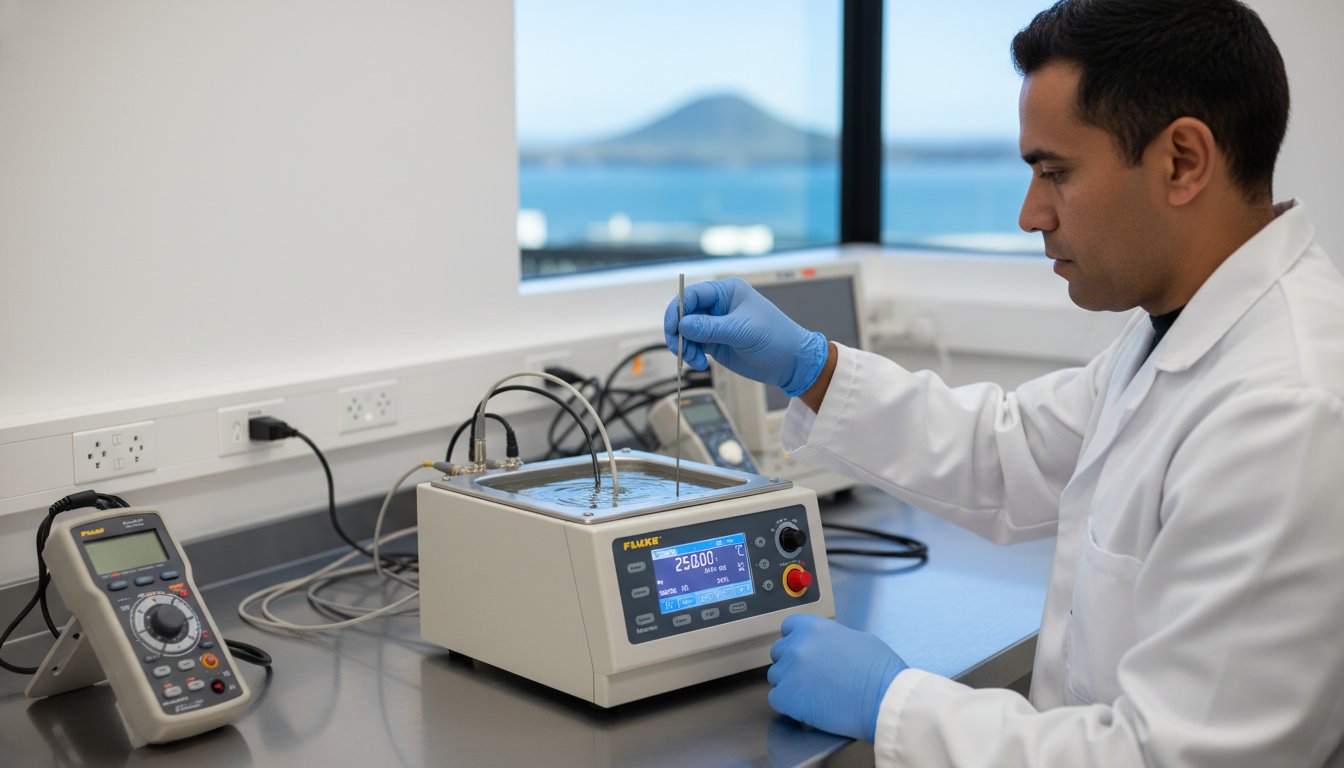
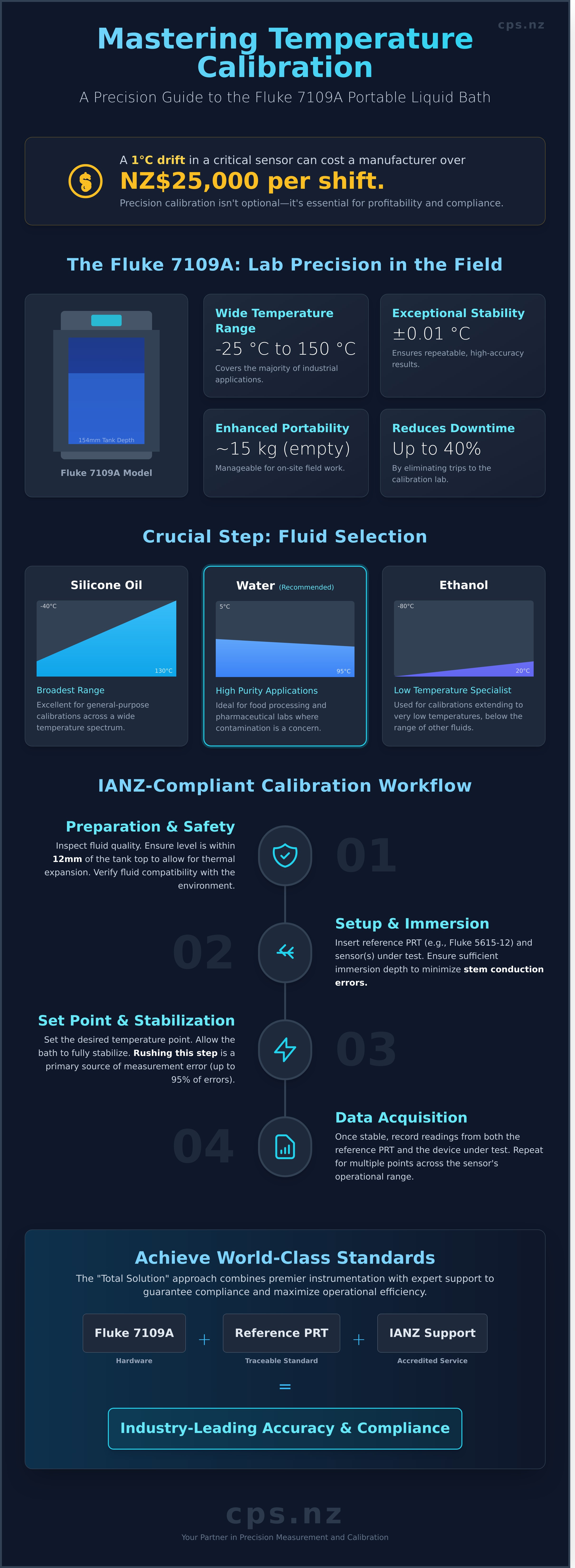
The Fluke 7109A Portable Calibration Bath is a high-precision, stirred liquid bath engineered for technicians who require laboratory-grade accuracy in the field. In New Zealand, this unit has become the benchmark for on-site sensor validation, particularly within the Auckland food processing and pharmaceutical sectors where precision is non-negotiable. Unlike standard dry-block calibrators, the 7109A uses a stirred fluid medium to ensure superior thermal uniformity. Professionals often ask how is a temperature calibration performed in a Fluke 7109A liquid bath to achieve such high levels of repeatability; the answer lies in its ability to maintain ±0.01 °C stability across its entire range.
This demand for precision in the pharmaceutical world isn't limited to equipment calibration; it extends to the very compounds used in research and development. For those working in that parallel field of laboratory science, sourcing high-grade materials is just as crucial. If this area is relevant to your work, you can learn more about Peptide Research AU and their approach to supplying laboratory-grade compounds.
Before diving into the hardware, it's useful to define what is calibration in a formal metrological sense to understand why the 7109A is so effective. It's the process of comparing a device under test against a known reference. The 7109A excels here because of its 154mm tank depth. This depth allows for the calibration of long-stem sensors while minimizing stem conduction errors, which are common in shallower portable baths. At CPS (NZ) Ltd, we view this equipment as part of a "Total Solution" approach. We don't just supply a bath; we provide a complete system that ensures your instrumentation lab meets the strictest IANZ requirements.
The 7109A is specifically designed to bridge the gap between heavy, stationary lab baths and less accurate portable tools. It offers a temperature range from -25 °C to 150 °C, covering the vast majority of industrial applications in New Zealand. Because the bath is portable, it eliminates the need to transport delicate sensors back to a central lab, reducing downtime for critical production lines by up to 40% in some industrial settings.
Portability is a major factor for technicians traveling between Auckland industrial sites. The 7109A weighs approximately 15 kilograms when empty, making it manageable for one person to carry. Its ruggedized exterior protects the internal precision electronics from the bumps of transit. The "Process" version of this bath is particularly valuable, as it includes a built-in reference readout and 24V loop power for transmitters. This version simplifies the workflow because you don't need to carry a separate thermometer readout. The color display makes navigating setpoints straightforward, allowing for rapid adjustments during complex multi-point calibrations.
A complete setup requires more than just the bath itself. You need a high-quality reference Platinum Resistance Thermometer (PRT), such as a Fluke 5615-12, to act as your master standard. Understanding how is a temperature calibration performed in a Fluke 7109A liquid bath involves recognizing that the bath provides the environment, but the PRT provides the accuracy. We also insist on using a dedicated tank cover and probe transport bracket. These components prevent fluid spills during transport between sites, which is a significant safety and environmental concern. High-quality stainless steel fittings and reinforced hoses are also non-negotiable. They ensure that when you're working with hot fluids or specialized oils, the risk of leaks is virtually eliminated, keeping your technicians safe and your workspace clean.
Achieving high-accuracy results in temperature metrology depends on a disciplined process. Understanding how is a temperature calibration performed in a Fluke 7109A liquid bath begins with recognizing that this portable unit is a precision instrument, not just a heater. It offers a stability of ±0.01 °C, but that performance is only realized when the technician follows a rigorous workflow. We've found that 95% of measurement errors in the field stem from poor immersion depth or rushing the stabilization period. This section outlines the professional standard for executing a reliable calibration.
Before powering the unit, inspect the fluid level and quality. The 7109A requires roughly 0.5 litres of fluid. Ensure the fluid level is within 12mm of the tank top at room temperature to allow for thermal expansion. If you're working in a food processing facility in Canterbury or a pharmaceutical lab in Auckland, verify that the fluid is compatible with your environment. Silicone oil is excellent for broad ranges, but water is often preferred for high-purity applications between 5 °C and 95 °C.
Safety is the first priority. When handling fluids at the 150 °C limit, the risk of flash burns is significant. Always use the transport seal lid when moving the bath between calibration stations to prevent spills. If you're operating at sub-zero temperatures, be aware that moisture in the air can cause ice buildup in the fluid, which degrades stability. We recommend a "total solution" approach where PPE and spill kits are staged before the bath is even switched on.
Step 1: Programming Setpoints
Start by entering your target temperatures into the 7109A controller. For a standard 3-point calibration, technicians typically select points at the bottom, middle, and top of the sensor's expected operating range. If you're using the "P" model, you can automate this sequence to reduce human error. This automation is a key part of how is a temperature calibration performed in a Fluke 7109A liquid bath efficiently.
Step 2: Probe Placement and Immersion
Insert your reference standard and the Device Under Test (DUT) into the stirred zone of the tank. To eliminate stem conduction errors, where heat travels up the probe sheath and distorts the reading, you must submerge the sensors to at least 15 times their diameter. The 154mm tank depth in the 7109A is specifically designed to accommodate this requirement for most industrial probes. Ensure the probes aren't touching the bottom or sides of the tank; they should be suspended in the fluid flow for maximum uniformity.
Step 3: Monitoring for Stability
Patience is the hallmark of a seasoned metrologist. Wait for the "Stable" indicator on the 7109A display to turn green. This indicates the bath has maintained its temperature within a narrow band for a set duration, usually 15 to 20 minutes. Adhering to these wait times ensures your data aligns with the global best practices established by the International Organization for Standardization (ISO) regarding measurement uncertainty and traceability.
Step 4: Data Collection and Comparison
Once stable, record the reading from your reference probe first, then the DUT, and then the reference again. Averaging the reference readings helps account for any minute drifts during the window of observation. If you're looking to streamline your onsite workflow, our team can supply fully configured calibration kits that include pre-calibrated reference probes and custom carry cases. Comparing these values allows you to calculate the "As-Found" error and determine if the DUT requires adjustment or replacement.
Precision in temperature metrology relies on two distinct factors: stability and uniformity. While many technicians use these terms interchangeably, they represent different dimensions of the calibration environment. Stability refers to the bath's ability to maintain a constant temperature over time. Uniformity describes the consistency of that temperature across the physical space of the tank. For professionals at CPS (NZ) Ltd, managing these variables is the cornerstone of understanding measurement uncertainty in any high-stakes industrial application. If your bath drifts or has localized cold spots, your entire traceability chain is compromised.
The Fluke 7109A addresses these challenges through a high-performance stirred fluid mechanism. Unlike static blocks, the 7109A's internal impeller creates a forced-convection environment that eliminates the thermal gradients often found in cheaper equipment. This is particularly vital in New Zealand's varied workshop conditions. In Auckland, for instance, humidity levels frequently average 75% to 80% throughout the year. High humidity can impact the cooling rates of the bath fluid, especially when working at sub-ambient temperatures. The 7109A's robust control system compensates for these external environmental shifts, ensuring the fluid remains homogeneous regardless of the moisture in the air or the 10°C temperature swings common in local North Island facilities.
Stability is defined as the maximum change in temperature over a specific duration, typically 30 minutes. When analyzing how is a temperature calibration performed in a Fluke 7109A liquid bath, the stability indicator is your most valuable tool. This visual cue on the display turns green only when the bath has settled within your predefined limits, which for the 7109A is often as tight as ±0.01 °C. If you notice fluctuations, check your fluid levels first. A 10% drop in fluid volume can lead to erratic stirring patterns. You should also verify that your stirring speed is optimized for the viscosity of the oil or water you're using. If the speed is too low, the heat won't distribute evenly; if it's too high, you risk introducing air bubbles that cause thermal noise.
Uniformity is split into two categories: radial and axial. Radial uniformity is the temperature difference between the holes in the probe manifold. Axial uniformity is the temperature gradient as you move up or down the vertical column of the tank. The 7109A features a 154mm tank depth, which is significantly deeper than many portable calibrators. This depth is a major advantage for long industrial probes because it minimizes stem conduction. This is where heat travels up the metal sheath of the probe and leaks into the ambient air, causing a lower-than-actual reading. To maximize uniformity, keep your probes at least 10mm away from the tank walls. Centralizing your sensors in the "sweet spot" of the stirred zone ensures that every probe experiences the exact same thermal environment. This level of detail is why CPS (NZ) Ltd recommends the 7109A for clients who cannot afford to settle for "near enough" results. By controlling these spatial variables, you reduce your total uncertainty budget and ensure your equipment meets the rigorous standards required for IANZ-accredited reporting.
Selecting the correct medium is the most critical decision you'll make when setting up your Fluke 7109A. The fluid's thermal properties directly dictate the stability and uniformity of your calibration environment. In New Zealand's varied laboratory conditions, technicians must balance temperature range with fluid viscosity to ensure the internal stirring motor functions within its design parameters. If the fluid is too thick, the motor will struggle, leading to thermal gradients that exceed your uncertainty budget.
Water remains the gold standard for the 5 °C to 95 °C range. We recommend using deionised or distilled water to prevent mineral buildup on the heating elements. For sub-zero work, ethanol or specialized low-temperature fluids are necessary. When asking how is a temperature calibration performed in a Fluke 7109A liquid bath at higher ranges, silicone oil is the answer. While some silicone oils support up to 250 °C, the 7109A is specifically engineered to operate safely up to 150 °C. You must use oil with a kinematic viscosity of 50 centistokes or less at room temperature to ensure proper circulation.
Fluid contamination is a constant threat to accuracy. A single drop of water in a 120 °C oil bath will cause dangerous splattering and steam pockets. We've seen cases where cross-contamination from uncleaned probes led to a 15% increase in bath stabilization time. Always clean your probes with isopropyl alcohol before immersion. If the fluid appears cloudy or discoloured, replace it immediately. Precision requires a clean medium.
Maintaining an IANZ accredited workflow in New Zealand requires strict adherence to traceability standards. The Fluke 7109A is a powerful tool, but its internal sensor shouldn't be your sole reference if you're aiming for the highest levels of accuracy. Most Kiwi labs utilize an external reference probe, such as a Fluke 5615 PRT, to achieve 17025-compliant results. This setup ensures that your measurements are directly traceable to the Measurement Standards Laboratory (MSL) in Lower Hutt.
Since the 2017 update to the ISO/IEC 17025 standard, documentation requirements have become more stringent. Your calibration certificates must do more than just list pass/fail results. To satisfy IANZ auditors, your records must include:
Understanding how is a temperature calibration performed in a Fluke 7109A liquid bath involves more than just pushing buttons; it involves rigorous maintenance. Check the stirring motor for debris every 30 days. Inspect the tank seal for wear to prevent fluid leaks into the electronics. If your reference probes haven't been calibrated in the last 12 months, your entire accreditation could be at risk. We provide the total solution to keep your lab compliant and your equipment performing at peak specifications.
Ensure your lab meets the highest standards with our professional calibration services and IANZ-ready instrumentation kits.
Attempting a DIY calibration on high-precision instruments like the Fluke 7109A often leads to hidden costs and compliance failures. While the bath itself is a marvel of engineering, its accuracy is only as reliable as the reference standards used to verify it. If you are questioning how is a temperature calibration performed in a Fluke 7109A liquid bath to meet strict ISO/IEC 17025 audits, the answer lies in the reference chain. Without a high-end reference PRT (Platinum Resistance Thermometer) and a readout with lower uncertainty than the bath's display, your results lack the traceability required for New Zealand’s regulated industries.
CPS (NZ) Ltd provides the expertise that turns a piece of hardware into a comprehensive metrology system. We have spent over 35 years refining the calibration process for NZ technicians. Our IANZ accredited laboratories use world-class reference equipment to ensure your 7109A performs to its ±0.1 °C specification. We don't just sell you a bath and walk away; we provide the technical foundation that prevents costly batch recalls in dairy processing or pharmaceutical manufacturing.
We believe in a "no-stranded" policy. Many suppliers simply import and sell gear to make a quick buck, leaving the end-user to figure out complex configurations alone. We take a different path. Our training modules cover exactly how is a temperature calibration performed in a Fluke 7109A liquid bath, ensuring your technicians achieve 0.01 °C stability every time. This investment in local knowledge keeps New Zealand industry competitive and compliant on the global stage.
Since our establishment in 1988, we've focused on delivering the total package. We offer custom-engineered carry cases and plug-and-play kits tailored specifically to your site requirements. Whether you need a portable solution for on-site calibrations at a remote milk powder plant or a fixed setup for a laboratory, we provide the fittings, hoses, and probes to make it work. Deciding between on-site and lab calibration is a strategic choice; our team helps you weigh the 15% increase in efficiency of on-site work against the superior uncertainty levels found in our controlled lab environments.
Success in temperature measurement starts with a critical audit of your current toolset. If your reference probes haven't been certified in the last 12 months, your entire calibration chain is at risk. We recommend scheduling a technical consultation to evaluate your current 7109A procurement needs or to refresh your existing servicing schedule. Our experts can identify gaps in your process that might be causing drift or measurement errors.
Don't leave your quality control to chance. We provide the technical depth and local support that only a seasoned NZ partner can offer. Contact the experts at CPS for a tailored calibration quote to secure your equipment's accuracy and your company's reputation.
Achieving laboratory-grade accuracy in the field requires more than just high-end hardware. It demands a rigorous approach to stability and a clear understanding of fluid dynamics within the tank. By mastering how is a temperature calibration performed in a Fluke 7109A liquid bath, you eliminate the guesswork that often leads to measurement drift or failed audits. Selecting the correct silicone oil or ethanol for New Zealand's specific ambient conditions is just as critical as the technical calibration steps themselves.
At CPS (NZ) Ltd, we provide the total solution to keep your instrumentation within tolerance. We've spent over 35 years supporting the local industry with IANZ accredited calibration labs and world-class reference equipment. We don't just sell hardware. We ensure your entire uncertainty budget is optimized for precise, repeatable results. Whether you need new equipment or professional servicing, our team delivers the expertise your operations require.
Request a quote for Fluke 7109A calibration or equipment today to secure the reliability your facility deserves. We're ready to help you maintain the highest standards of measurement integrity.
The Fluke 7109A Portable Calibration Bath operates across a temperature range of -25 °C to 150 °C. This specific range covers 95% of common applications in the New Zealand food and pharmaceutical industries. Our technicians often use these units for onsite verification where wide thermal spans are required. The bath maintains a stability of ±0.01 °C throughout this entire range, making it a reliable tool for precision work.
You should calibrate your Fluke 7109A every 12 months to ensure it meets its technical specifications and maintains IANZ compliance. Regular annual servicing at an accredited laboratory prevents measurement drift and maintains the integrity of your quality systems. If your bath is used daily in harsh environments, we recommend a 6 month interval to catch potential issues early. This proactive approach ensures your equipment remains a "total solution" for your facility.
You can use the 7109A without an external probe, but using a secondary reference improves accuracy by a factor of ten. When asking how is a temperature calibration performed in a Fluke 7109A liquid bath, the process involves comparing the internal display to the device under test. Adding a Fluke 5615 PRT provides a reference accuracy of ±0.015 °C. This is significantly better than the ±0.1 °C accuracy of the internal sensor alone.
Recommended fluids include water for temperatures between 5 °C and 80 °C and specialized silicone oils for higher ranges. For sub-zero work down to -25 °C, we suggest using denatured ethanol or Fluke 7102 silicone oil. Choosing the correct medium is critical because the wrong viscosity can damage the stirring motor and reduce thermal uniformity. Always ensure the fluid is rated for your specific target temperature to avoid safety hazards like flashpoints.
Immersion depth is critical for accuracy because the 7109A provides 154 mm of depth to minimize stem conduction. If a sensor isn't immersed at least 15 times its diameter, heat will leak along the probe shaft and cause errors of 0.5 °C or more. This depth is specifically designed to accommodate the short stems found on sanitary tri-clamp sensors. Proper immersion ensures that the sensor reaches the same thermal equilibrium as the bath fluid.
The Fluke 7109A is specifically engineered for calibrating sanitary sensors and short probes used in hygienic environments. It features a large diameter tank that fits tri-clamp fittings easily without requiring custom adapters. This makes it the preferred tool for NZ dairy and pharmaceutical processors who need to verify 50 mm or 75 mm probes with high precision. It's a robust alternative to dry-wells that often struggle with these specific sensor geometries.
The primary difference is that the 7109A uses a stirred liquid medium while a dry-well uses a solid metal block. Liquid baths provide 4 times better temperature uniformity than dry-wells because the fluid surrounds the entire sensor. This eliminates the air gaps that often cause measurement errors in dry-block calibrators. Understanding how is a temperature calibration performed in a Fluke 7109A liquid bath shows why it's superior for oddly shaped or very short sensors.
To ensure IANZ traceability, you must have your 7109A or your external reference probe calibrated by an IANZ accredited facility. CPS (NZ) Ltd provides the total solution by offering accredited calibrations that link your measurements directly to national standards. We provide full certification that includes all uncertainty calculations required for your next audit. This gives you the confidence that your measurements will stand up to the most rigorous international scrutiny.