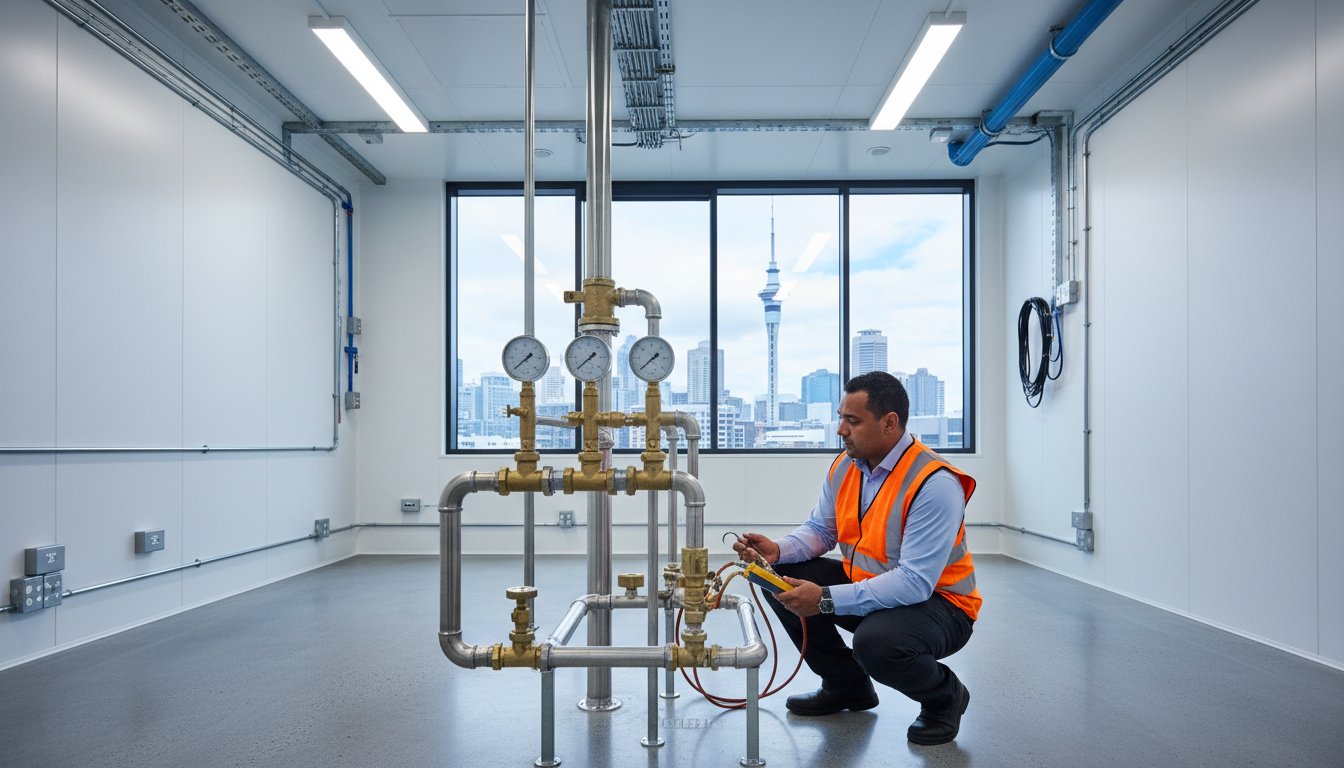



Faced with a wall of technical specifications and confusing accuracy classes, selecting the right calibration equipment can feel like a daunting task. You need to ensure your instrumentation is reliable, but how do you know what level of precision is truly required for your application? More importantly, how can you be certain your choice will satisfy New Zealand's stringent IANZ compliance standards and ensure complete traceability for your industrial processes?
This practical guide is designed to provide clear, confident answers. We will walk you through the essential factors to consider when choosing calibrators for pressure, temperature, or electrical tasks. You will learn how to confidently match equipment to your specific needs, understand the critical role of IANZ accreditation, and find a reliable NZ-based partner who provides a total solution-not just a product off the shelf. By the end, you'll have the knowledge to improve the accuracy, compliance, and efficiency of your entire operation.
•
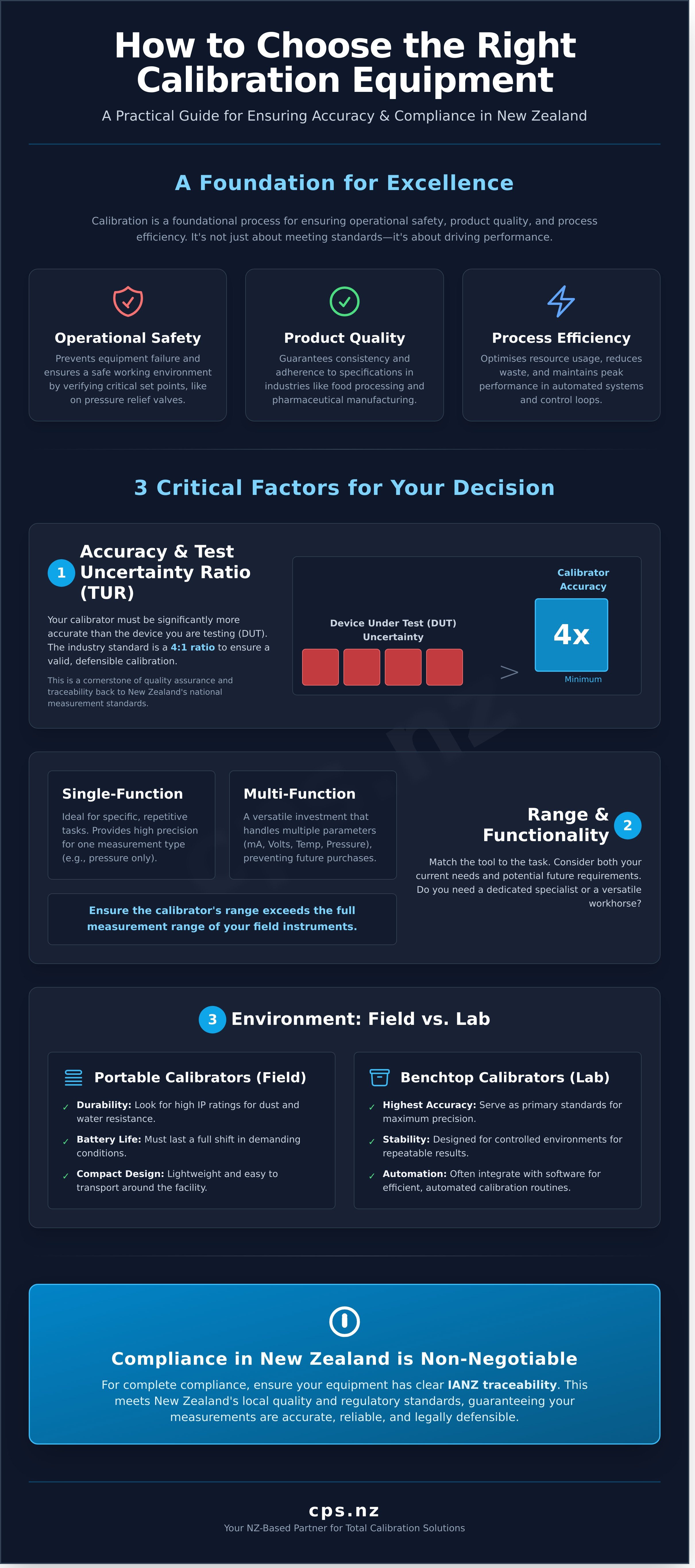
Understand that calibration is a foundational process for ensuring operational safety, product quality, and process efficiency in your facility.
•
Choosing the right calibration equipment is application-specific; evaluate factors like accuracy, pressure range, and portability to make an informed decision.
•
An effective setup is a complete system, often requiring specific accessories like hoses, fittings, and pumps to perform accurate measurements in the field.
•
For compliance in New Zealand, ensure your equipment has clear IANZ traceability to meet local quality and regulatory standards.
•
Understanding the Core Types of Calibration Equipment
•
How to Choose: Key Factors for Selecting the Right Calibrator
•
A Closer Look: Common Pressure Calibration Setups
•
Essential Accessories: Building a Complete Calibration Kit
•
Compliance in New Zealand: Why IANZ Traceability Matters
In any precision industry, accurate measurement is the foundation of quality, safety, and efficiency. This is achieved through calibration-the process of comparing the readings of an instrument being tested, known as the Device Under Test (DUT), against a measurement standard of known accuracy. To understand the fundamentals of what is calibration, it's essential to recognise its purpose: to detect, correlate, and minimise any discrepancy in the DUT's accuracy. Using specialised calibration equipment is not optional; it is a non-negotiable requirement for maintaining operational integrity, ensuring product quality, and meeting strict regulatory compliance across New Zealand's industries.
To simplify the vast range of instrumentation available, we group equipment by the physical quantity it measures.
This category includes a wide array of tools, from portable handheld pressure pumps and digital gauges for fieldwork to highly accurate deadweight testers that serve as primary standards in a lab. For high-volume work, automated pressure calibrators provide unmatched efficiency and repeatability. This equipment is vital for process control in manufacturing, dairy processing, and energy sectors, as well as for critical safety tasks like verifying the set points of pressure relief valves.
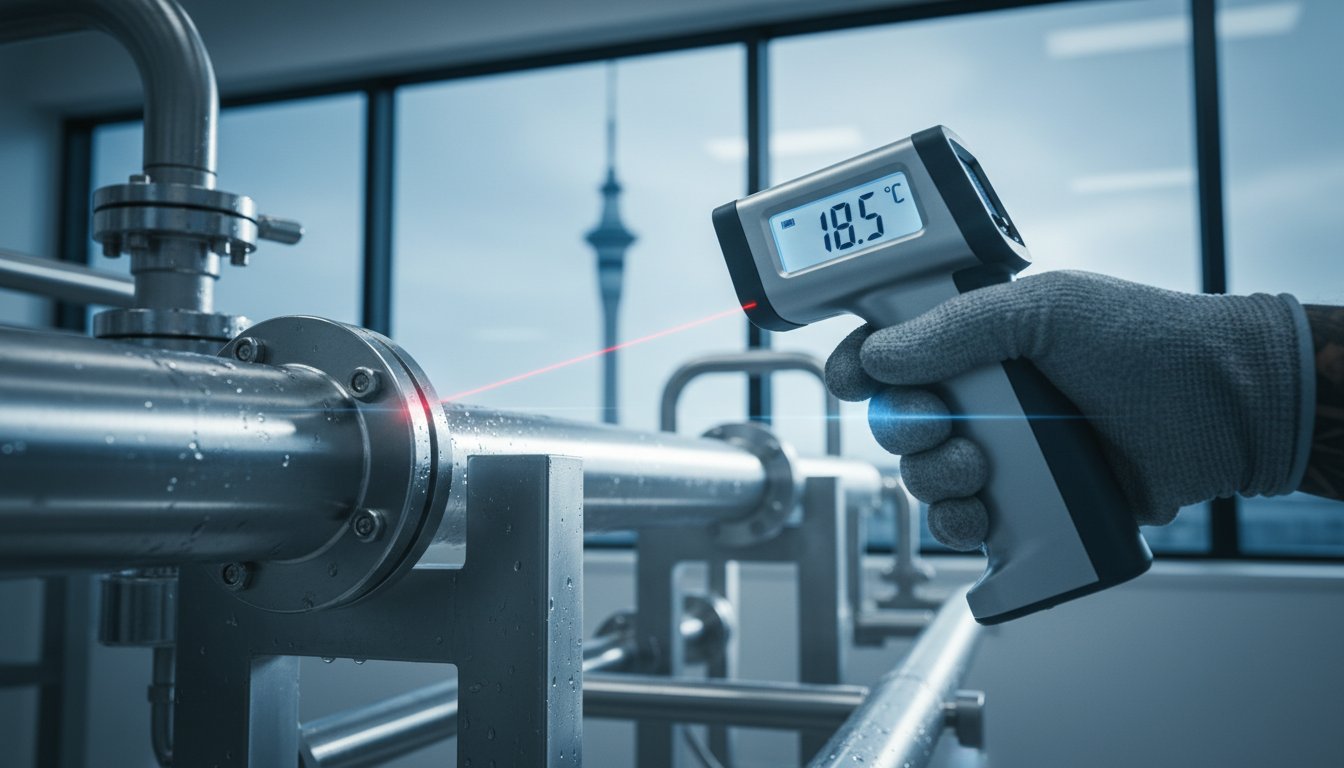
Maintaining precise temperature is critical for safety and quality. Key tools include dry-block calibrators for convenient field and workshop use, high-stability liquid baths for superior accuracy, and infrared (IR) calibrators for non-contact measurements. Additionally, temperature simulators are used to test and calibrate sensors like RTDs and Thermocouples directly. These instruments are indispensable in food processing, pharmaceutical manufacturing, and HVAC system management.
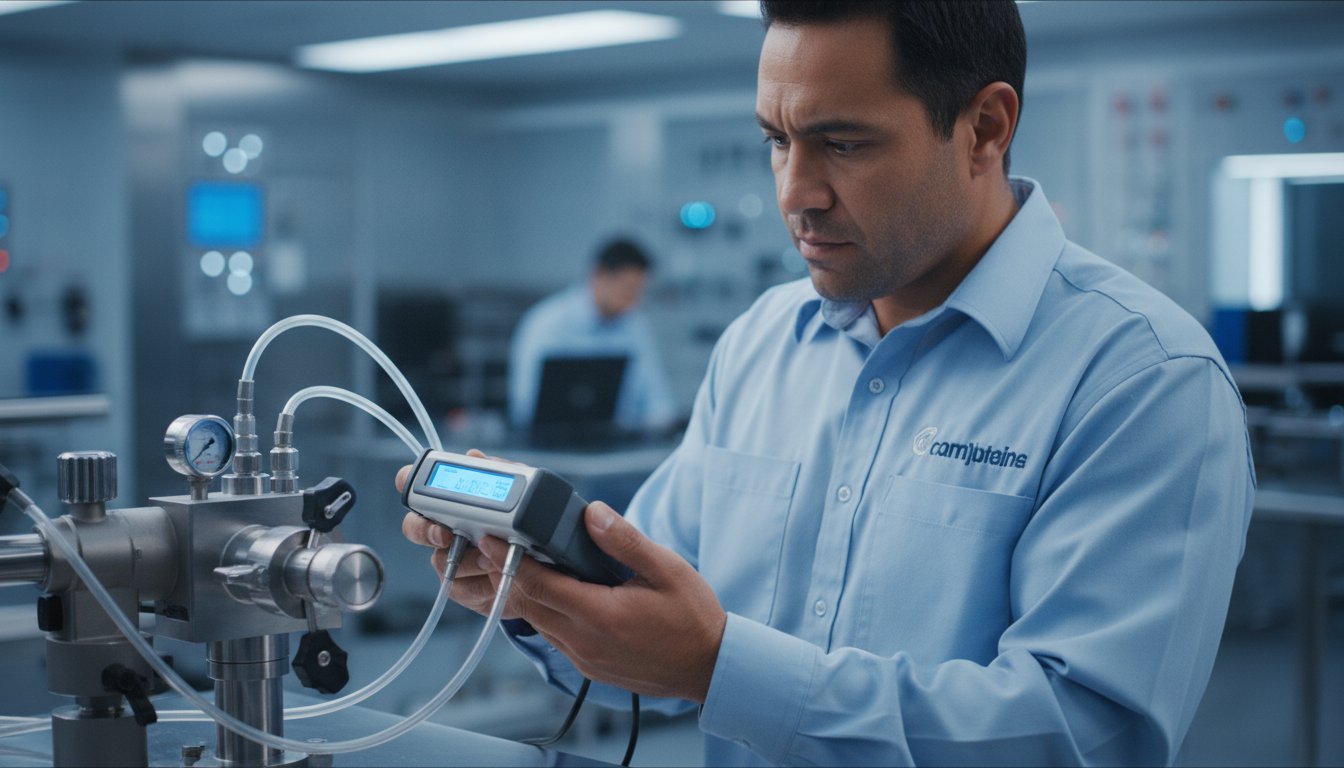
The backbone of modern automation relies on accurate electrical signals. This range of calibration equipment includes precision digital multimeters, versatile multifunction calibrators, and specialised process calibrators designed to source and measure signals like milliamps (mA) and volts (V). They are essential for testing sensors, transmitters, and entire control loops, making them daily tools for electricians, automation engineers, and I&C technicians maintaining plant operations.
Selecting the right calibration equipment is a critical investment that directly impacts your operational quality, safety, and efficiency. The 'best' calibrator is not the most expensive one, but the one that precisely fits your application. Moving beyond the initial purchase price to consider the total cost of ownership-including maintenance, training, and potential downtime-is essential. This checklist will guide you through the key factors to ensure you choose a tool that is neither over-specified and costly nor under-equipped for your critical tasks.
A calibrator's accuracy specification defines how close its measurements are to the true value. This is often expressed as a percentage of the reading (e.g., ±0.025% of reading). To ensure a valid calibration, your reference standard must be significantly more accurate than the device under test (DUT). The industry standard for this is the Test Uncertainty Ratio (TUR), which is typically 4:1. This means your calibrator should be at least four times more accurate than the instrument you are calibrating. This ensures your measurements are defensible and traceable back to New Zealand's national measurement standards, a cornerstone of quality assurance.
The calibrator you choose must be able to cover the full measurement range of your field instruments. Whether you're measuring pressure, temperature, or electrical signals like mA and Volts, verify that the calibrator’s range exceeds that of your DUTs. Consider if you need a single-function device, like a dedicated pressure calibrator, or a multi-function process calibrator that can handle multiple parameters. While a single-function unit may be ideal for a specific, repetitive task, investing in a versatile multi-function tool now can prevent the need for additional purchases as your needs evolve.
Your work environment dictates the physical form of your calibrator.
•
Portable Calibrators: Designed for field technicians, these handheld units prioritise durability (look for IP ratings for dust and water resistance), long battery life, and a compact, lightweight design for easy transport.
•
Benchtop Calibrators: These are the workhorses of a dedicated calibration lab or workshop. They offer the highest levels of accuracy and stability and often integrate with software for automated calibration procedures, making them ideal for high-volume work.
In modern quality systems, how you manage calibration data is as important as the measurement itself. Calibrators with internal memory and data-logging capabilities eliminate manual transcription errors and create a reliable audit trail. Furthermore, software integration can automate calibration procedures, manage your asset database, and generate professional calibration certificates with ease. This functionality transforms a calibrator from a simple measurement device into a comprehensive tool for process management and compliance.
Pressure is one of the most fundamental and frequently measured variables across New Zealand's industrial sectors. Accurate pressure measurement is critical for safety, efficiency, and quality control. However, a single instrument is rarely enough. A successful calibration depends on a complete system where every component works in harmony. This 'total solution' approach is key to achieving reliable and traceable results, using calibration equipment specifically configured for the task.
Below, we explore three common tiers of pressure calibration setups, from portable field kits to primary laboratory standards.
For routine on-site tasks, a portable field kit provides essential functionality. This setup typically consists of a manual hand pump-either pneumatic for lower pressures (e.g., up to 40 bar) or hydraulic for higher pressures (up to 700 bar or more)-to generate a stable pressure. This pressure is applied simultaneously to the Device Under Test (DUT) and a high-accuracy digital reference gauge. The entire system's integrity relies on using the correct, high-quality hoses and fittings to ensure a secure, leak-free connection.
For applications demanding higher efficiency, repeatability, and precision, an automated pressure calibrator is the modern standard. Advanced portable or benchtop units, like those in the Additel series, integrate a pressure source, controller, and reference measurement into a single device. The technician simply enters the required pressure setpoints, and the calibrator automatically generates and stabilises the pressure with exceptional accuracy. The benefits are significant:
•
Speed: Dramatically reduces the time spent on multi-point calibrations.
•
Repeatability: Eliminates inconsistencies from manual pumping.
•
Reduced Error: Minimises the potential for human error in control and data logging.
At the highest level of the metrology hierarchy is the deadweight tester (DWT). A DWT is a primary standard that defines pressure with unparalleled accuracy by applying precisely known masses to a precision-engineered piston-cylinder assembly. These instruments are not for daily field use; they reside in controlled laboratory environments and serve as the standard for calibrating other high-accuracy reference instruments. The traceability of a DWT is paramount, ensuring its performance is directly linked to New Zealand's national measurement standards and, by extension, international standards.
Whether you need a robust kit for field work or a high-precision laboratory standard, understanding the right combination of tools is crucial. As NZ's leading experts, we provide complete, pre-configured systems to meet your exact requirements. See our comprehensive range of pressure calibration equipment to build the perfect solution for your needs.
A high-quality calibrator is the heart of your toolkit, but it cannot perform its job in isolation. Arriving on-site only to find you lack the correct fitting or a spare battery is a frustrating and costly delay. A complete, well-considered kit of calibration equipment is the mark of a true professional, ensuring every job is performed efficiently and accurately. The key is compatibility, where every accessory works seamlessly with your core instruments.
For pressure calibration, the integrity of your connections is paramount. Low-quality hoses can leak, compromising the accuracy of your readings before you even begin. Technicians often face a maze of thread types, from NPT to BSP, making a secure connection a game of chance. This is where a knowledgeable supplier becomes invaluable. We don't just sell you a calibrator; we ensure you have the correct high-pressure hoses, adapters, and quick-connect fittings to connect to your devices under test, saving you significant time and frustration in the field.
Precision instruments are a significant investment and require robust protection. A durable, custom foam-cut case does more than prevent damage during transport; it provides critical organisation. When every pump, lead, and fitting has its designated place, you can see at a glance that your kit is complete before leaving for a job. This level of organisation ensures you are always prepared and projects an image of professionalism to your clients.
The basics are often what get forgotten. For field work, relying on a single battery is a risk. A comprehensive kit should include spare batteries or a reliable external power supply to avoid downtime. For electrical calibration, a single set of test leads is rarely sufficient. Quality leads with a variety of terminations are essential for connecting to different instruments and panels. A good kit includes:
•
Alligator clips for secure connections
•
Spade lugs for terminal blocks
•
Banana plugs for standard inputs
Building the right kit is about more than just convenience; it's about guaranteeing performance and reliability. At CPS, we specialise in providing the total solution-not just a single instrument, but a complete, field-ready kit tailored to your needs. Contact our experts to build your perfect calibration kit.
In New Zealand, the quality and accuracy of your measurements are not just internal benchmarks; they are often tied to stringent industry regulations and quality assurance standards. Selecting the right equipment is the first step, but ensuring its measurements are verifiably accurate is what guarantees compliance. This is achieved through traceability-an unbroken chain of comparisons linking your instrument back to a national or international standard. This process builds undeniable trust in your results and is essential for any professional operation.
International Accreditation New Zealand (IANZ) is the country's national authority for accrediting testing and calibration laboratories. An IANZ accredited calibration is therefore a formal guarantee of technical competence, impartiality, and performance. The resulting certificate is internationally recognised, providing proof that your equipment has been calibrated in a controlled environment against traceable standards. At CPS, we provide IANZ accredited calibration for the instruments we supply, ensuring they are compliant and ready for service from the moment you receive them.
Owning professional-grade equipment is only the foundation of a robust quality system. To maintain compliance and ensure ongoing accuracy, all of your reference instruments must be on a regular calibration schedule. This isn't just best practice; it's a requirement for most quality management systems and audits. Working with an IANZ accredited laboratory like CPS simplifies this entire process, as we can help manage your schedule, provide reminders, and maintain a complete history for your assets.
Ultimately, achieving and maintaining compliance comes down to choosing the right partner, not just a product off a shelf. A true partner provides expert advice on selecting the most suitable calibration equipment for your specific applications and regulatory needs. We don't just supply a gauge; we provide a total solution. We can build a complete, pre-calibrated kit with all necessary fittings, ready for immediate use in the field, saving you time and eliminating compliance risks. Talk to our experts to build your perfect calibration kit.
Choosing the right calibrator is a critical decision that directly impacts your operational accuracy, efficiency, and compliance. As this guide has shown, a successful selection process involves a clear understanding of core equipment types, a thorough evaluation of environmental and performance factors, and a firm grasp of why IANZ traceability is non-negotiable for New Zealand industries.
You don't have to navigate these complexities alone. With over 35 years of dedicated experience in New Zealand, CPS is your expert partner, not just a supplier. As an IANZ accredited calibration laboratory, we provide total solutions built on trust and technical excellence. We specialise in delivering complete 'plug and play' kits featuring world-class calibration equipment, all tailored precisely to your onsite requirements.
Ensure your measurements are accurate and your compliance is secure. View our comprehensive range of calibration equipment or contact our expert team to discuss a total solution designed for your success.
Calibration involves comparing a device under test against a more accurate reference standard to quantify and correct any deviation. It is a process of adjustment to ensure precision. Verification, on the other hand, is a simpler check to confirm that an instrument is operating within its stated tolerance limits. It is essentially a pass/fail test without any adjustment, confirming the device's ongoing fitness for purpose.
The recalibration interval depends on several factors, including the manufacturer's recommendations, industry standards, frequency of use, and the operational environment. While an annual recalibration is a common industry benchmark, critical instruments used heavily or in harsh conditions may require more frequent service. A robust quality system will define these intervals based on risk and historical performance data to ensure ongoing accuracy and compliance.
A multi-function calibrator is an excellent tool for streamlining the calibration of common process instruments measuring pressure, temperature, and electrical signals. However, it may not be suitable for every application, especially those requiring very high accuracy or specialised functions. It is crucial to assess your complete range of instrumentation to determine if a single unit's specifications cover all your critical requirements or if specialised reference equipment is also needed.
TUR, or Test Uncertainty Ratio, is a comparison of the accuracy between the reference standard and the device being tested. A TUR of 4:1 means your calibrator is at least four times more accurate than the instrument it is calibrating. This is a vital industry benchmark as it ensures the measurement uncertainty from your calibration equipment is minimal, providing high confidence in the calibration results and the performance of your instrument.
No, there is no requirement for your calibrator to be the same brand as the instruments you are testing. The most important factors are that the calibrator’s specifications (such as range and accuracy) are appropriate for the task and that its calibration is traceable to national standards, often through an IANZ accredited laboratory. Performance and traceability always take precedence over brand matching for ensuring accurate, reliable measurements.
Begin by identifying all instruments that require calibration and defining the specific accuracy tolerances for each. The next step is to select the correct reference standards that meet or exceed a 4:1 TUR for your instruments. You must then develop and document clear, step-by-step calibration procedures. Finally, establish a robust record-keeping and recall system to manage schedules and maintain a complete, traceable audit trail for all your assets.