


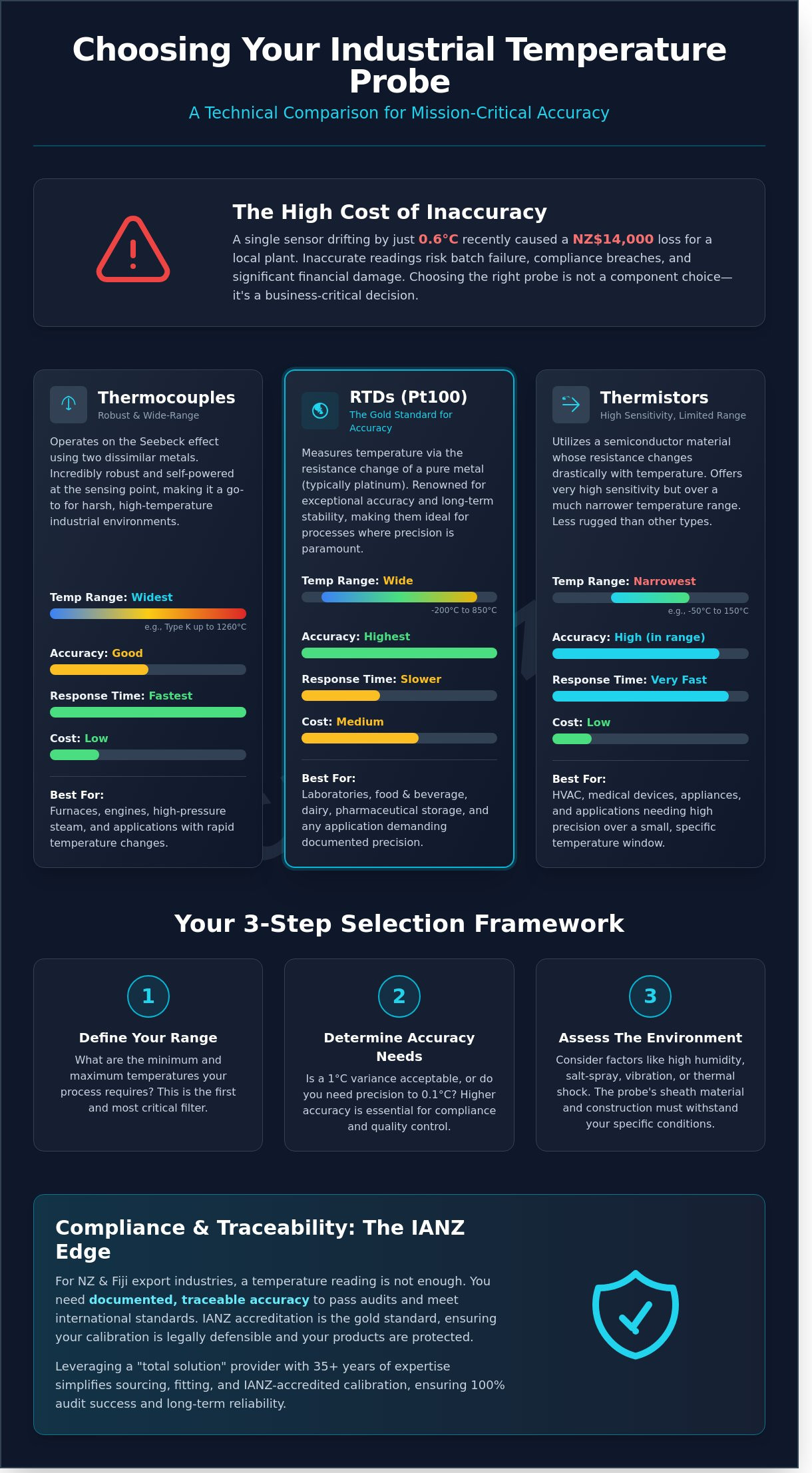
Last month, a local processing plant faced a NZ$14,000 loss when a single sensor drifted by just 0.6°C during a critical production run. It's a frustratingly common scenario in New Zealand when a standard temperature probe fails to withstand high-humidity or corrosive conditions. You understand that your instrumentation is more than just a component; it's the primary safeguard for your quality and your reputation. When readings become unreliable or you struggle to meet IANZ audit requirements, the cost isn't just the hardware, it's the unplanned downtime and the risk of batch failure.
We've spent over 35 years providing the total solution for industrial calibration, and we're here to ensure your systems remain precise and compliant. This guide will show you how to master the technical nuances of probe selection and calibration to achieve 100% audit success and long-term reliability. We'll preview the essential steps to choosing hardware that lasts for years and explain how to maintain the rigorous traceability your industry demands. You'll gain the confidence to manage your instrumentation without the fear of unexpected failures.
• Understand the critical anatomy of professional sensors and why high-grade sheath materials are essential for maintaining measurement integrity in demanding industrial environments.
• Learn how to navigate the technical trade-offs between thermocouples, RTDs, and thermistors to ensure your equipment handles temperatures from cryogenic levels to extreme furnace heat.
• Master a comprehensive selection framework for choosing the ideal temperature probe based on mechanical specs and environmental challenges like salt-spray corrosion and high humidity.
• Discover why IANZ accreditation is the gold standard for New Zealand and Fiji export compliance, ensuring your instrumentation provides more than just a reading, but documented accuracy.
• Find out how leveraging a "total solution" provider with over 35 years of expertise simplifies the complex process of sourcing, fitting, and calibrating your thermal instrumentation.
• What is a Temperature Probe and Why Does Quality Matter?
• Thermocouples vs. RTDs vs. Thermistors: Technical Breakdown
• The Selection Framework: Finding the Right Probe for Your Environment
• Calibration and Compliance: The IANZ Accreditation Edge
• Why CPS is the Leading Choice for Temperature Probes in NZ and Fiji
A professional temperature probe is a precision sensor engineered to measure thermal energy in solids, liquids, or gases through direct physical contact. Unlike basic thermometers, industrial probes are built to withstand the rigours of heavy manufacturing and processing. The anatomy of a high-quality unit includes a durable outer sheath, often 316 stainless steel or Inconel, which protects the internal sensor junction. These junctions typically utilize temperature measurement technologies such as Resistance Temperature Detectors (RTDs) or Thermocouples to convert heat into a readable electrical signal. This signal travels through specialized lead wires, often insulated with PTFE or fibreglass, to a digital indicator or control system.
Many facilities in Auckland or Fiji attempt to use off-the-shelf consumer probes to save on initial costs. This strategy often fails because consumer-grade equipment lacks the ingress protection (IP) ratings required for high-humidity environments. In Suva, where humidity levels frequently exceed 85 percent, moisture can penetrate a poorly sealed probe head, causing immediate sensor failure or significant signal noise. Industrial-grade probes from experts like CPS (NZ) Ltd are designed with hermetic seals and robust connectors that ensure longevity in these exact conditions. We provide the total solution, ensuring your hardware survives the environment it's meant to monitor.
The cost of inaccuracy is the most compelling reason to invest in quality. In food production, a 1.0°C drift in a temperature probe can lead to a batch being held outside of safe HACCP parameters. For a Fiji-based fish exporter, this single degree of error could result in the rejection of a container worth over NZ$45,000 at the destination port. In pharmaceutical storage, the stakes are even higher. If a vaccine fridge drifts by 1.0°C beyond its validated range, the entire inventory might require disposal according to Ministry of Health regulations. Precision isn't just a technical preference; it's a financial necessity.
In Fiji's sugar processing and New Zealand's dairy manufacturing, thermal monitoring is the backbone of safety and quality. High-pressure steam systems require probes that can handle vibration and thermal shock without losing calibration. Export-heavy industries must meet strict regulatory requirements for thermal logging to prove compliance with international standards. Our IANZ accredited labs ensure that every probe we supply provides the traceability needed to satisfy these rigorous audits, protecting your reputation in the global market.
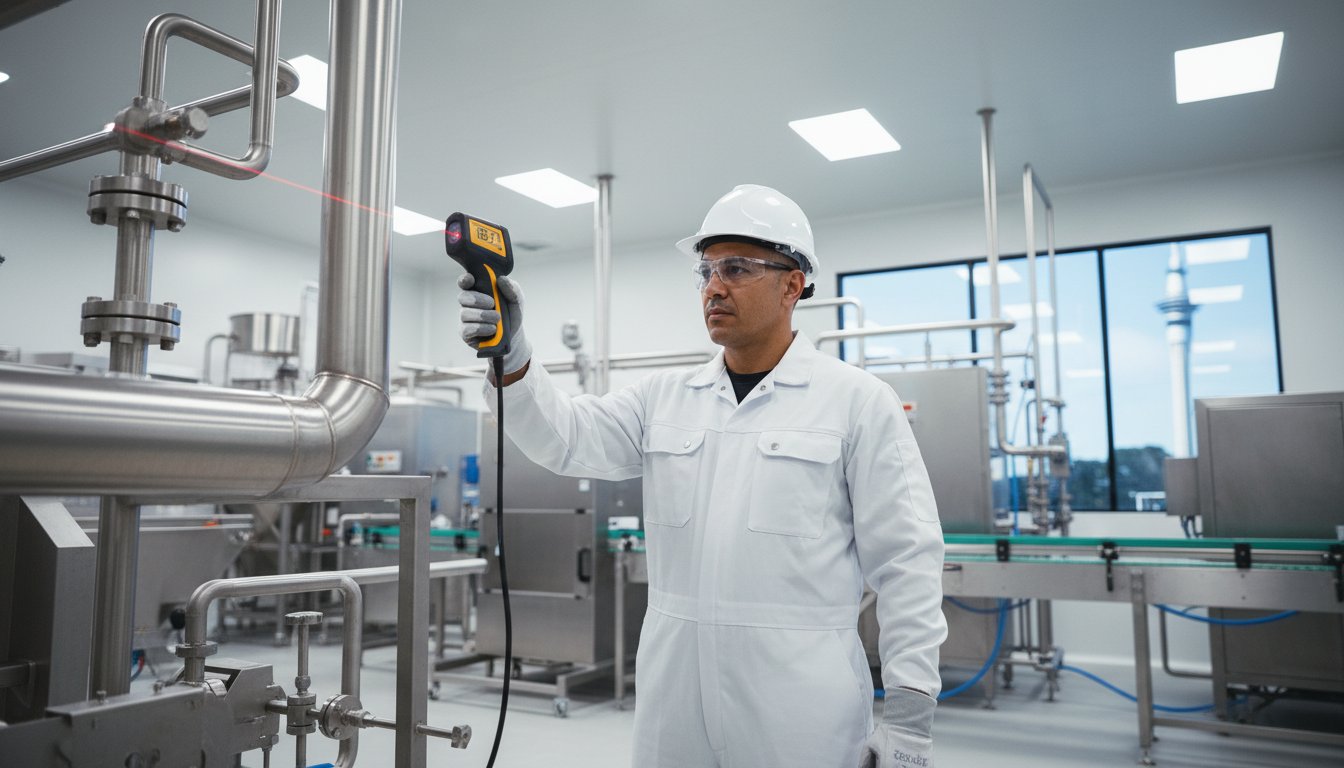
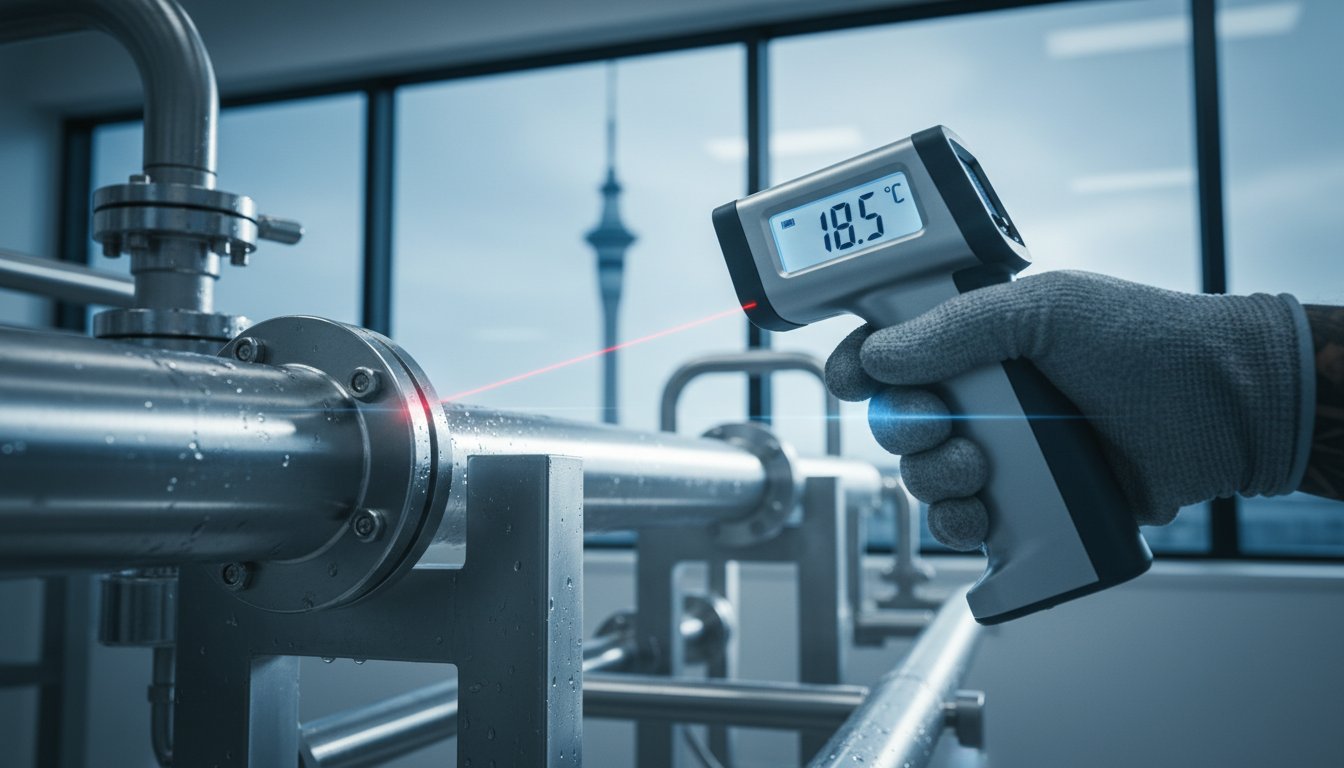
Choosing between a physical probe and an infrared (IR) thermometer depends on the physics of heat transfer. Infrared sensors measure surface radiation, which is often misleading in deep-vessel applications or for shiny metallic surfaces with low emissivity. A physical temperature probe provides superior accuracy because it reaches thermal equilibrium with the substance being measured. This is vital in chemical processing or deep-fryer monitoring where surface-level readings don't reflect the core temperature of the medium. For true process control, contact measurement remains the industry gold standard.
Selecting the correct
requires a technical understanding of sensor physics and how they react to specific environmental stressors. In Fiji's industrial landscape, from high-heat sugar mills to precise cold storage for tuna exports, the choice between a thermocouple, RTD, or thermistor determines the reliability of your data. Each technology offers a different balance of range, accuracy, and ruggedness. Choosing the wrong sensor leads to frequent failures or drift, which compromises safety and compliance standards.
Thermocouples operate on the Seebeck effect, where two dissimilar metals joined at one end generate a small voltage proportional to the temperature gradient. This technology is incredibly robust because it doesn't require an external power source at the sensing point. Type K is the industry standard for high-temperature applications, capable of reaching 1,260°C in industrial furnaces. It's the primary choice for heavy manufacturing because it handles extreme heat without immediate degradation.
For Fiji's food safety and cold chain sectors, Type T thermocouples are the superior option. Consisting of copper and constantan, Type T probes are highly stable in sub-zero environments and offer a narrow accuracy tolerance. Since 2021, 75% of cold storage facilities we've consulted have transitioned to Type T for their frozen export monitoring. They provide response times as fast as 0.5 seconds when using an exposed junction, making them ideal for rapid air temperature checks.
Resistance Temperature Detectors (RTDs) rely on the predictable change in electrical resistance of platinum as temperature fluctuates. These sensors are the gold standard for stability and repeatability. While a thermocouple might drift by several degrees over a year of heavy use, a high-quality Pt100 RTD typically maintains accuracy within 0.1°C. This makes them essential for laboratory environments or precise chemical processing where a 1% variance could ruin a batch.
When selecting thermocouples vs. RTDs, consider the wiring configuration. RTDs come in 2-wire, 3-wire, and 4-wire setups. We recommend 3-wire configurations for most industrial sites in the Pacific. This setup uses a lead-wire compensation technique to cancel out the resistance of the cable itself, ensuring that the reading at the controller is the actual temperature at the probe tip. RTDs are slower than thermocouples, often taking 1 to 10 seconds to stabilize, but their long-term accuracy reduces the frequency of required calibrations.
Thermistors are ceramic-based sensors that exhibit a massive change in resistance over a very small temperature range. They're significantly more sensitive than RTDs or thermocouples, allowing them to detect minute fluctuations that other sensors miss. However, they're limited by a narrow operating window, typically between -50°C and 150°C. You'll find these in medical equipment, high-end HVAC systems, and specialized laboratory incubators across Suva and Nadi.
The trade-off for this sensitivity is fragility. Thermistors don't handle mechanical vibration or thermal shock as well as thermocouples. If your process involves heavy machinery or rapid temperature cycling, a thermistor will likely fail prematurely. For those managing delicate laboratory processes, we provide expert instrumentation advice to ensure your sensor choice matches your specific durability needs.
Durability remains a deciding factor for many engineers. Thermocouples are the toughest, often encased in stainless steel or Inconel sheaths to withstand physical abuse. RTDs are more sensitive to vibration, which can fracture the internal platinum element. If your temperature probe is mounted on a vibrating pump or an engine block, a mineral-insulated thermocouple is almost always the best technical decision.
Selecting a temperature probe for Fiji requires accounting for an environment where relative humidity often stays above 80%. Salt-spray corrosion near coastal facilities in Suva or Lautoka will degrade inferior metals within 12 months. We recommend a minimum of 316 stainless steel for all exposed housings. Mechanical specs are just as vital. A 6mm diameter sheath is standard; however, high-flow pipelines might require a stepped-down 3mm tip for faster response times without sacrificing structural integrity. You've got to ensure the mounting threads match your existing thermowells, typically 1/2" BSP or NPT, to prevent leakages in high-pressure systems.
Connectivity isn't just about the wire. In humid tropical climates, fixed cables often fail at the entry point due to capillary action drawing moisture into the sensor. M12 connectors provide an IP67 rated seal that keeps moisture out of the internal circuitry. For remote sites where cabling costs exceed NZ$50 per metre, wireless transmitters are more cost-effective. These systems eliminate the need for long cable runs that are prone to physical damage or electrical interference. If you're working in food or beverage production, 3A and FDA-grade probes are mandatory. These sensors feature a surface finish of Ra < 0.8µm to prevent bacterial growth and withstand Clean-in-Place (CIP) cycles.
Immersion probes are the workhorse for liquids and gases. You need to calculate the immersion depth carefully; it should be at least ten times the sheath diameter to avoid stem conduction errors. Surface probes require a different approach. They rely on flat-tip designs or leaf springs to ensure proper thermal contact on pipes or motors. For the Fiji meat and poultry industry, penetration probes are essential. These feature a sharpened "needle" tip and a rugged handle designed for repetitive insertion into frozen or chilled products, ensuring HACCP compliance during processing.
Material choice dictates the lifespan of your temperature probe. While 316 stainless steel handles most organic chemicals, Inconel 600 is necessary for temperatures exceeding 800°C or for use in carburising environments. If your facility uses acid baths or harsh industrial cleaning agents, a Teflon (PTFE) coating provides the necessary chemical resistance. For extreme heat applications like glass manufacturing or heavy smelting that exceed 1000°C, ceramic sheaths are the only viable option. They prevent the sensor wire from melting while providing high-temperature electrical insulation.
We don't just supply a generic sensor and leave you to figure out the fitment. Our team ensures the total solution includes the correct compression fittings and lead lengths for your specific layout. This technical precision prevents common failures like vibration fatigue or signal lag. Most industrial failures occur because the wrong sheath material was chosen for the chemical environment. We've seen 304-grade steel fail in weeks where 316-grade would have lasted years. Making the right choice during the procurement phase saves thousands in replacement costs and downtime later. It's about getting the engineering right the first time.
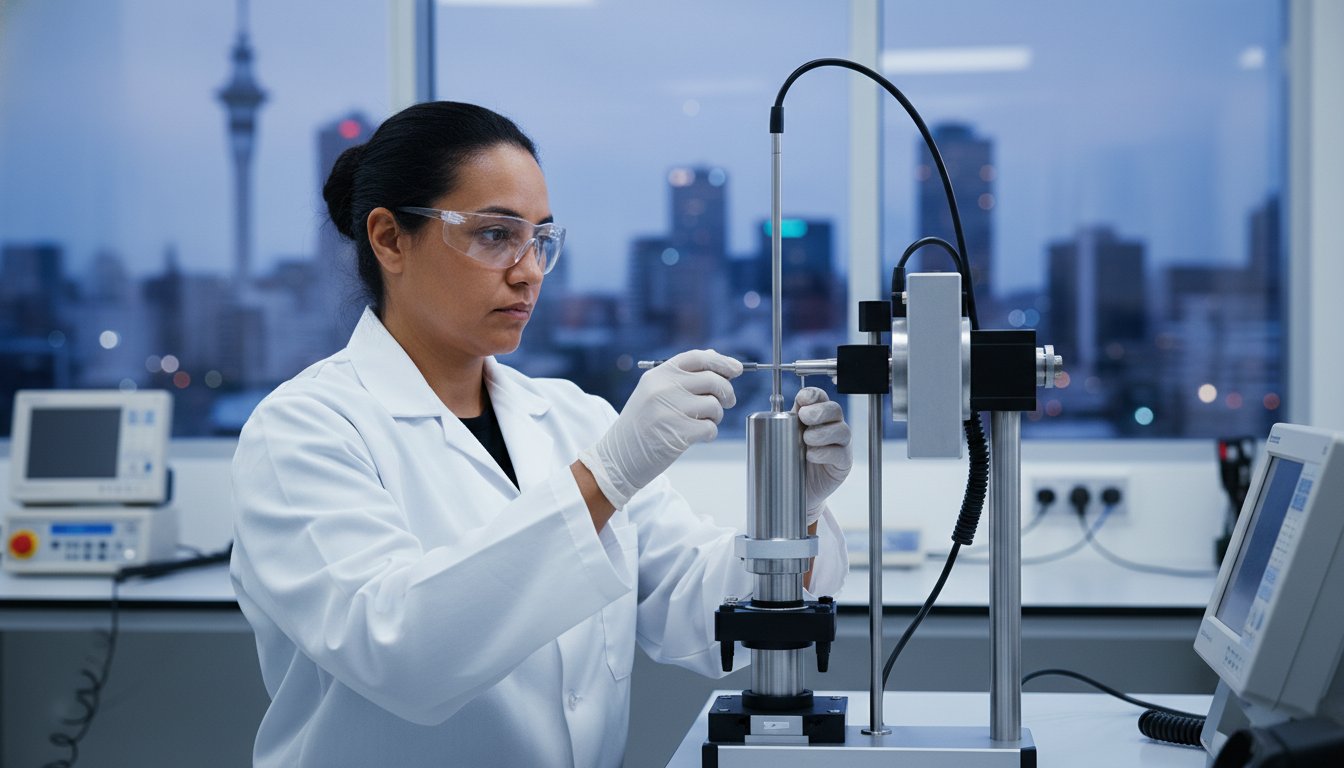
Many engineers assume a new temperature probe is ready for the production line the moment it's unboxed. It isn't. A factory-new sensor might be within manufacturer specifications, but it lacks the documented proof required for high-stakes industries like food export or pharmaceuticals. Without an IANZ calibration certificate, you have no legal proof of accuracy during an audit. For Fiji-based exporters sending goods to New Zealand, compliance with ISO/IEC 17025 is mandatory. IANZ accreditation ensures your measurements are recognized globally via the ILAC Mutual Recognition Arrangement, making it a vital component of international trade.
There's a massive difference between a factory "check" and a full accredited calibration. A check is often just a single-point test performed by a manufacturer to see if the unit turns on and reads roughly correctly. An IANZ-accredited calibration is a rigorous process involving multiple temperature points, documented uncertainty, and a clear chain of traceability to national standards. If you're managing a cold chain, relying on a basic "check" is a gamble you don't need to take.
Frequency of testing depends entirely on your risk profile. Most New Zealand food safety programs require annual calibration as a baseline. However, if your probes operate in extreme environments, such as -80°C medical freezers or 200°C industrial ovens, 6-month intervals are much safer. Data shows that 92% of sensor failures are identified during scheduled calibrations before they cause a significant batch loss. Regular testing isn't just a compliance box to tick; it's an insurance policy for your product quality.
Your calibration certificate must show the specific reference equipment used and its own traceability chain. It's not just about the final number. It's about the uncertainty. If your process has a ±0.5°C tolerance, a temperature probe with a ±0.4°C uncertainty leaves almost no room for error. CPS provides the total solution by managing your entire assets list. We provide IANZ-accredited lab services that meet the strictest international trade requirements, ensuring your audit trail is bulletproof from day one.
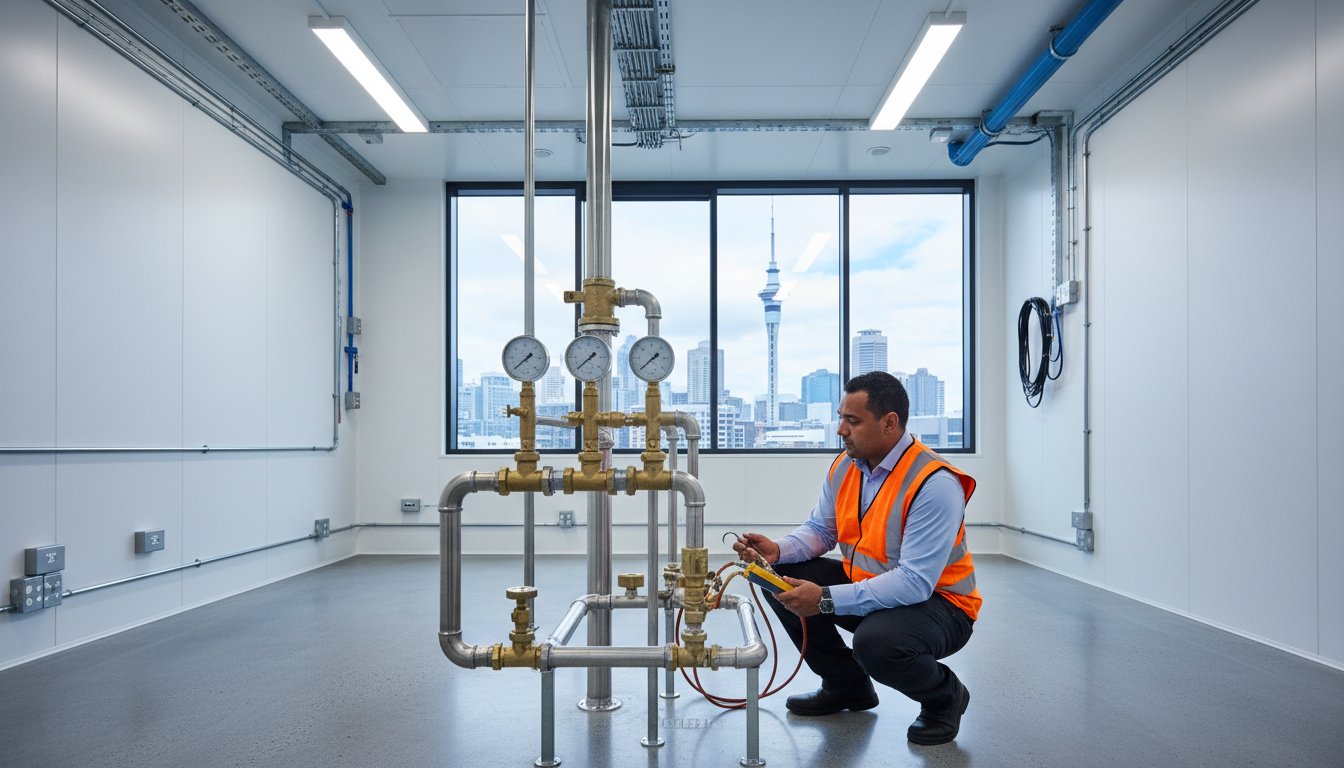
Sensors don't always fail suddenly. They drift. This is often caused by thermal cycling, where a probe moves between hot and cold extremes, causing mechanical stress on the internal wiring. In chemical or high-moisture environments, "poisoning" occurs when contaminants penetrate the sensor junction. You can spot this early if your weekly ice-point checks start climbing or falling by 0.2°C or more. Using a dry-well calibrator for monthly onsite verification allows you to catch these small errors before they become expensive compliance breaches. Practical steps for onsite care include:
• Performing regular "ice bath" checks to verify the zero point.
• Inspecting the probe sheath for pitting or physical damage.
• Ensuring cable connections are free from moisture and corrosion.
• Keeping a log of drift patterns to predict when a sensor needs replacement.
Ensure your equipment meets the highest standards for export. Contact CPS for
to secure your audit trail.
Since 1988, CPS (NZ) Ltd has operated as a cornerstone of the South Pacific instrumentation industry. We've spent over 35 years refining our expertise in calibration and measurement. This isn't just about moving boxes. We've invested heavily in our IANZ-accredited laboratories to ensure every temperature probe we supply meets the highest international standards for accuracy and traceability. Our team consists of seasoned technicians who understand the technical nuances of thermal dynamics, not just sales representatives looking for a quick transaction.
Our "Total Solution" philosophy sets us apart from standard resellers. We don't just hand you a sensor and leave you to figure out the logistics of integration. We provide the probe, the specific industrial fittings, the high-pressure hoses, and the final calibration. This end-to-end approach eliminates the common compatibility issues that plague many procurement processes. By managing the entire chain, we ensure that your measurement system works perfectly from the moment it's installed on your factory floor or in your laboratory.
Fiji's industrial sectors in Suva and Lautoka require a partner who understands local challenges. The tropical environment and coastal salinity create a rugged set of conditions for sensitive electronics. We provide strategic support specifically for these regions, ensuring that businesses in Fiji have access to the same world-class technology available in New Zealand. We've successfully supported over 200 Pacific-based facilities with instrumentation that survives and thrives in high-humidity environments.
We partner with world-leading brands like Additel to bring the best reference equipment to the region. This gives our clients access to cutting-edge technology that might otherwise be difficult to source locally. Whether you need a standard industrial sensor or a customised probe kit for high-precision laboratory work, our inventory is curated to meet the most demanding specifications.
Field technicians often work in demanding, remote environments where missing a single adapter can stall an entire project. We solve this by building plug-and-play solutions tailored to your specific facility requirements. Every kit comes in a rugged, custom-fitted carry case designed to protect your temperature probe and associated calibrators from impact and moisture. We provide a personalised service that ensures your kit includes every necessary fitting for your specific pipework. You're never left stranded with a part you can't use.
Supply is only the first step of our commitment to your operational success. Our team assists with onsite installation and commissioning to verify that your new instrumentation integrates seamlessly with existing control systems. We also provide comprehensive training for your staff on correct handling and maintenance procedures. This hands-on education helps prevent common user errors that lead to drift or mechanical failure. If you want to ensure your measurement systems are reliable and accurate, Contact CPS for an expert consultation on your temperature measurement needs.
Choosing the correct temperature probe is a technical decision that directly impacts your operational safety and product quality. Whether your environment demands the rugged durability of a thermocouple or the high precision of an RTD, your selection must align with specific industrial requirements. Accuracy only matters if it's verifiable. This is why IANZ accredited calibration is essential for maintaining traceability and meeting New Zealand's strict regulatory standards.
CPS (NZ) Ltd has provided the total solution for over 35 years, supporting New Zealand and Fiji industries with world-class instrumentation. We aren't just a supplier that ships boxes; we're a full-service partner with an IANZ accredited calibration lab and a team of seasoned experts. We handle everything from initial supply to custom fittings and long-term support, so you're never left stranded with failing equipment. Our commitment to reinvesting in reference technology means you receive the most reliable data possible for your facility.
Get a Professional Quote for Calibrated Temperature Probes
We're ready to help you streamline your thermal processes and ensure your business stays fully compliant.
Resistance Temperature Detectors, specifically the Pt100 Class 1/10 DIN, provide the highest accuracy for industrial applications. These sensors offer a narrow tolerance of ±0.03°C at 0°C, which far exceeds standard thermocouples. At CPS, we verify these high-precision instruments in our IANZ accredited laboratory to ensure they meet international traceability standards. Choosing a high-quality temperature probe ensures your data remains reliable over long-term monitoring cycles.
You should calibrate your sensor if it shows a reading drift exceeding 1% of its range or if it has reached its 12-month service interval. Physical signs like frayed lead wires or moisture ingress in the sheath also necessitate a professional check. We recommend annual recalibration to maintain compliance with ISO 9001 standards. If your readings fluctuate by more than 0.5°C in a stable environment, it's time for a technical assessment.
Type K thermocouples are suitable for general food processing, but Type T is the preferred choice for Pacific food safety due to its higher accuracy at sub-zero temperatures. Fiji businesses must ensure their equipment meets the Food Safety Act 2003 requirements for cold chain integrity. We supply Type T sensors because they offer a tighter tolerance of ±0.5°C, providing better protection against bacterial growth in tropical climates.
The primary difference is the electrical resistance at 0°C, where a Pt100 measures 100 ohms and a Pt1000 measures 1000 ohms. Pt1000 sensors are more efficient for battery-powered devices and 2-wire configurations because lead wire resistance has a smaller impact on the final reading. However, Pt100 remains the industry standard for PLCs and industrial controllers. We provide both options as part of our total solution for process instrumentation.
A high-quality industrial temperature probe typically lasts between 3 and 5 years when used within its specified thermal limits. Harsh environments involving high vibration or chemical exposure can reduce this lifespan to less than 18 months. Regular maintenance and visual inspections help identify degradation before a total failure occurs. We've seen well-maintained stainless steel probes last over 10 years in clean, stable warehouse environments.
You should use a 3-wire RTD for your PLC to ensure the system compensates for the electrical resistance of the lead wires. 2-wire setups don't account for wire length, which adds significant error to your temperature data. A 3-wire configuration provides a stable, accurate signal over distances up to 100 metres. This setup is the most common choice for Fiji's industrial processing plants and manufacturing facilities.
PTFE or Hastelloy C-276 sheaths are the best choices for environments involving aggressive acids or corrosive chemicals. While Stainless Steel 316 is the standard for most applications, it will corrode quickly when exposed to high concentrations of sulphuric acid or chlorine. We recommend PTFE-coated probes for chemical processing because they resist degradation for up to 24 months in harsh conditions. This specialized protection prevents sensor failure and contamination.
Yes, CPS provides comprehensive on-site calibration services for businesses across Fiji, including major industrial hubs like Lautoka and Suva. We don't just sell equipment; we offer a total package that includes technician visits for system verification and IANZ-traceable certification. Our team regularly travels to the Pacific to support food manufacturers and power plants. We ensure your local operations meet the same rigorous standards as our New Zealand clients.