




You've invested in accurate pressure instrumentation, but during an IANZ audit, the conversation suddenly shifts to 'uncertainty.' For many in New Zealand's industrial sector, this moment brings a familiar sense of anxiety. Is a manufacturer's accuracy statement enough to pass? The answer is no. Understanding what is uncertainty when it comes to pressure calibration is not just an academic exercise; it's a fundamental requirement for your operational safety, process integrity, and regulatory compliance.
This practical guide, from NZ's leading calibration experts, is designed to cut through the complexity. We will demystify the key components that contribute to a measurement uncertainty budget and clarify the critical difference between a simple 'error' and a calculated uncertainty value. By the end, you'll have a clear roadmap for achieving the traceability required by IANZ standards, giving you the confidence to manage your calibration processes, justify equipment needs to management, and ensure your pressure measurements are truly fit for purpose.
To understand what is uncertainty when it comes to pressure calibration, we must first look beyond the common term 'accuracy'. While accuracy tells you how close a measurement is to a known value, uncertainty quantifies the doubt surrounding that measurement. It is the explicit range within which the true value of the 'measurand'-the specific quantity being measured-is confidently believed to lie. In any high-precision environment, we acknowledge that a perfect, 'true' value is a theoretical ideal; our professional goal is to define the boundaries of our measurement with absolute clarity.
This is why a zero-error reading is fundamentally impossible. Every measurement, no matter how sophisticated the reference equipment, is influenced by a range of factors from environmental conditions to equipment limitations. The discipline of Measurement uncertainty involves identifying, evaluating, and combining these individual components of doubt into a single, defensible value. This process is the bedrock of credible calibration, connecting directly to traceability (the unbroken chain of comparisons to a national standard) and culminating in an 'uncertainty budget'-a comprehensive calculation of all potential error sources.
Imagine measuring a length of pipe with a standard ruler. Even if it appears to be exactly 500mm, you can only be certain to the nearest mark-perhaps ±0.5mm. This range is your uncertainty. A pressure gauge operates on the same principle; its smallest increment defines the absolute floor of its certainty. Furthermore, factors like temperature fluctuations, parallax error (viewing the needle from an angle), and minute manufacturing differences mean two identical gauges can yield slightly different results under the same pressure, all contributing to the total uncertainty.
In New Zealand, quantifying uncertainty is not just good engineering practice-it's essential for compliance, safety, and operational integrity. International Accreditation New Zealand (IANZ) sets the stringent standards that accredited laboratories must meet, with uncertainty calculation being a core, non-negotiable requirement. For industries operating high-pressure steam or gas systems, a properly calculated uncertainty budget ensures that critical safety margins are never compromised. Ignoring this vital metric can lead to significant legal and financial risks, from failed audits and process failures to catastrophic equipment damage.
To properly answer what is uncertainty when it comes to pressure calibration, we must first categorise its sources. In metrology, every factor that could influence a measurement is evaluated and grouped into two distinct categories: Type A and Type B. This structured approach, detailed in official resources like the NIST Guidelines on Uncertainty, ensures no variable is overlooked. A ‘Total Solution’ approach to calibration doesn't just focus on the reference standard; it meticulously accounts for every statistical fluctuation and external influence to build a robust uncertainty budget.
Type A uncertainty is evaluated using statistical methods on a series of repeated observations. Think of it as the randomness or ‘scatter’ you see when you take the same measurement multiple times. This is directly influenced by the repeatability of the measurement process. A highly skilled technician following a consistent procedure will produce less variation, thereby reducing the Type A uncertainty component. This value is typically quantified by calculating the standard deviation of the mean of your measurement readings.
Type B uncertainty includes all other sources of doubt, which are evaluated by means other than statistical analysis of current measurements. These are often known or assumed influences based on specifications, previous data, or experience. Key contributors include:
Ultimately, a comprehensive uncertainty budget is not complete without a thorough analysis of both Type A and Type B factors. The final calculation combines these components to provide a complete and defensible statement of measurement confidence, which is the true goal of any professional calibration process.
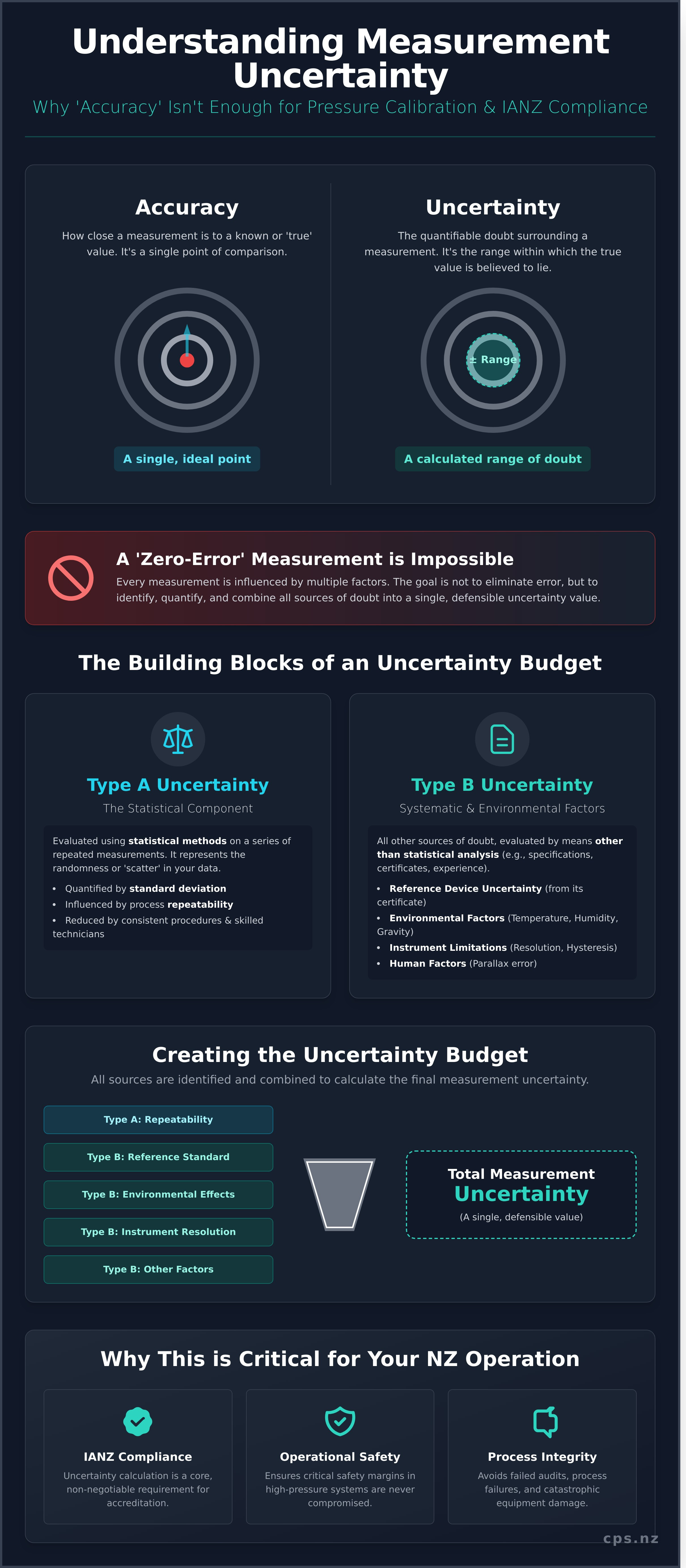
In the world of instrumentation, the terms 'accuracy' and 'uncertainty' are often used interchangeably, but they represent fundamentally different concepts. Accuracy is a qualitative term; it describes how close a measurement is to the true value. Uncertainty, however, is a quantitative value-it is the calculated, statistical doubt that exists around every measurement result. A manufacturer might sell a pressure gauge with an accuracy specification of ±0.1% of Full Scale (FS), but this is merely a design tolerance, not the full story of its performance in the field. Understanding what is uncertainty when it comes to pressure calibration is about moving beyond these simple specifications to a complete, evidence-based picture of measurement quality.
Relying solely on a 'Percent of Full Scale' specification is a common but dangerous oversimplification. For a 1,000 bar gauge with a ±0.1% FS accuracy, the potential error is ±1 bar. This ±1 bar error applies whether you are measuring 1,000 bar or just 20 bar. At the low end of the scale, this fixed error becomes a massive percentage of the actual reading, leading to critical process control failures. An accredited calibration certificate bridges this gap by providing a calculated uncertainty value specific to the calibration performed.
The Tolerance vs. Uncertainty Ratio (TUR) is a critical metric used to ensure a calibration is meaningful. It compares the tolerance of the device under test (DUT) to the total uncertainty of the measurement process performed by the reference standard. A commonly accepted minimum ratio is 4:1. This means the calibration standard is at least four times 'better' than the device it is testing. A low TUR, such as 2:1, significantly increases the risk of passing a device that is actually out of tolerance, or failing a device that is in tolerance.
An IANZ accredited calibration certificate provides the objective data needed to make informed decisions. When reviewing a report, look for the 'Expanded Uncertainty of Measurement'. This figure, which is paramount for understanding what is uncertainty when it comes to pressure calibration, quantifies the range of doubt. You will typically see a 'coverage factor of k=2', which indicates a 95% confidence level in the result. The principles for these calculations are internationally harmonised, as outlined in publications like the Guide to the Expression of Uncertainty in Measurement. This is why simple 'Pass/Fail' statements on a certificate must be interpreted carefully; they are made using decision rules that account for this uncertainty to prevent false acceptances.
Understanding the theory behind pressure calibration uncertainty is one thing; actively managing it during a real-world test is another. The goal is not to eliminate uncertainty-which is impossible-but to minimise and control it. By implementing robust procedures and using the right equipment, you can significantly improve the reliability of your measurements and ensure compliance.
These principles of ensuring quality and reliability through high-standard equipment are not limited to industrial calibration. In other critical sectors, such as the medical field in Indonesia, companies like PT Serenity Indonesia play a similar role by distributing internationally-standardized health products to ensure patient safety and treatment efficacy.
Here are the foundational steps to controlling your uncertainty budget in a practical setting:
Some of the largest avoidable errors come from the test setup itself. Pay close attention to head pressure-the height difference between your reference gauge and the device being tested can introduce significant hydrostatic pressure error, especially with liquid media. Also, consider media compatibility; calibrating a gas device with hydraulic fluid (or vice-versa) will alter the uncertainty profile. Finally, a proper zeroing procedure before starting is critical. An incorrect zero is a systematic error that affects every subsequent measurement.
Modern instrumentation offers a direct path to lower uncertainty. High-accuracy digital pressure modules provide far greater precision and lower intrinsic uncertainty than traditional analogue master gauges. For technicians trying to understand what is uncertainty when it comes to pressure calibration, upgrading equipment is often the most impactful step. Furthermore, using automated pressure controllers can eliminate 'dwell' errors caused by operators not waiting long enough for pressure to stabilise, ensuring repeatable and reliable results. For a detailed breakdown, review our guide on Choosing The Right Pressure Gauge: A Complete Guide.
By focusing on these practical elements, you take direct control over your measurement quality. For expert advice on building a total calibration solution that minimises uncertainty, contact the CPS team today.
For over 35 years, CPS (NZ) Ltd has been the trusted partner for New Zealand's leading industries, helping them navigate the complexities of measurement uncertainty. While understanding the theory is crucial, successfully managing it in a real-world industrial environment is what truly matters. We don't just explain what is uncertainty when it comes to pressure calibration; we provide the accredited services and expert guidance to control it.
Our commitment to quality starts in our IANZ accredited Auckland laboratory. We invest heavily in a fleet of world-leading reference equipment from manufacturers including:
This high-end instrumentation allows us to achieve some of the lowest possible measurement uncertainties, providing you with a more accurate and reliable calibration. This isn't just about a certificate; it's about delivering the 'Total Solution'-a foundation of measurement confidence you can build your quality systems upon.
IANZ accreditation is the cornerstone of trust in calibration. Our laboratory undergoes a rigorous peer-review process, where our procedures, equipment, and uncertainty calculations are meticulously audited by independent technical experts. This ensures our stated uncertainties are proven and reliable. Every calibration we perform is traceable to the New Zealand National Standard held at MSL, providing an unbroken chain of measurement integrity. Learn more about What is IANZ Accreditation and Why Does It Matter?
We go beyond simply calibrating your instruments. Our team works with you to develop custom 'plug and play' calibration kits tailored to your specific onsite requirements. We help you build a robust uncertainty budget that not only improves your process control but also satisfies the stringent demands of quality auditors. Let our experts provide the clarity and documentation you need. Contact CPS (NZ) Ltd today for an IANZ accredited calibration quote.
Our partnership extends far beyond the calibration certificate. We provide comprehensive after-sales support and can deliver tailored training for your technical team. We ensure you not only have precisely calibrated equipment but also the in-house knowledge to use it effectively. When you work with CPS (NZ) Ltd, you gain a long-term partner dedicated to the accuracy and reliability of your operations.
Navigating the complexities of pressure measurement means moving beyond simple accuracy. As we've explored, a deep understanding of the various sources of uncertainty and how they are calculated is non-negotiable for maintaining quality, safety, and compliance in New Zealand's demanding industries. Grasping what is uncertainty when it comes to pressure calibration is the critical first step towards achieving reliable and defensible measurement results.
Why leave such a critical factor to chance? At CPS, we provide the total solution you need for complete confidence in your operations. With over 35 years of industry experience, an IANZ Accredited Laboratory, and as the official NZ distributor for world-leading brands like Additel and Fluke, we have the technology and the expert know-how to minimise your measurement uncertainty.
Take the guesswork out of your processes. Request an IANZ Accredited Calibration Quote from the Experts at CPS today and ensure your measurements are not just accurate, but truly certain.
Error is the specific difference between your gauge's reading and the true value from a reference standard. For example, if your gauge reads 100.1 bar when the true pressure is 100.0 bar, the error is +0.1 bar. Uncertainty, however, is the quantifiable doubt about that result. It’s a range (e.g., ±0.05 bar) that expresses the confidence in your measurement, accounting for all potential sources of error in the calibration process itself.
A coverage factor of k=2 is standard practice in accredited calibration to provide a high level of confidence. It expands the calculated "standard uncertainty" to a level that encompasses approximately 95% of the probable values for your measurement. When you see k=2 on your IANZ accredited certificate from CPS, it gives you the assurance that the instrument's true value lies within the stated uncertainty range with 95% probability, a crucial factor for quality systems.
While technically possible, calculating a measurement uncertainty budget for an IANZ audit is a complex metrological task. It requires identifying all uncertainty contributors (e.g., reference standard, environmental factors, operator influence), quantifying them, and combining them using statistical methods. To ensure a robust and defensible result, we highly recommend relying on an IANZ accredited laboratory like CPS. We provide the expertise and validated procedures to deliver an accurate and compliant uncertainty value.
The ideal calibration interval depends on your specific application, the instrument's stability, and your quality system requirements. However, a 12-month interval is a common and reliable starting point for most industrial pressure gauges. For critical applications or instruments used in harsh environments, more frequent calibration may be necessary to maintain low uncertainty and ensure process accuracy. Our team can help you establish an optimal calibration schedule based on your operational needs and instrument history.
Absolutely. Temperature is one of the most significant contributors to pressure measurement uncertainty. Changes in ambient temperature can cause expansion or contraction in a gauge's mechanical components and affect the performance of electronic sensors, leading to measurement drift and errors. That is why our IANZ accredited laboratory performs all calibrations in a strictly temperature-controlled environment. This minimises thermal effects and ensures the lowest possible uncertainty in your calibration results.
Traceability is an unbroken chain of comparisons linking your instrument's measurement back to a national or international standard. Each step, or link, in this chain has its own uncertainty value. The uncertainty of our reference standards is passed down to your instrument during calibration and combined with other uncertainties from the process. Therefore, having a direct and well-documented traceability chain, as provided by CPS, is fundamental to establishing a credible and low measurement uncertainty.
A Test Uncertainty Ratio (TUR) of 4:1 is a widely accepted industry guideline. It means the reference standard used for calibration is at least four times more accurate than the device under test (DUT). This ratio ensures that the uncertainty of the calibration standard has a minimal impact on the final result. It provides a high degree of confidence that the DUT is performing within its specified tolerance and helps prevent incorrect pass/fail decisions.
If your measurement uncertainty is larger than the required tolerance, you cannot definitively state whether the instrument is performing correctly. A reading might appear "in tolerance," but the wide uncertainty band means the true value could actually be outside the acceptable limits. This is an inconclusive result and is generally not acceptable for quality assurance or regulatory compliance. To resolve this, you must use a more accurate calibration standard to reduce the measurement uncertainty.